When I first came to Miyako Island, a local said something to me before I crossed the Irabu Bridge: "Cross the bridge, turn left, and the beach straight ahead is the most beautiful — you absolutely have to go." They gave no further explanation, and I more or less let it slide.
I actually saw Toguchi-no-Hama on my second trip after I'd started visiting Irabu Island regularly. I still slightly regret skipping it the first time.
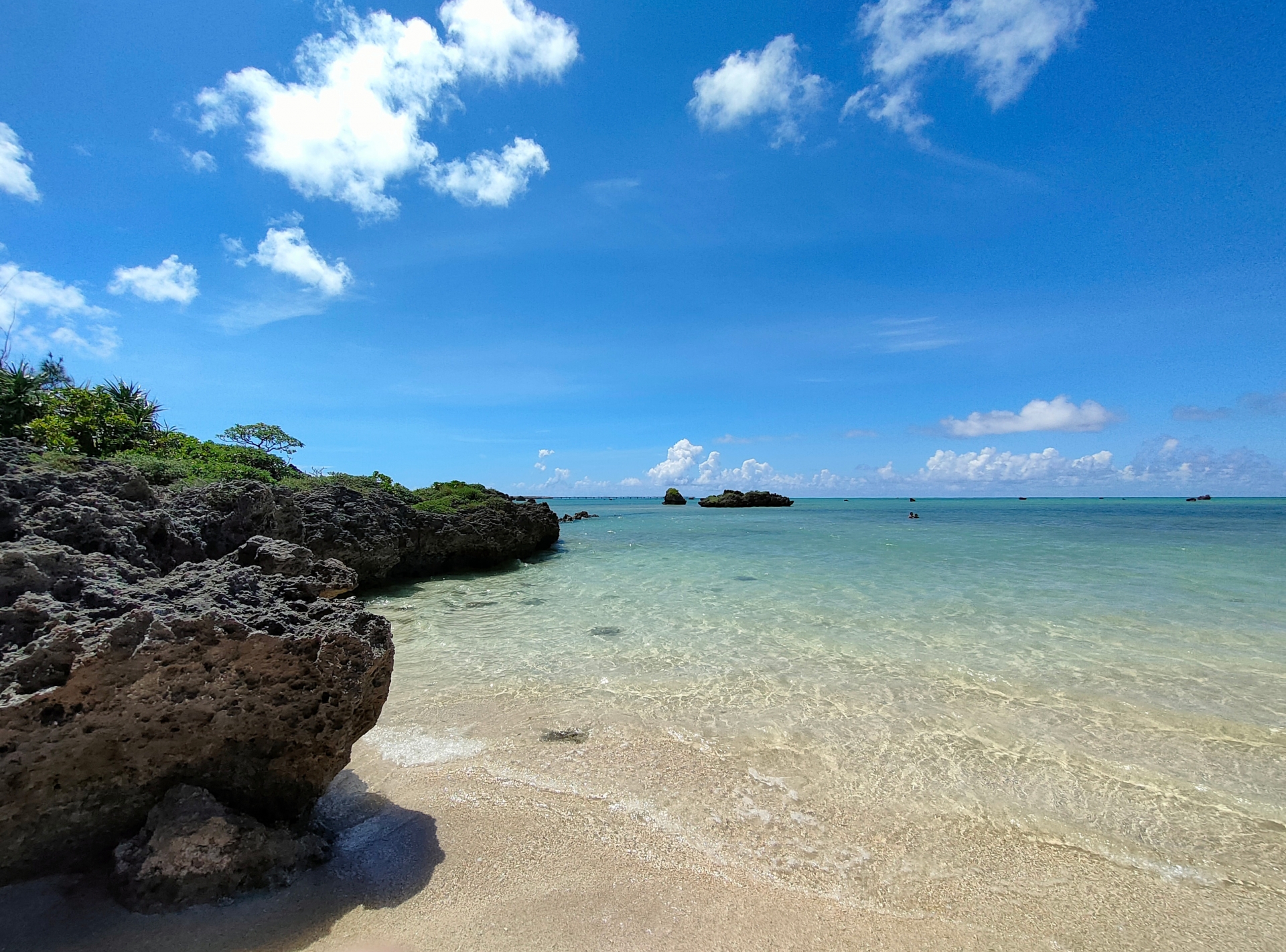
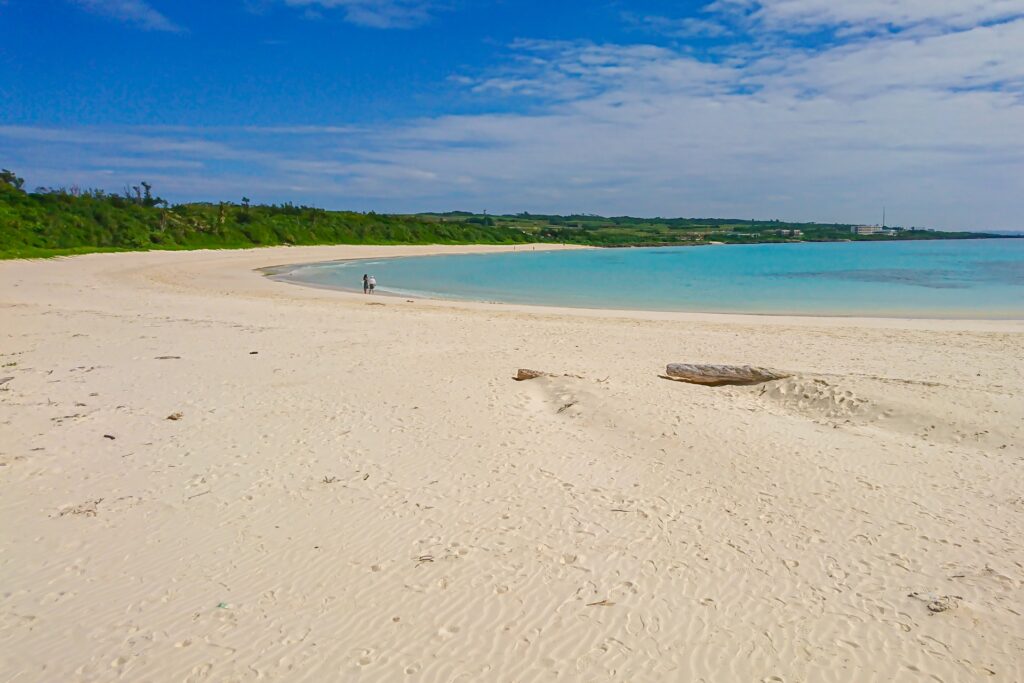
The whiteness of the sand was completely different from what I'd imagined. The phrase "white sandy beach" comes up to the point of tedium in Okinawa travel info, but Toguchi-no-Hama's is a different texture entirely. Fine, powdery sand continues for 800 metres, and your feet sink with each barefoot step. The feel was so good that before I knew it I'd walked the beach from end to end.
As for the clarity, there's nothing more to say. You can see the gradation from cobalt blue to emerald green just looking from land. The white sand on the seabed shows through, reflecting the light and sparkling again. Go on a fine morning and you'll find yourself doubting whether that scene is a real sea at all.
In this article I've carefully pulled together everything about Toguchi-no-Hama — from the basics to its history and culture, access, photo spots, best season, food and accommodation — based on my experience of visiting the beach many times. I've aimed to make it useful for first-time visitors and returners alike.
- What Makes Toguchi-no-Hama Special? The Beach's Basics and Features
- The History and Legends of Toguchi-no-Hama: A Glimpse of Local Culture
- How to Get There: From Miyako Airport to Toguchi-no-Hama
- Activities to Enjoy at Toguchi-no-Hama
- The Best Season to Visit Toguchi-no-Hama and Tips for Avoiding Crowds
- Instagram-Worthy Photo Spots and Shooting Techniques
- Nearby Sights
- Recommended Food at Toguchi-no-Hama
- Accommodation Around Toguchi-no-Hama
- Things to Note When Visiting
- Reviews and Reputation of Toguchi-no-Hama
- FAQ: About Toguchi-no-Hama
- Why Toguchi-no-Hama Becomes the Axis of Irabu Island Sightseeing
What Makes Toguchi-no-Hama Special? The Beach's Basics and Features
Top-Class Clarity and White Sand Even by Miyako Standards
Toguchi-no-Hama is a beach on the south-west of Irabu Island, located in Irabu, Miyakojima City, Okinawa. The bow-shaped, curving coastline runs about 800 metres, around 50 metres wide. This shape is extremely beautiful seen from the air.
The fineness of the sand is said to be top-class in Okinawa, and compared with Yonaha Maehama and other popular beaches, the small grain size of Toguchi-no-Hama's sand really stands out. Your feet sink when you step in, and I think this feel alone is worth the visit.
As for the sea's clarity, the whole Miyako area is known for world-class standards, but thanks especially to Toguchi-no-Hama's shallow terrain, the white sand on the seabed shows straight through. You can make out the gradation of emerald green and cobalt blue even from land — a sight only seen in well-conditioned spots.
One honest point: don't expect too much of the snorkelling. Being a sandy beach, there's little coral reef, so if you want to enjoy snorkelling on Irabu Island, Nakanoshima Beach suits better. Toguchi-no-Hama is a beach for swimming and relaxing, and on that front it has the number-one environment on Irabu Island.
The Best Facilities on Irabu Island
Compared with Irabu Island's other beaches, Toguchi-no-Hama has overwhelmingly good facilities. Car park, toilets, showers, changing rooms and a shop are all there, so it works as a self-contained base for a full day at the beach.
At a facility called Itoshima Kanko Service you can rent a parasol (¥1,000 / about US$7), a beach chair (¥1,000) and a float mat (¥1,000), as well as a snorkel set. There are paid showers too, so you can clean up after playing hard in the sea before heading home. Since Irabu Island's other beaches have almost no facilities, this level of provision is a real boon for planning your itinerary.
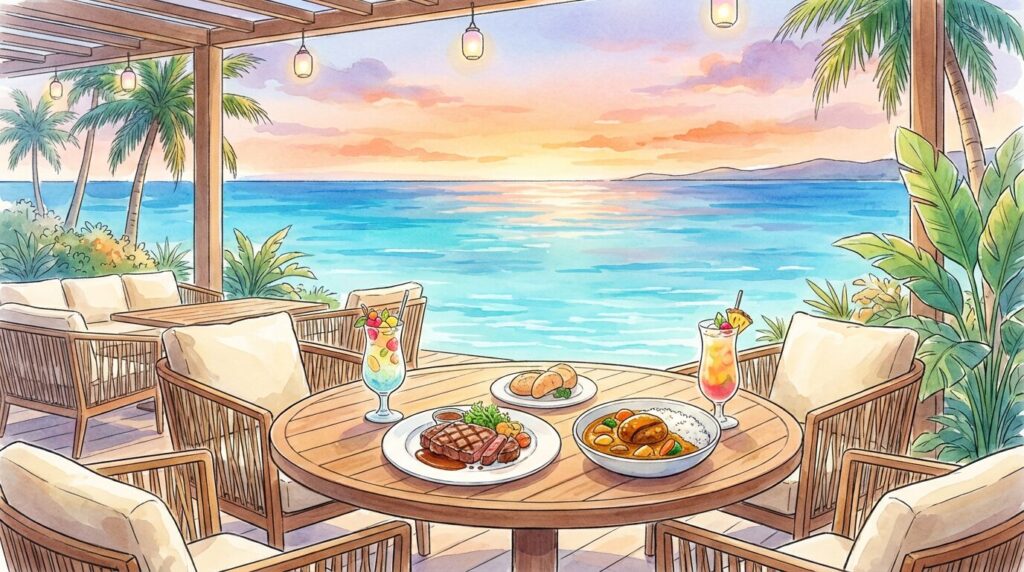
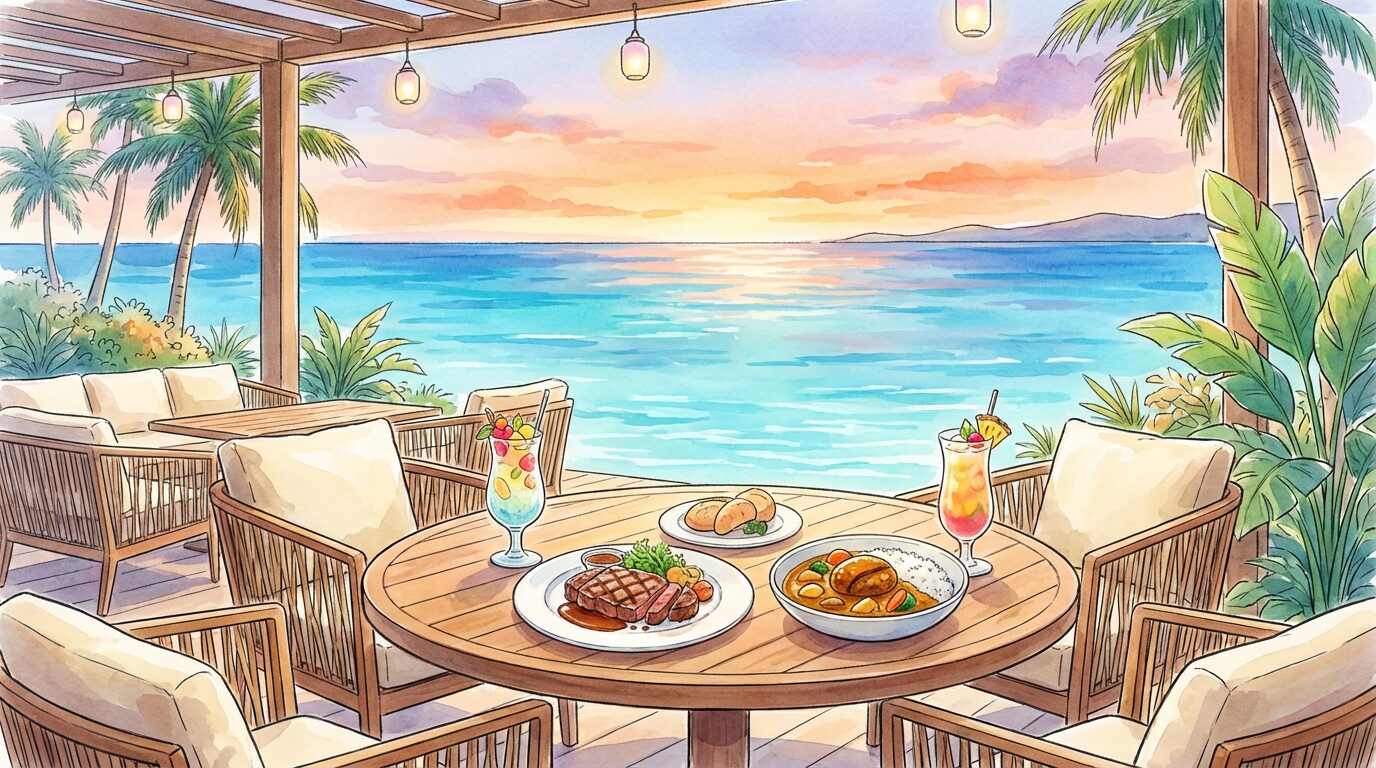
Right by the beach there's a café-restaurant called "Blue Turtle," where you can dine gazing at the sea from an open terrace you can enter still in your swimwear. More on this later, but whether or not it's there completely changes how long you spend at the beach.
The Spectacular Panorama from the Beach
Stand on Toguchi-no-Hama facing the sea and you'll see Shimoji Island, Kurima Island and the Miyako mainland lined up in front of you. This view is a composition you rarely see elsewhere, with several islands appearing to float on a gradated sea.
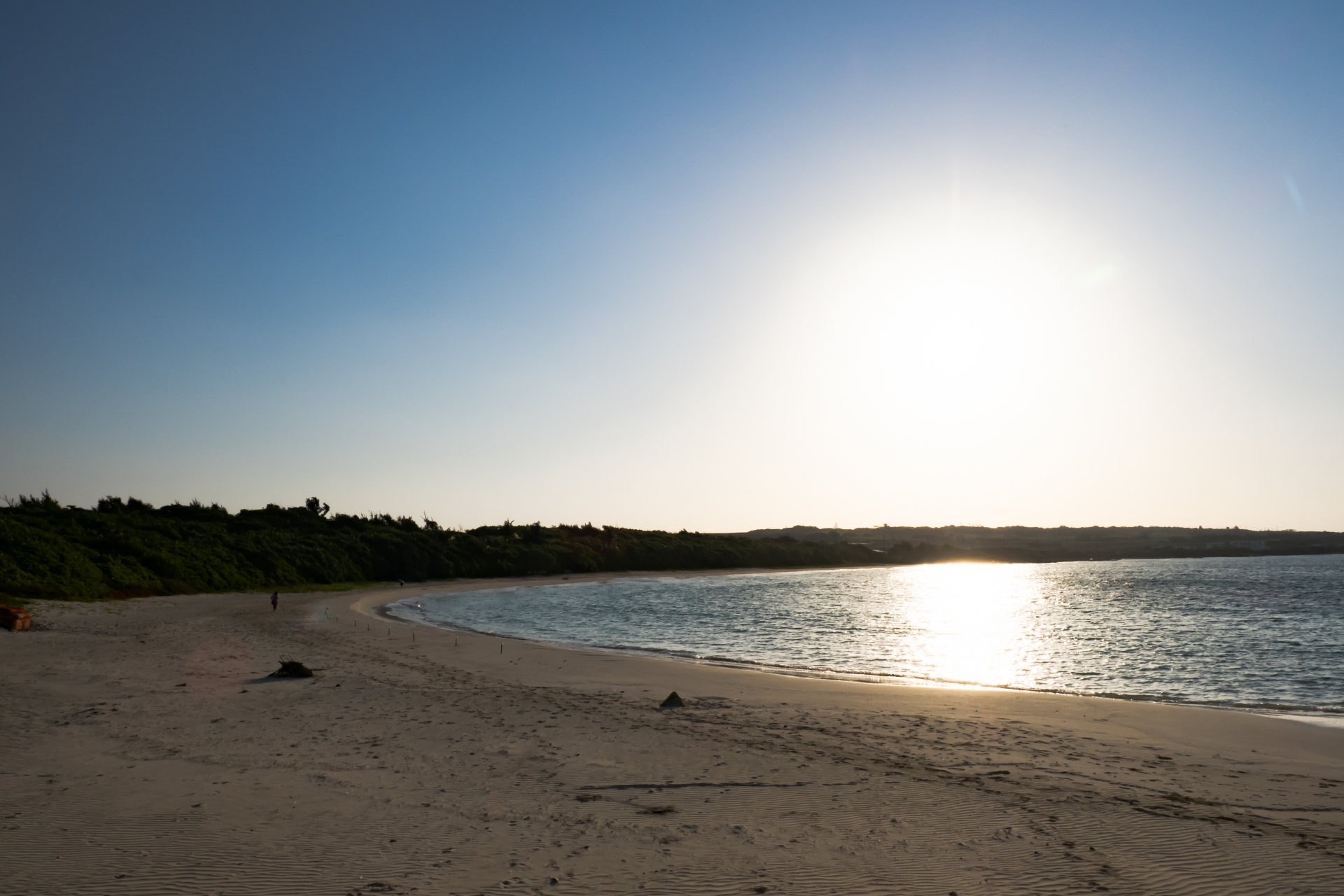
Climb onto the breakwater and you can look down over the whole beach for a different view. Gazing from above at the contrast of the bow-shaped coastline and the white sand, you simply think, "why is this so beautiful?" In the evening, orange light reflects off the sand for a face quite different from the daytime.
The History and Legends of Toguchi-no-Hama: A Glimpse of Local Culture
Toguchi-no-Hama is a place with a long history for the people of the "Toguchi" settlement. The place name Toguchi itself is an old settlement name appearing in Miyako Island's local history, and among Irabu Island's several settlements it was a sea-facing place deeply tied to the lives of the fishermen.
For the islanders of Irabu Island, the sea is the source of food and the foundation of life. In Irabu Island's history of flourishing on bonito fishing, the waters around this beach were where the fishermen came and went every day. An elderly resident told me, when I lived on the island, that the sight of fishing boats hauled up onto Toguchi-no-Hama's white sand for work was one of the original scenes of old Irabu Island.
The whole Miyako area is dotted with sites of worship called utaki, and faith in the sea and the land is rooted in the islanders' lives. There was a time when the area around Toguchi-no-Hama too was treated as sacred waters by the locals, and traditions about conduct and words on the beach were passed down within the settlement.
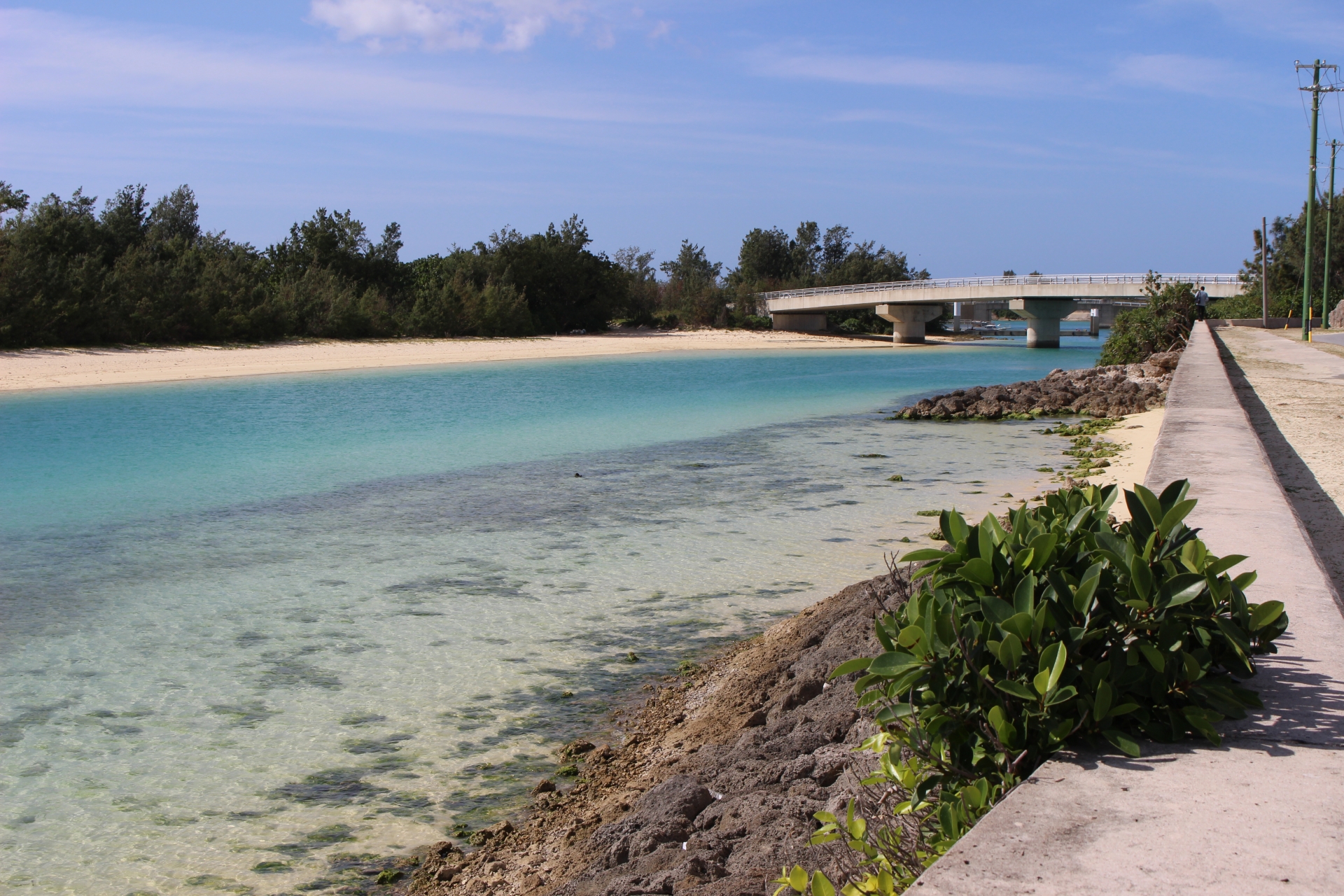
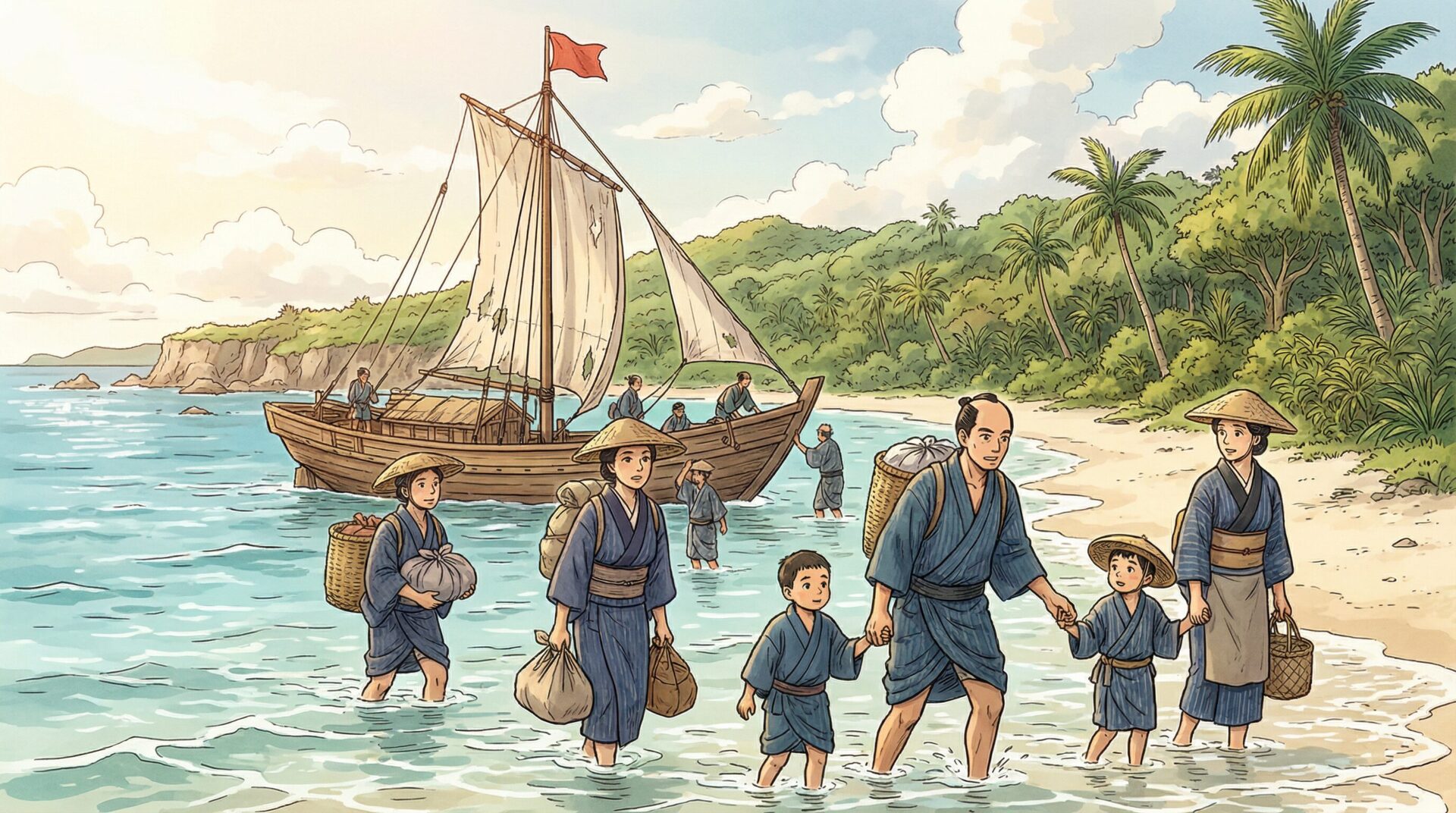
That the whole of Irabu Island was long a "remote island reachable only by boat" is also essential to understanding Toguchi-no-Hama's place. Until the Irabu Bridge opened in 2015, you could only cross by boat from Miyako Island to Sarahama Port. For the islanders of that era, Toguchi-no-Hama wasn't "the edge of the island" but "a seaside near the island's gateway." It was a place where they saw family off as they crossed by boat to Miyako Island, and a beach where they waited for their return.
As for cultural events, the Old Bon rituals held in Miyakojima City (such as Mushaama) continue across the remote-island area, and on Irabu Island too, observances expressing prayer and gratitude to ancestors are still rooted in the locals' lives. Visitors have few chances to encounter such culture, but if you become a little aware of "the time that has accumulated in this place" when you visit, the white sandy beach may look a little different.
How to Get There: From Miyako Airport to Toguchi-no-Hama
A Rental Car Is by Far the Best
For getting to Toguchi-no-Hama, a rental car is overwhelmingly convenient. It's about 25–40 minutes from Miyako Airport across the Irabu Bridge, or about a 5–10-minute drive from Shimojishima Airport — that easy. The Irabu Bridge is toll-free, and after crossing the bridge you turn left and follow the road to reach the beach car park.
The car park is free and has a fair amount of capacity. That said, it can fill up during the summer peak (July–August), so it's best to arrive early in the morning.
Rental cars on Miyako Island are basically collected at the airport, with each company providing a shuttle-bus transfer. Cars run short in peak season, so I strongly recommend booking early once your travel dates are set. In fact, I once went over Golden Week without booking anything and was turned away by several companies. That lesson still serves me. On choice of car: some roads on Irabu Island are narrow, so an ordinary passenger car is often more practical than a large SUV.
If You Use Public Transport
You can get there by bus, but the service is infrequent and inconvenient. Take the Kyowa Bus local line (Hirara Port–Sawada line) from Hirara Port and get off at the Dakifugaa (Irabu settlement) stop, and it's about a 5-minute walk to the beach. But with few services and hard-to-read timing, it's unsuited to sightseeing.
Taxis cruise the town centre of Miyako Island, but there are hardly any on Irabu Island. You'll need to call ahead by phone or have your accommodation arrange one. If you're touring Irabu Island over a full day, a rental car is realistically the way.
The map address is around "1352-16 Irabu, Irabu, Miyakojima City, Okinawa," and entering "Toguchi-no-Hama" into your car navigation or Google Maps will guide you there without trouble.
Activities to Enjoy at Toguchi-no-Hama
Swimming and Beach Walks Are the Classics
The classic way to enjoy Toguchi-no-Hama is, of course, swimming. The shallow terrain and calm waves mean children and weaker swimmers can get in the sea with peace of mind. In summer the water is warm enough to be lovely, and even around March you can get in with a wetsuit.
Just walking the sand barefoot is plenty of fun here. The feel of the powdery white sand on your soles is distinctive — something you can't taste at other beaches. The whole beach is flat and easy to walk, so a round trip from end to end gives you a real sense of its length. You sometimes find hermit crabs along the way, and I remember it being a hit when I came with children.
One point needs care, though. Toguchi-no-Hama looks shallow, but go offshore and it connects directly to the open ocean. In 2015 there was an accident in which a family of three drowned. When a high-waves warning or advisory is in effect, never get in the sea, and check the conditions for a few days after a typhoon too. On days with a southerly wind, jellyfish can drift in, and the Miyakojima Tourism Association site carries a warning about this as well.
If You Want to Enjoy Snorkelling
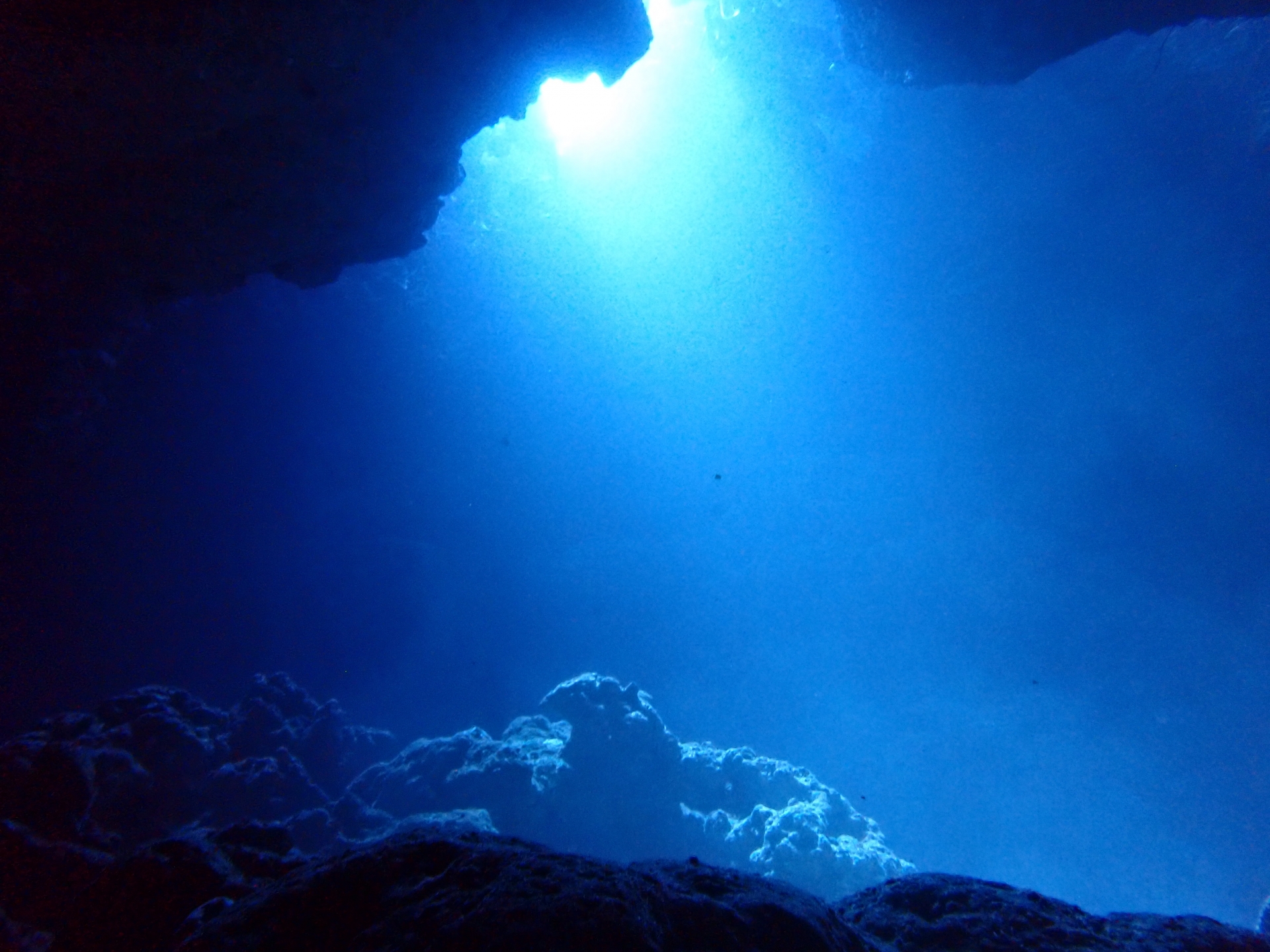
As mentioned, Toguchi-no-Hama itself isn't suited to snorkelling, but the Blue Cave (Sapphire Cave) on Shimoji Island is close, so I recommend enjoying them as a set. Using Toguchi-no-Hama as a base to shower and change before joining a tour is an easy flow.
Itoshima Kanko Service also rents snorkel sets, so you can try one at Toguchi-no-Hama and then do proper snorkelling at Nakanoshima Beach or on a Blue Cave tour — a two-stage way to enjoy it.
There are few tropical fish at the beach itself, but dip your face in the water and you can sometimes see small schools of fish. For relaxed paddling with children, it's plenty.
Relaxing on the Beach Is the Best Way to Spend It
Honestly, I think the best way to enjoy Toguchi-no-Hama is to "do nothing." Renting a parasol and beach chair, reading a book to the sound of the waves, or just gazing at the sea — that kind of use of time suits this place.
Toguchi-no-Hama has a "different flow of time" you can never taste in the city. The beach is so vast that even with other visitors there's distance, giving a private-beach feel. Walk the sand slowly barefoot, gaze at the sea, eat lunch at the beach café, then return to the sand. Just continuing that loop for half a day makes it a beach where you feel the trip was worth it.
The Best Season to Visit Toguchi-no-Hama and Tips for Avoiding Crowds
Features by Season
Irabu Island is relatively warm even among Okinawa's remote islands and can be visited year-round, but if Toguchi-no-Hama is your aim, the swimming season of May–October is basically best.
May–June is the rainy season with a lot of rain, but relatively few tourists. Even in the rain you can enjoy the sea fully if there are sunny breaks, and from late May to early June after Golden Week the crowds settle down. The air and water temperatures rise enough too.
July–August is full summer, when the beach is at its busiest. The car park can fill up, so it's best to go early in the morning (the 8–10 am range). Around noon the sunshine is too strong, so sunscreen and a rash guard are essential. It's also the season for habu jellyfish, so consider wearing protective gear or a snorkel suit.
September–October is when the typhoon season settles and tourists start to thin, and in years with stable weather it becomes a very good season. The water is still warm enough to swim, and the sunshine softens a little for comfort. From January to March the temperature drops to around 20°C (68°F), but on a fine day Toguchi-no-Hama has hardly anyone, and you can walk the sand almost to yourself. That's a special experience in its own way.
Times and Days to Avoid the Crowds
The busiest window is around midday (10 am–2 pm) on summer weekends and holidays. Both the beach car park and Blue Turtle's seats fill up. To avoid it, visit on a weekday, or even at weekends in the 8–10 am range or after 4 pm, and you can relax relatively well.
Golden Week, Obon and the New Year period are especially crowded, and Blue Turtle can have a wait to get in. Tourism has grown, so people who knew the quiet off-season Toguchi-no-Hama often remark, "it's got busier lately."
My personal hidden-gem recommendation is early morning, 6–8 am. The sight of the morning sun reflecting off the sea on a clear day is special, and there's hardly anyone about. Walking the sand to yourself at sunrise is an experience that never gets old no matter how often you come.
Instagram-Worthy Photo Spots and Shooting Techniques
The Best Shooting Angles at Toguchi-no-Hama
Toguchi-no-Hama is a beach that makes a picture wherever you shoot, but knowing the especially photogenic points lets you take far better photos.
The overhead shot from the breakwater is the classic of classics, capturing the bow-shaped sand and the transparent blue sea together in one frame. Shoot wide and pulled back for a powerful image that conveys the beach's length. A vertical composition lines up sky, sea and sand for an easy beauty of composition.
Shooting from a low angle at the water's edge overlaps the reflection on the water's surface with the sky for a fantastical mood. At low tide, when the sand at the water's edge is wet and mirror-like, you can capture the sky, sea and sand all reflected — like a "mirror of the sky." This is striking.
Looking out at the sea straight ahead from the beach, you see Shimoji Island, Kurima Island and the Miyako mainland lined up. Putting a person in front of this view conveys the remote-island feel and openness well.
Shooting Advice by Time of Day
In the morning (8–11 am) the sun streams in from the east, and it's the window when the sea's clarity shows best. The sand in the clear water is easy to see and the emerald green is vivid. For the "transparent tropical sea" you see on Instagram, the morning is best.
In the evening (4–6 pm) the sun sinking in the west dyes the sea's surface orange. Shoot a backlit silhouette and the figure melts into the sea and sky for a striking image. Dining while gazing at the sea at this hour from Blue Turtle's terrace is the best time too, photo-wise.
As for gear, a smartphone camera takes beautiful photos just fine. The one point is to keep the condition of "a fine morning." On a cloudy day the sea's colour dulls and Toguchi-no-Hama's greatest charm is halved. It's well worth checking the forecast and timing your visit for a sunny day.
Nearby Sights
The Irabu Bridge Spectacle and Photo Op
You'll cross the Irabu Bridge on the way to and from Toguchi-no-Hama, and this bridge is itself a sight. At 3,540 metres (2.2 miles) it's the longest toll-free bridge in Japan, opened in 2015 at a total project cost of ¥39.9 billion.
You can't walk across the bridge as it's a carriageway, but there's space to park and take photos on both the Miyako Island and Irabu Island sides. The angle looking up at the bridge from the Miyako side, and the angle looking back at it from the Irabu side, both make photos that convey the bridge's huge scale and the beauty of the surrounding sea. The view from inside the car as you cross is stunning too, with a sensation of driving across the sea.
To enjoy the view from an observation deck, Makiyama Observatory — a short drive after entering Irabu Island — is good. From the island's highest point you can survey the Irabu Bridge, the Miyako mainland, Ikema Island and Kurima Island, and take in the whole of Irabu Island's terrain. It has a car park and toilets, and admission is free.
On Comparing with Kabira Bay (Ishigaki Island)
Kabira Bay is sometimes compared with Toguchi-no-Hama, but Kabira Bay is a sight on Ishigaki Island, a different island from the Irabu Island where Toguchi-no-Hama lies. They're sometimes compared as fellow Okinawa remote islands, but it's hard to visit Ishigaki Island on an itinerary touring Miyako and Irabu Islands. Ishigaki Island is reached by plane or boat from Miyako Airport.
That said, many people interested in sightseeing towards Ishigaki Island plan it as a set with Miyako Island sightseeing. In terms of breadth of area, a route touring both the Miyako/Irabu Island area and the Ishigaki/Taketomi Island area is popular.
Recommended Food at Toguchi-no-Hama
Dining at Blue Turtle
When it comes to food at Toguchi-no-Hama, Blue Turtle is unmissable first of all. It's a café-restaurant reborn in 2018 from a renovation of "Toguchi-no-Hama Shokudo," a diner originally run by a local grandpa and grandma.
Just five seconds' walk from the beach, with all-ocean-view terrace seating, you can dine gazing at Toguchi-no-Hama. You can come in still in your swimwear, with an atmosphere easy to drop into between bouts of sea play. The white-toned, tropical exterior is exactly the look you often see on Instagram.
The popular dishes are the Miyako beef hamburger curry (¥1,850 / about US$12) and various steaks. Miyako beef is a brand beef from Miyako Island, a rare ingredient you can't easily eat on the mainland. For drinks, the pine-mango yoghurt and brown-sugar island-banana smoothie are popular, with a full tropical feel. It's open from 11 am for lunch and operates as a bar at night.
Note that lunch can't be booked, and there can be a wait in popular seasons. Evening dinner can be booked. Reviews also mention that "the service is person-dependent and uneven," so take that as part of being a resort beach café. The aim is the combination of spectacle and food, so come with the mindset to enjoy it, a little waiting included.
If You Want to Enjoy Local Cuisine
There aren't many restaurants around Toguchi-no-Hama, so I recommend heading back to the Miyako Island town centre for Miyako soba. There are local diners dotted around Irabu Island too — a few small places where you can eat a sashimi set or stir-fried island vegetables.
Miyako soba is a type of Okinawa soba, characterised by thin noodles and a light pork-bone broth, topped with soki or three-layer pork. It's a humble diner meal you can eat for ¥400–600 (about US$3–4) locally on Miyako Island, though with growing tourism many places have raised prices a little recently. Ask the locals and they may tell you a hidden-gem place.
For souvenirs, snow salt, island bananas and mango products available at farms and shops in the Shimoji area are the standards. Snow salt is a natural sea salt from Miyako Island, rich in minerals with a mild, un-fussy flavour. Incidentally, island bananas are completely different in sweetness and texture from the bananas sold on the mainland, so if you spot some, buy them.
Accommodation Around Toguchi-no-Hama
Resort Hotels Near the Beach
The closest luxury hotel to Toguchi-no-Hama is the "IRAPH SUI, a Luxury Collection Hotel, Okinawa Miyako." A Marriott-operated luxury-brand hotel, it stands in a location near Toguchi-no-Hama. All rooms are suite-type, with luxurious spaces to spend gazing at the Miyako-blue sea.
The Irabu/Miyako Island area has seen a run of resort-hotel openings in recent years, and the options are growing. Hotels are increasing in the area just across the Irabu Bridge from Miyako Airport too, and the "stay on the island while still having easy access to the Miyako Island town centre" style is drawing attention. With a resort hotel that has parking, it's easy to tour Toguchi-no-Hama and other parts of Irabu Island freely by rental car.
For bookings, checking the official site or various accommodation-booking sites is surest, and since Golden Week, summer and the New Year period fill up early, I recommend moving early once your travel plans are set.
Guesthouses and Hostels as an Option
If a resort hotel is a little out of reach, Irabu Island and Miyako Island also have guesthouses and hostels dotted about. With a small, homely atmosphere, the owners often kindly share island information. Accommodation is often about a 10–20-minute drive from Toguchi-no-Hama, and hearing about hidden-gem spots is a pleasure unique to a guesthouse.
Staying at lodging in the Miyako Island town centre and crossing the Irabu Bridge to sightsee each day is a common style too — the town centre has many restaurants and tourist facilities, so it works well as a base.
Things to Note When Visiting
Checking Weather and Sea Conditions
Toguchi-no-Hama is a natural beach with no lifeguards. There's no set swimming period or hours, so swimming is at your own risk. Sea conditions change suddenly after a typhoon, so always check for high-waves warnings or advisories before setting out.
On days with a strong southerly wind, waves pick up easily and habu jellyfish can drift in. Habu jellyfish are seen most around July–October on Irabu and Miyako Islands, and a sting hurts intensely. Wearing a full suit or rash guard is effective at reducing the risk, and if there's beach-café staff on site, it's worth asking about conditions.
In winter — January, February, March — the sea temperature drops and swimming is difficult, but Toguchi-no-Hama on a fine day has a different beauty. As a place just to walk the beach, it can be enjoyed year-round.
Sea Safety Measures
Even on a shallow beach, going offshore is dangerous. As with the 2015 accident, a sea connected to the open ocean has strong currents and you may become unable to get back. Don't go beyond a depth where your feet can't touch — keep just this and you avoid most of the risk.
When coming with children, I strongly recommend having them wear a life jacket. You can rent one at the shop, so you don't need to bring your own. A float ring can come off the body, so a life jacket that fastens to the body is safer.
Don't forget sun protection either. The summer sun of Miyako and Irabu Islands is nothing like the mainland's — just 30 minutes leaves you bright red. The basic rule is to apply sunscreen 30 minutes before getting in the sea, and out of care for the environment, choosing a reef-friendly formula is ideal.
If you spend a long time at Toguchi-no-Hama, don't forget to hydrate. You can buy drinks at Blue Turtle or Itoshima Kanko Service, but in midsummer the risk of heatstroke is high. With the glare off the sand raising the felt temperature, I recommend taking frequent breaks in the shade.
Reviews and Reputation of Toguchi-no-Hama
Visitor Accounts
It has a record of ranking high in a "Waterside Ranking Popular with Japanese, Chosen by Travel Lovers," and visitor ratings are generally high. On review sites and social media, comments like "I was amazed by the whiteness of the sand and the clarity," "my child ran around the beach having a great time," and "I can't forget the dusk scenery" stand out.
A common reaction from first-time visitors is "it's far more beautiful in person than in photos." This is true of Irabu Island's beaches in general — the clarity and quality of light you see on site aren't conveyed even by half in photos.
It's also well-rated by families, with voices saying "shallow and easy for small children to play" and "the facilities are good so you can travel light." It's recognised as a beach kind to swimming beginners and seniors too.
The Highly Rated Points
The points raised in Toguchi-no-Hama's high rankings are almost consistently four: sand quality, clarity, good facilities and location.
The whiteness and fineness of the sand draw voices calling it "Okinawa's best," receiving a top-class rating alongside Yonaha Maehama and Yuri-ga-hama. As for clarity, photos taken by people who visited on a fine, well-conditioned day are often shared on social media, and that's the biggest reason it became a famous beach.
On the other hand, there are a certain number of voices saying "I expected too much of the snorkelling" or "it was crowded at the summer peak." Going in understanding it as "a beach to enjoy swimming, scenery and food" adjusts your expectations and raises satisfaction.
That the expression "never gets old no matter how often I go" stands out in returners' reviews is a feature of Toguchi-no-Hama too — clearly a beach whose face changes each time with the weather and time of day. As a beach suited to those who want to spend a leisurely time, it's stably well-rated by experienced travellers.
FAQ: About Toguchi-no-Hama
Q. Can you swim year-round? There's no official swimming period set, but water-temperature-wise you can swim from late April to around November. In winter you can get in with a wetsuit, but for most people it's difficult.
Q. Is it safe with children? It's shallow with many calm-wave days, so a relatively reassuring beach. But there are no lifeguards, so an adult should always keep watch. Wearing a life jacket is recommended too.
Q. Can you book Blue Turtle? Lunchtime (11 am–5 pm) can't be booked. Dinner (after 5 pm) can be booked, and in popular seasons booking is surer.
Q. Is it free to use? Entry to the beach itself is free. The car park is free too. Showers, toilets and rentals are paid.
Why Toguchi-no-Hama Becomes the Axis of Irabu Island Sightseeing
When sightseeing Irabu Island, many people agonise over how to plan the day. With several highlights — 17END, Makiyama Observatory, Toriike Pond, Nudokubi Abu — trying to do them all gets hectic. I hear voices saying they believed the info that "Irabu Island can be toured in half a day," then found more highlights than expected and ended up rushed.
At such times, making Toguchi-no-Hama the axis works just right. Tour Toriike Pond and Makiyama Observatory in the morning, settle at Toguchi-no-Hama from before noon, dine at Blue Turtle, and watch the sunset before heading home in the evening. This route is the least forced and makes a day where you firmly feel Irabu Island's beauty.
Toguchi-no-Hama's white sand and transparent sea never get old no matter how often you visit Irabu Island. Rather, it's a place that makes you think "I'm glad I came again" each time. Cross the Irabu Bridge by rental car from Miyako Airport, stand at the end of the sand, and that sight is waiting once more. That there's a beach on Irabu Island that makes you feel this is, I find, what makes a trip to Miyako Island special.
For the latest information on Toguchi-no-Hama (opening hours, facility status, sea conditions), please check on site or on the Miyakojima Tourism Association website before visiting. Conditions change with the weather and season.