- The Day I Went to 17END and Thought "This Wasn't What I Expected"
- What Is 17END? The Origin of the Name and the Truth of the "Phantom Beach"
- The 15-Minute Hell from the Car Park | Why Midsummer 17END Is So Brutal
- Aim for Low Tide! But That Alone Isn't Enough
- A Beach with Zero Facilities | The Reality of No Vending Machines, No Toilets
- The Wall of Tetrapods | Getting Down to the Sand Is Hard Work
- Why You Should Still Go to 17END | The Spectacle Was the Real Thing
- 7 Preparations for Enjoying 17END Comfortably
- Frequently Asked Questions (FAQ)
- Go Knowing the Reality, and It Becomes the Best Memory
The Day I Went to 17END and Thought "This Wasn't What I Expected"
"17END is as beautiful as those photos, right?"
I still remember being asked that by a friend in the summer of my third year living on Irabu Island. After instantly replying, "yeah, it's incredibly beautiful," I found myself adding a few words.
"It's just that it might be a little different from what you're imagining."
My friend looked puzzled. In the photos seen on social media, it was supposed to be a paradise-like place where pure-white sand and a clear emerald-green sea spread out. But when you actually go to 17END, there are plenty of moments before you take that photo where you think, "wait, are we really going there?"
The first time I visited 17END was at 1 pm in August. I'd thoroughly checked the low-tide time and set off in high spirits. The moment I arrived at the car park and thought "right, let's go," I realised: we walk from here. And there's not a scrap of shade. The temperature was over 33°C (91°F).
Five minutes after starting to walk from the car park, I was drenched in sweat. At ten minutes, I was asking myself "why am I even doing this." And fifteen minutes later, I stood transfixed before the sea that had finally come into view.
Sure, it was beautiful. Just as in the photos — no, more beautiful than that. But the "reality" of getting there was so different from what I'd imagined.
In this article I'll write not just about 17END's beauty, but about the "reality nobody told me about" of getting there. The struggle of walking under the blazing summer sun, the inconvenience of zero facilities, the fear of climbing down the tetrapods. Go knowing that "real" side, and 17END will, without a doubt, become the best of places.
What Is 17END? The Origin of the Name and the Truth of the "Phantom Beach"
First, what 17END actually is.
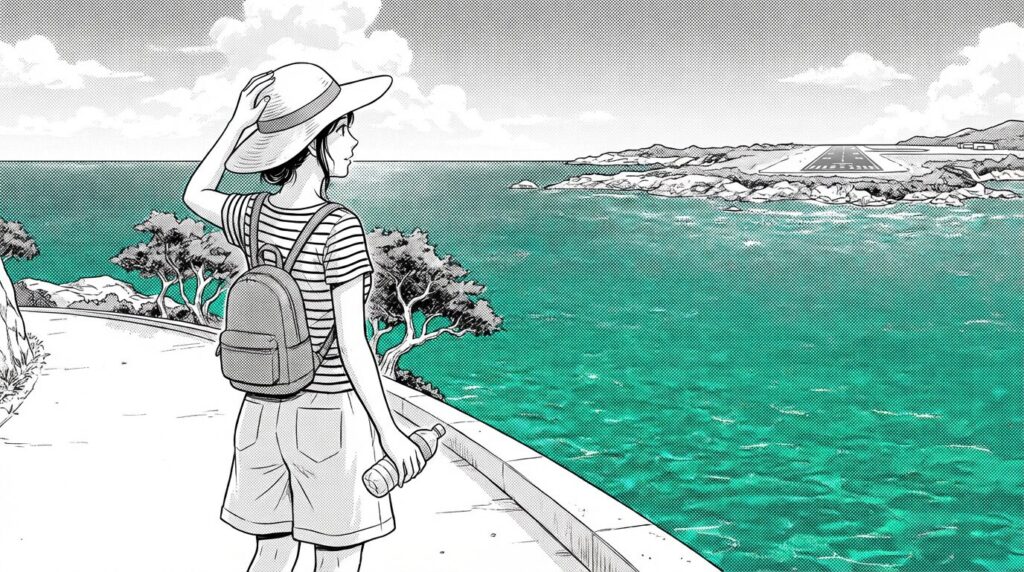
17END is the coast at the northernmost tip of Shimojishima, the island next to Irabu Island. It's the spot at the end of the runway of Shimojishima Airport, and that's where the name comes from.
Runways are given numbers showing their direction, and because Shimojishima Airport's runway faces 170 degrees relative to north, it's called "Runway 17." Because it's the End of that runway, it's "17END" (One Seven End). An aviation term became a place name as is.
The reason it's called a "phantom beach" is that the white sand appears only at low tide. At high tide it sinks beneath the sea and you can't even set foot on it. Actually, 17END's sandbar isn't a natural beach. Apparently, when the airport was built, the land reclamation changed the tidal flow, and sand accumulated on the seabed to form this place.
So you can't see it just by going anytime. You need to look up the low-tide time in advance and go to match that timing. This is surprisingly tough, and it's a common story that the trip schedule and the low-tide time don't line up.
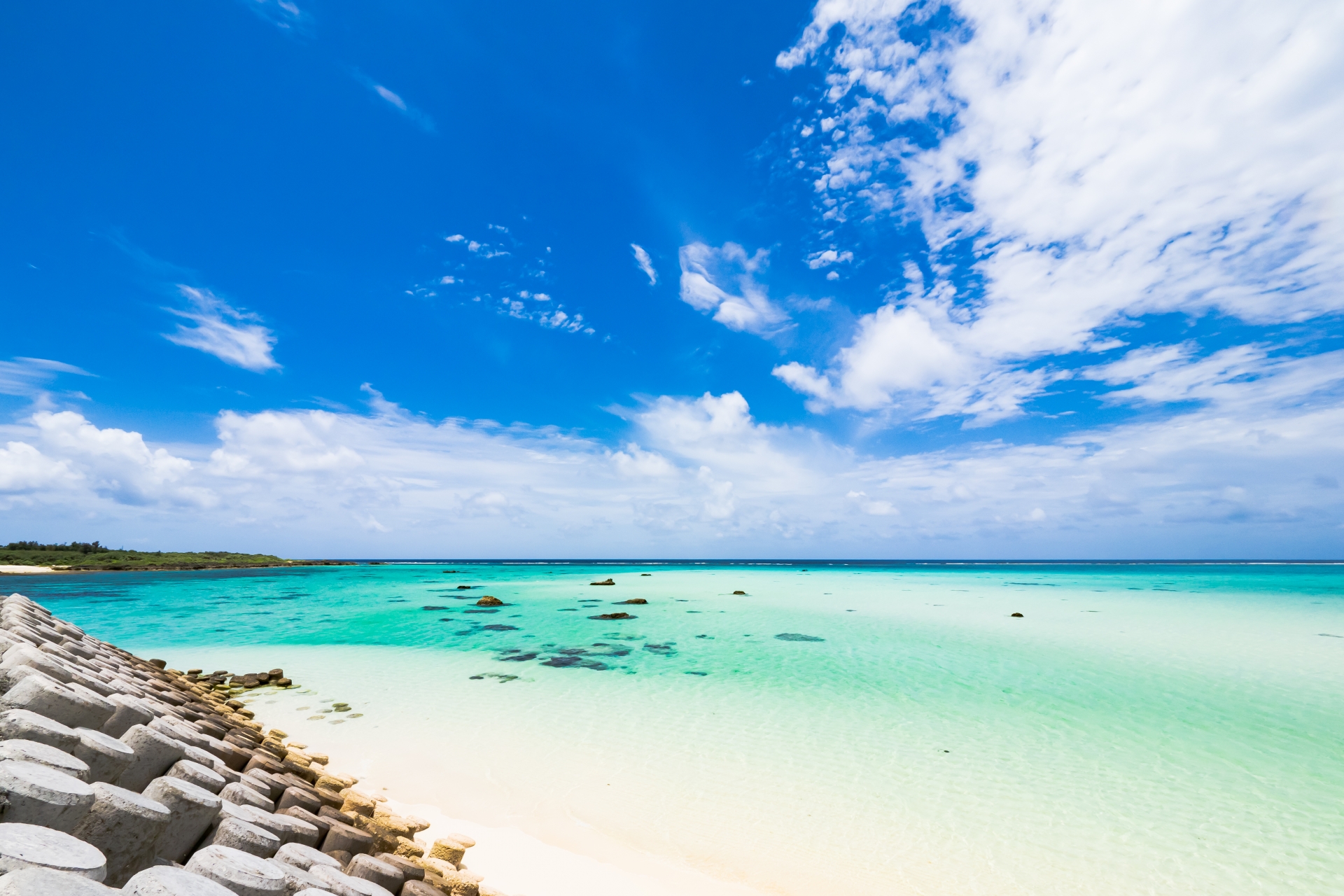
The sea's clarity is top-class even in the Miyakojima area. The gradient changing from white sand and emerald-green shallows towards deep blue offshore was, honestly, breathtakingly beautiful. The sea colour apparently looks more vivid because there's little coral.
Also, 17END's appeal is being able to watch planes take off and land up close. Since it's right behind Shimojishima Airport, if the timing's right you can see planes passing just over your head. For aviation fans it's apparently a "holy site."
The 15-Minute Hell from the Car Park | Why Midsummer 17END Is So Brutal
Now, to the main point. About 17END's "reality."
The first ordeal is the walk from the car park to 17END. Apparently you could once drive close to the tip, but with the opening of Shimojishima Airport in 2019, vehicles were banned. Now you have no choice but to park at the car park and walk from there.
The distance is about 700 metres to 1 kilometre. A 10-to-15-minute walk at a normal pace. "That's nothing," you'd think, right? I thought so too.
But reality wasn't so kind.
First, there's not a scrap of shade. Truly none. You keep walking the paved coastal road, beaten down on by the sun. From July to September, Miyakojima temperatures over 30°C (86°F) are the norm, and the perceived temperature is higher. With the glare reflecting off the asphalt too, there's no word for it but hell.
The first time I went, I stopped partway and seriously considered turning back. My T-shirt was soaked through with sweat and my head started spinning. The 500 ml bottle I'd brought was empty by the time I arrived.
And you walk the same road back, too. Since you've used up your stamina on the way there, the return is even harder. Especially if you go around midday to match the low tide, the sun is right overhead with no escape.
I've also seen several groups of tourists turn back at the car park. "No way, I can't do this." I understand the feeling well.
When I asked a local, they said, "I wouldn't recommend walking to 17END in the daytime in summer." Early morning or evening, and ideally winter, is apparently good. But many tourists come in summer, and the low-tide time is sometimes in the daytime.
One day, a fellow with a mobile shop was selling drinks at the car park. "Everyone comes back drenched in sweat, so it's good business," he laughed. Indeed, I bought two Salty Lychee drinks that time. I felt like I'd come back to life.
Midsummer 17END takes resolve. A hat, a parasol, sunglasses, sunscreen, and above all drinks. These are absolutely essential. Go with the light feeling of "I'm just popping out to see the sea," and it's seriously dangerous.
▶For details of tourist information, please also see the [Miyakojima City Tourism Association]
Aim for Low Tide! But That Alone Isn't Enough
The absolute condition for enjoying 17END is the low-tide time. This is non-negotiable.
The low-tide time changes every day, so you need to check the Miyakojima tide table in advance. Look at the tide level for "Hirara" on the Japan Meteorological Agency site and you'll get a rough idea. The best timing is around 1 to 2 hours either side of low tide. With a tide level of 30 cm or less, the white sand appears properly.
One of my failure stories. The first time I went, I'd checked the low-tide time properly. But I hadn't thought about the weather. That day was cloudy. The sea was certainly beautiful, but it wasn't that clear emerald green — it was more of a greyish blue, somehow.
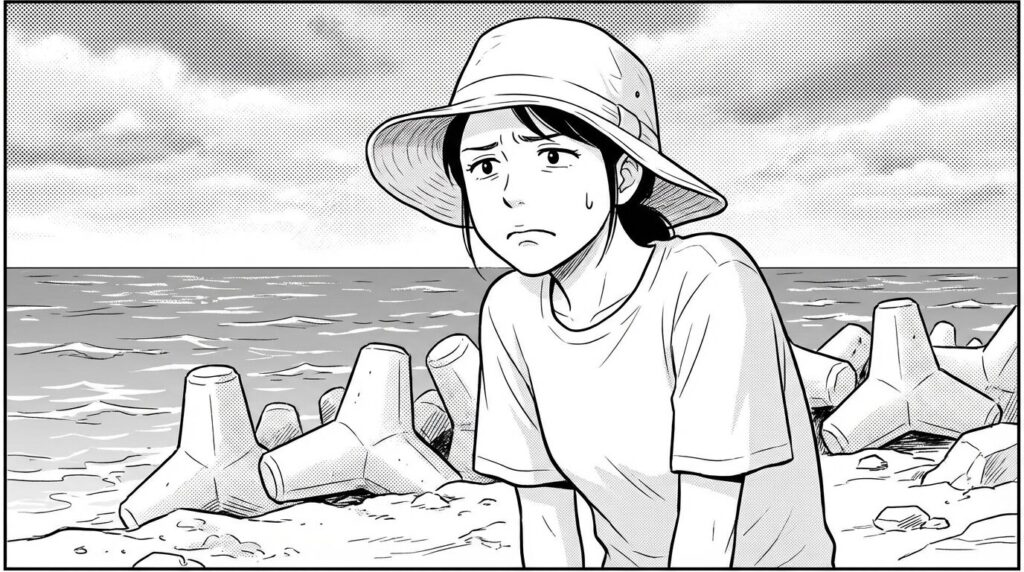
I went home thinking, "huh? It's different from the photos…" Later, when I went on a fine day, the scenery was completely different and it surprised me. Ah, this is it!
To see 17END in its best state, not just the low-tide time but the weather matters too. Without sunshine, that vivid colour doesn't come out. Only when the sunlight reflects off the sea is that gradient born.
And the time of day. From the morning to early afternoon is best. Get to late afternoon and it's backlit and the colours look dull. The evening apparently has a beautiful sunset, but it often doesn't line up with the low tide.
In other words, to see 17END in its best state:
- Low tide (tide level 30 cm or less)
- Fine weather
- Morning to early afternoon
These three conditions need to come together. If your trip dates are fixed, whether they all line up is down to luck. My friend said that on a 4-day, 3-night trip, the conditions never once lined up and they went home.
Miyakojima's weather changes easily. It can be rainy in the morning and sunny by midday. Conversely, it can be sunny in the morning and suddenly hit by a squall. So if there are several low tides during your stay, it's good to pick the day among them with the most promising conditions.
Also, 17END at high tide isn't bad either. You can't see the sand, but the sea's clarity doesn't change, and there are fewer people and it's quiet. You can't see the "phantom beach," but a spectacle is a spectacle.
A Beach with Zero Facilities | The Reality of No Vending Machines, No Toilets
Another "reality" of 17END. That is, there really are no facilities at all.
Toilets, none. Vending machines, none. Showers, none. Shop, none. No lifeguards or lifesavers either. All there is is a car park and a road leading to the sea.
As for toilets, preparation in advance is essential. The closest is the toilet at the car park of "Toriike Pond," which is on the way to 17END. Using it before heading to 17END is the iron rule. Stop here on the way back too.
Since there's no shower, after getting in the sea you have no choice but to air-dry as you are or wipe off with a towel you brought. You'd best be prepared for your rental car to get sticky with seawater. The nearest shower means going all the way back to Toguchi-no-Hama.
The lack of a vending machine is the hardest. Especially in summer. You walk nearly 30 minutes round trip from the car park, and under the blazing sun at that. Bringing drinks is absolutely essential, but quite a few tourists forget this.
The worst I saw was when a small child in a family group was crying "water, water." The mother was frantically searching for the water bottle, but it was already empty. Unable to watch, I shared the bottled water I had. "I'm sorry, I didn't think it'd be this hot," she apologised — but everyone underestimates it at first.
Sometimes a mobile shop van comes, but that's really just luck. Basically you'd best assume "it won't come." There's no convenience store nearby either, so you need to buy drinks in advance.
There are no bins either. All the rubbish you bring in, you take home. This is obvious manners, but just in case.
"A wild beach" sounds nice, but in reality it means "a place of self-responsibility." If something happens, there's no one to call for help. Injured, heatstroke — you have no choice but to manage on your own.
That's exactly why preparation matters. Drinks, a hat, sunscreen, a first-aid kit. At minimum you should bring these. Also, the phone signal does just about reach, so you can secure a means of contact in an emergency.
The Wall of Tetrapods | Getting Down to the Sand Is Hard Work
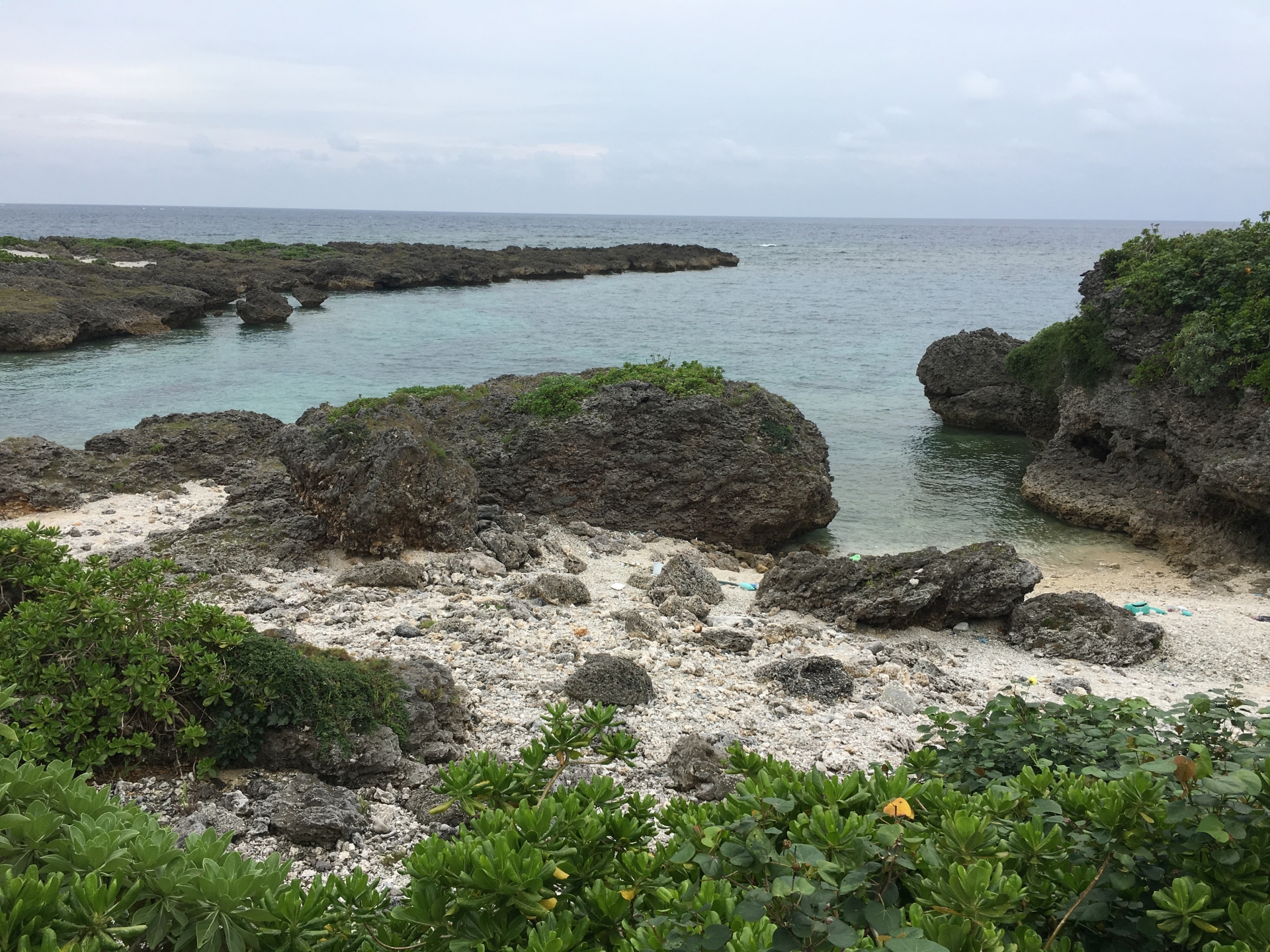
Along 17END's coastline, tetrapods (wave-dissipating blocks) are lined up in a row. Those grey, rugged, giant lumps of concrete.
Yes — to get down to that "phantom white sand," you have to climb over these tetrapods to descend.
There are no stairs. No handrail. Just tetrapods.
The first time I tried to climb down, I honestly thought, "isn't this impossible?" The gaps between the tetrapods are wide, and slip and you fall into the sea. The height is considerable too, about 2 metres (6.5 ft).
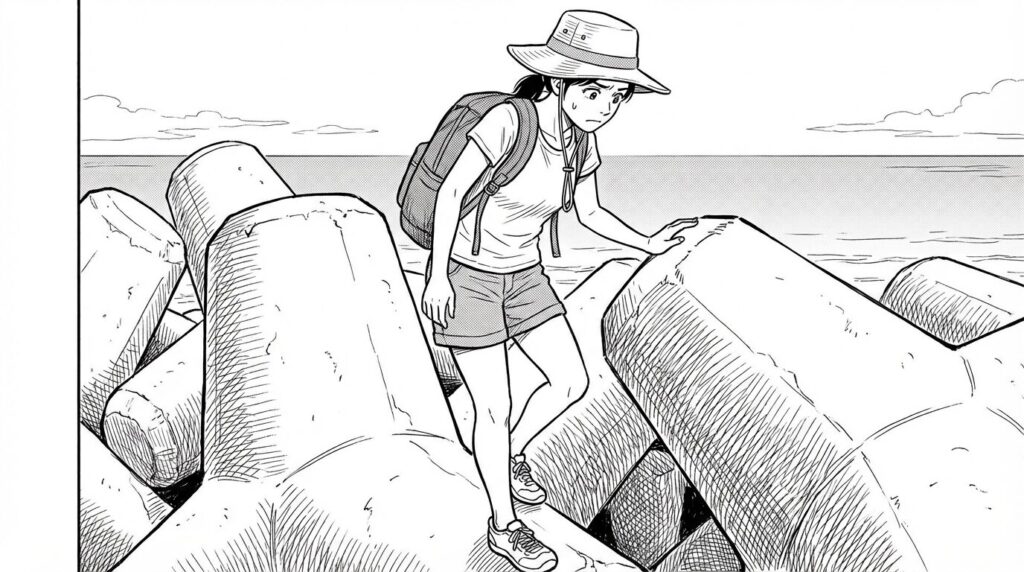
Coming in sandals was a mistake too. They slip, and the footing is unstable. Looking around, everyone was descending carefully, slowly, slowly. Some gave up partway and turned back.
Going with small children is truly dangerous. Climbing down carrying them is impossible, and a child descending alone is scary. Indeed, I often see the pattern of a family where only the father descends, while the mother and child take photos from above.
It's tough for elderly people too. Those with bad knees or unsure of their balance had best not force the descent. Even just looking from above is beautiful enough.
When I asked a local, apparently if you walk a little to the north, there's a place where the tetrapods are lower. Descending from there is easier. But most tourists come without knowing that. I didn't know at first either.
For those not used to tetrapods, just be careful. Don't rush, don't force it. It's hard to descend with a lot of luggage, so keep it minimal. Trainers are the best footwear. Beach sandals or heels are out of the question.
Also, even if you don't intend to get in the sea, just walking on the tetrapods can wet your feet. Sea spray catches you, or you step on a wet patch. It's safer to bring a change of clothes.
Once you're down on the sand it's comfortable, but the "descent" itself is the biggest hurdle. Go without knowing this and it's "wait, we climb down here?"
Why You Should Still Go to 17END | The Spectacle Was the Real Thing
I've written a lot here about how "it's hard" and "it's brutal," but if you ask whether 17END isn't worth going to, that's not it at all.
Quite the opposite. 17END is, without a doubt, a place you should go.
Because that scenery is the real thing.
The moment you climb down the tetrapods and put your feet on the white sand. The clear sea spreads before you, and you can see the seabed right to your feet. The gradient from emerald green to deep blue. Walking through the shallow sea, you get the sensation of walking on the sky.
"Ah, this is it," I thought. The photos I saw on social media — they weren't edited or anything, it really is this colour.
And seen in person, it's beyond the photos. Surrounded 360 degrees by sea and sky, all you can hear is the sound of the waves. I've lived in Miyakojima for years, but 17END's clarity really is in a class of its own, I think.
The Irabu Bridge in the distance, the horizon, and a plane passing overhead. You can feel from the heart that walking through that blazing sun to see this scenery was worth it.
My favourite is 17END in the morning when the tide has gone out. There are few people, and the sea mirrors the sky. On days with a gentle breeze, you really feel like you're in another world.
I've also gone in the evening, and that time the sea shone golden. The moment the sun set, the sky and sea dyed the same orange, as if time had stopped.
Even the locals say, "17END never gets old no matter how many times you see it." By season, by time of day, by weather, how it looks is completely different.
The hardship is a fact. But the scenery beyond that hardship becomes something you'll never forget for the rest of your life. "I've never seen a sea this beautiful," everyone says in unison. Me too.
So if you prepare properly and go with resolve, 17END becomes the best memory. A place where you can think, "it was hard, but I'm glad I went." That's 17END's true form.
7 Preparations for Enjoying 17END Comfortably
Now, I've written about 17END's "reality" up to here, but finally, some practical advice. Let me sum up the preparations I learned from going many times, for enjoying 17END even a little more comfortably.
1. Thoroughly check the low-tide time and weather forecast
Once your trip plans are set, first check the low-tide time on the Japan Meteorological Agency's tide table. Aim for the time when the tide level drops to 30 cm or less. Then the weather forecast. Ideally you want to pick a fine day. Miyakojima's weather changes easily, so it's good to check the rain-cloud radar too.
2. Bring plenty of drinks
At least two 500 ml bottles per person. In summer, three is fine. Bringing a frozen bottle is handy as it doubles as a cool pack partway. Sports drinks or oral rehydration solution are recommended.
3. Full kit of heat-protection gear
A hat, a parasol, sunglasses, sunscreen. These are absolute. Ideally a neck gaiter to cover your neck is good too. A handheld fan or cooling towel also helps. Don't underestimate the heat.
4. Footwear must be trainers
Sandals or heels are out of the question. They're dangerous when climbing down the tetrapods, and walking the blazing asphalt is tough too. Trainers you don't mind getting wet, or marine shoes, are best.
5. Use the toilet beforehand
The toilet at the Toriike Pond car park is the last one. Be sure to go here. There's nothing at all at 17END.
6. Keep luggage minimal, but don't forget the essentials
Walking with big luggage is hard, and it gets in the way when climbing down the tetrapods. But drinks and heat-protection gear are essential. Putting them in a waterproof bag and carrying it as a rucksack is recommended.
7. Allow plenty of time
At least 30 minutes round trip from the car park to 17END. Considering time spent on site too, you'll want to allow 1.5 to 2 hours. It's not a place to rush there and rush back. Secure time to enjoy the scenery slowly.
Also, this isn't a preparation, but never overdo it. Don't go on days you feel unwell. Give up on days that are too hot. If you're with small children or elderly people, also consider the option of just looking from above.
17END is an unmanaged beach, so if something happens it's self-responsibility. That's exactly why preparation and judgement matter. Force it, get heatstroke or injured, and your precious trip is ruined.
Frequently Asked Questions (FAQ)
Q1: When is the best season to go to 17END?
Miyakojima's tourist season is summer, but for going to 17END, spring (April–June) or autumn (October–November) is recommended. The heat eases and walking is easier. Winter is surprisingly good too. There are few tourists and it's quiet, and the temperature is comfortable at around 20°C (68°F). However, it being down to the low-tide time and weather is the same in any season.
Q2: Does the car park get crowded?
Going to match the low tide, the car park gets quite crowded. Especially in the summer tourist season. Only about 10 to 20 cars can park, so you want to arrive an hour before low tide. You also see cars parked on the roadside, but I don't recommend it.
Q3: Is it OK with children?
Honestly, with small children it's tough. Making them walk under the blazing sun is hard, and climbing down the tetrapods is dangerous. If you do go, early morning or winter. Even so, climbing the tetrapods while carrying a baby in a sling is impossible. Primary-school age or older, and you can manage depending on stamina and conditions.
Q4: Can you swim?
It's not that you can't, but I don't recommend it. There are no lifeguards and no emergency facilities. There's no shower either, so you'll end up going home wet with seawater. Keep it to dipping your feet, and if you want to swim properly, a beach with proper facilities like Toguchi-no-Hama is better.
Q5: Can you watch planes take off and land?
It's down to timing. You can see them when there are international flights or training flights at Shimojishima Airport. Training info is sometimes posted on the airport's official site or X. But basically you'd best think of it as "lucky if you see it."
Q6: Is it worth going even on a rainy day?
When the weather's bad the sea colour looks dull, so I don't think you need to go out of your way on a rainy day. Miyakojima's weather changes easily, so it's better to check the rain-cloud radar and aim for a break in the clouds.
Q7: Is it OK to go alone?
Alone is totally fine. If anything, alone you can walk at your own pace and enjoy the scenery slowly. However, since there's no one to call for help if something happens, take full care with your health management and safety. Always bring your phone.
Go Knowing the Reality, and It Becomes the Best Memory
I've written honestly about 17END's "reality."
The brutality of walking 15 minutes under the blazing sun. The inconvenience of zero facilities. The fear of climbing down the tetrapods. There really are those "hard things" that the social-media photos don't show.
But that's exactly why I can say it. 17END is worth going to.
The hardship is a fact. Preparation is needed too. But the scenery beyond it was a spectacle I'll never forget for the rest of my life. Even I, who've lived in Miyakojima for years, am moved no matter how many times I see it.
Rather than "this wasn't what I expected," I want you to be someone who can say, "I knew it'd be like this, so I came prepared." Do that, and 17END becomes the best memory.
Wear a hat, bring water, put on trainers. Look up the low-tide time, aim for a fine day. Don't overdo it, at your own pace.
Head off having got your preparations in order like that, and the white sand and clear sea spreading beyond the tetrapods you climb down will surely welcome you.
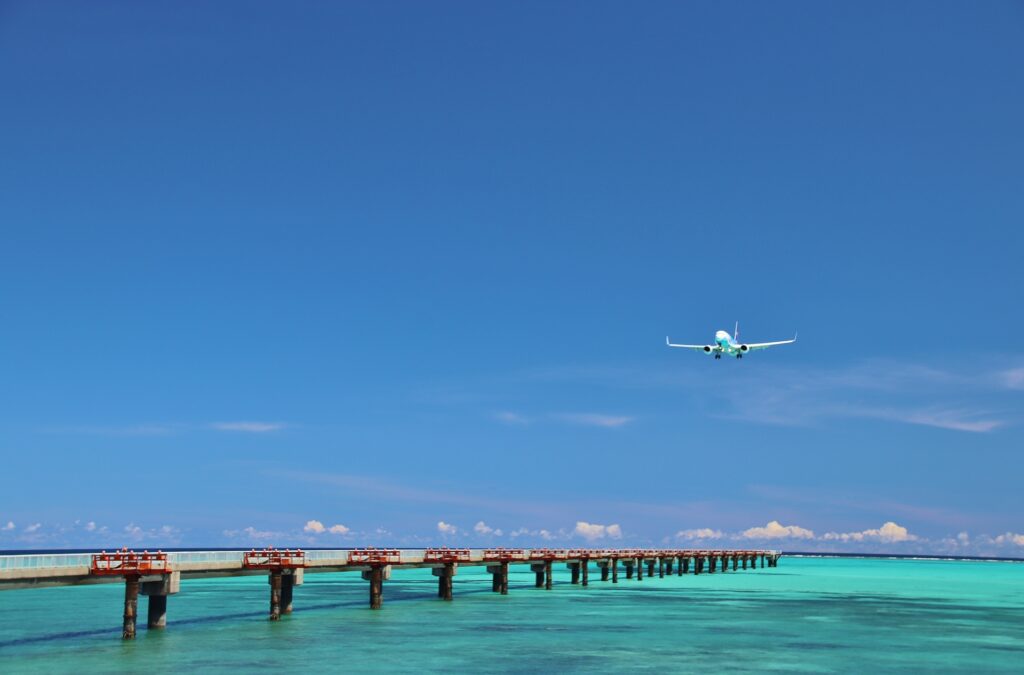
You're sure to think, from the heart, "ah, I'm glad I came."
I'll go again too. Next time I want to go early in the morning and have a deserted 17END all to myself. I want to see 17END in winter too. And at sunset, I want to go once more.
No matter how many times I go, 17END shows me a new face. That's 17END's appeal. It's hard, but that's exactly why it's a special place, I think.
I want you, too, to get your preparations in order and go see 17END's true form. A view beyond your expectations is surely waiting.