- The Giant Boulder Thrown Up by the Great Meiwa Tsunami, and the Memory of the Tsunami
- Obiiwa Is One of Japan's Largest Tsunami Boulders, Carried by the Great Meiwa Tsunami
- The Tragedy of the Great Meiwa Tsunami Carried Obiiwa
- The Origin of the Name Obiiwa Is the Figure of a Tied Sash
- Obiiwa Is an Object of Folk Faith and Is a Place of Worship
- Around Obiiwa Are Toriike Pond and Beaches
- Things to Note and Prepare When Going to Obiiwa
- The Lesson of Tsunami Learned from Obiiwa
- Frequently Asked Questions and Answers
- It Will Keep Remaining as a Giant Boulder Conveying the Memory of the Tsunami
The Giant Boulder Thrown Up by the Great Meiwa Tsunami, and the Memory of the Tsunami
The first time I went to Obiiwa was just past 2 pm. I was driving casually after passing Nakanoshima Beach when a sign reading "Obiiwa" caught my eye, and I thought, "if there's a sign out, maybe I'll take a quick look."
When I turned onto the side road, it wasn't paved, and rattling along I grew anxious about "can I even get there by car?", but I was curious so I pressed on. Mangrove forest spread on both sides of the road — very Okinawa-like scenery.
After driving for 1–2 minutes I came out into an open area, like a car park, with just one other car parked. Getting out of the car, a torii gate appeared before me, and beyond it an incredibly large rock, and "whoa, it's huge" escaped me involuntarily.
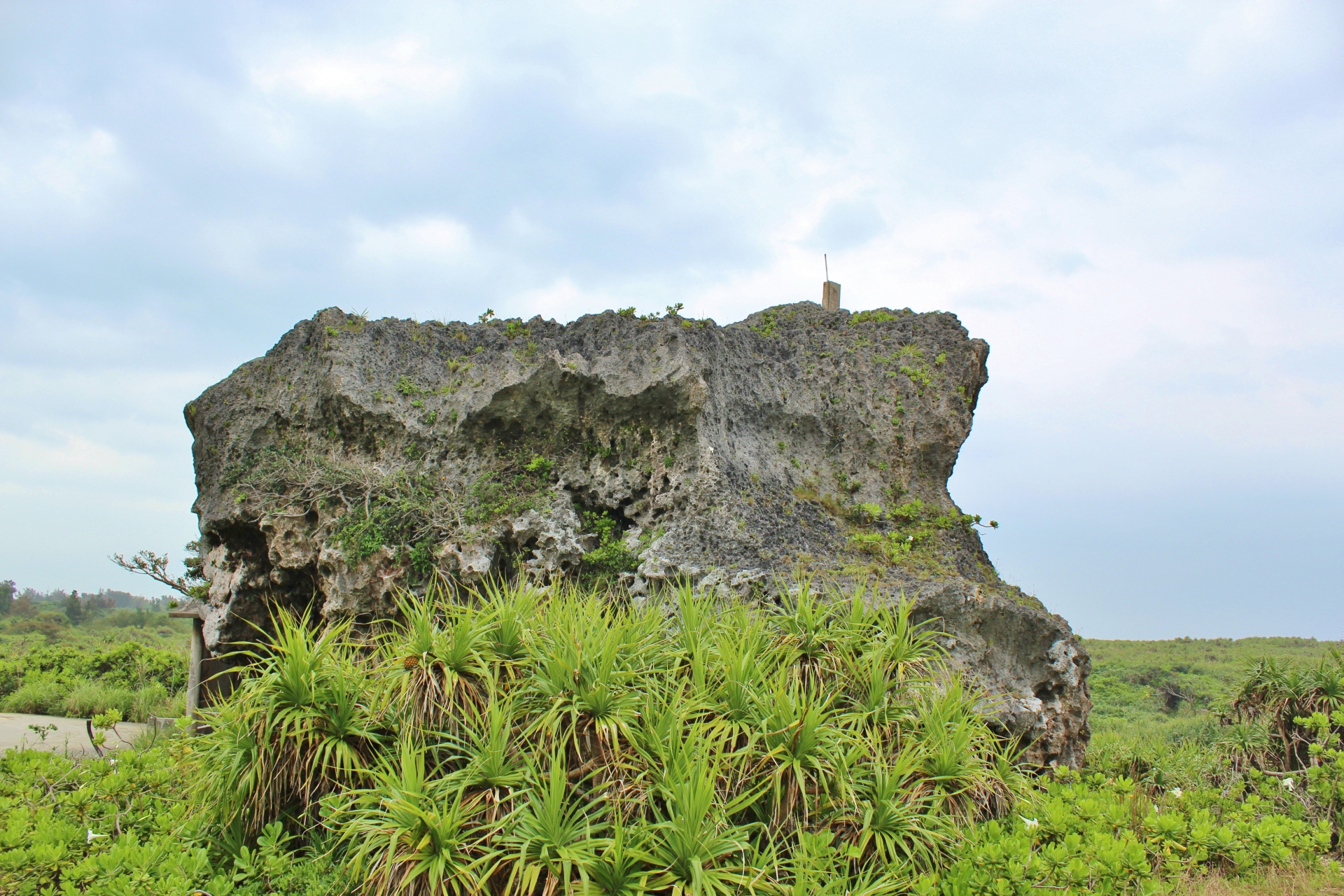
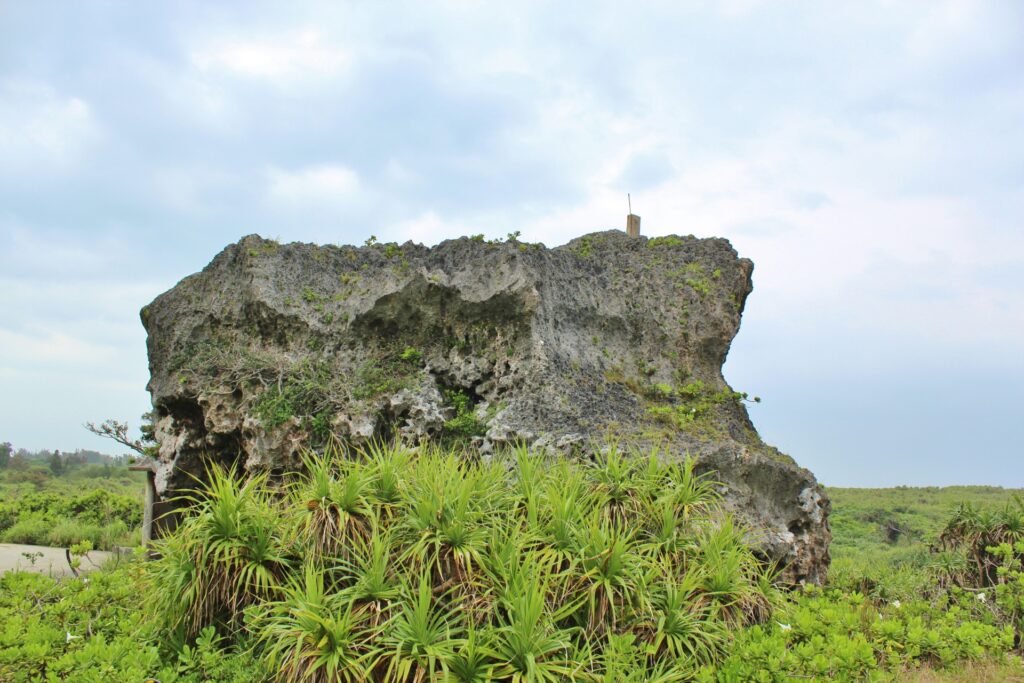
Passing through the torii gate and approaching, the rock towered up, and the sign said 12.5 metres tall, about 60 metres in circumference, estimated weight 20,000 tonnes. Looking up I was overwhelmed and thought, "this was carried by a tsunami?" and couldn't believe it, but that's what the sign says.
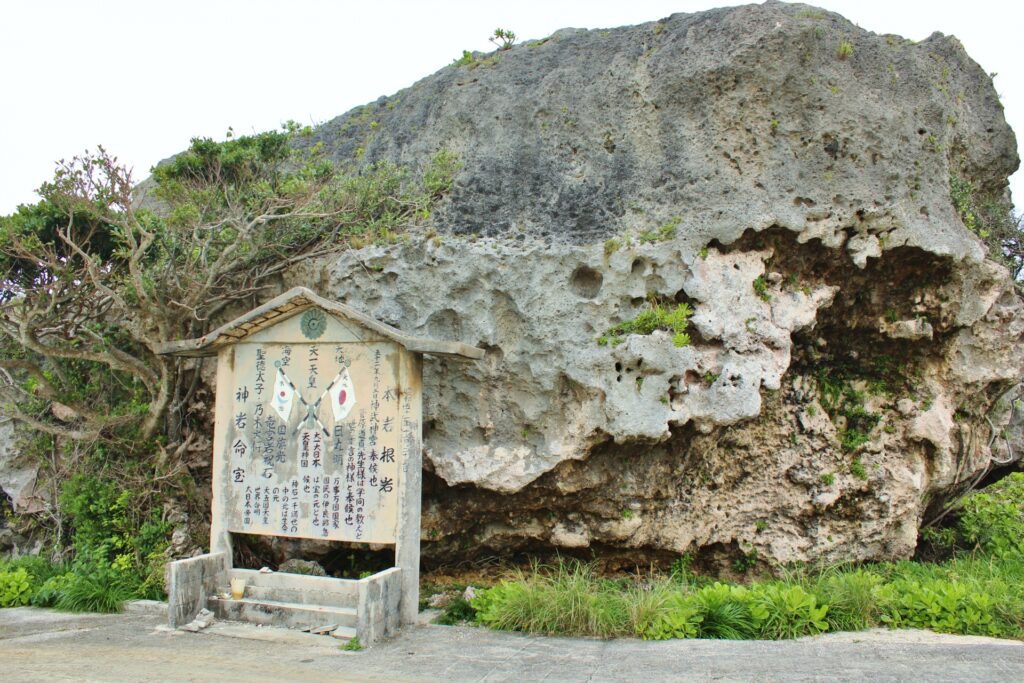
I learned that the middle of the rock is sunken, so it looks like a person wearing an obi (sash), which is why it's called Obiiwa (sash rock). In front of the torii was a mysterious stone monument inscribed "Ten'ichi Tennō," with a Hinomaru drawn on it too. I didn't understand the meaning, but it had a sacred atmosphere, and I felt this was a place of prayer.
In this article I'll introduce Obiiwa's appeal in detail, based on the experience of actually visiting many times. The tsunami history, the origin of the name, how to get there — I'll write it all, so if you're planning to go to Shimojishima, you absolutely should stop by Obiiwa. It's an experience of learning the threat of tsunami, a place where you feel the power of nature.
Obiiwa Is One of Japan's Largest Tsunami Boulders, Carried by the Great Meiwa Tsunami
Obiiwa is a giant boulder on the west coast of Shimojishima. A rock thrown up by a tsunami is called a tsunami stone, and even among those tsunami stones, this is one of the largest. It was designated a historic site of Miyakojima City in 1979, and its official name is "Shimojishima Giant Rock (Obiiwa)."
Lost for Words at the Astonishing Size
Height: about 12.5 metres (41 ft)
Circumference: about 59.9 metres (197 ft)
Weight: estimated 2,500–20,000 tonnes
A height of 12.5 metres is about a 4-storey building, a circumference of 60 metres is about two tennis courts, and a weight of 20,000 tonnes is the unimaginable weight of about 3,000 elephants.
Standing before it in person, it has force beyond the numbers, and you really feel "a rock this big was carried by a tsunami." The first time I saw it too, I was so overwhelmed by the sheer size that I couldn't move for a while.
The Wonder of Being Atop a Cliff
Obiiwa is located about 50 metres from the coast, atop a 12.5-metre cliff. In other words, the tsunami climbed over this cliff to carry this giant boulder here. Just thinking about it is chilling.
The first time I saw it I couldn't believe "wait, the tsunami came this far?", but as a fact this giant rock is before my eyes. Go round the back of Obiiwa and there's a cliff, and when I saw its height I thought, "the tsunami went over this height," and really felt the terror of nature's power.
One of the World's Largest Tsunami Stones
The Great Meiwa Tsunami threw up rocks of various sizes from the seabed, and Obiiwa is one of the largest tsunami stones among them, known as one of the largest in Japan and one of the heaviest tsunami stones in the world.
It's such an amazing rock that, among those reported up to 2010, it was said to be the heaviest in the world. Hearing "one of the world's largest," I felt Obiiwa's incredibleness anew.
Location and Access
Address: 1742 Sawada, Irabu, Miyakojima City, Okinawa
Access: about 10 minutes by car from Miyako Shimojishima Airport, about 800 metres on foot from Toriike Pond
It's about 10 minutes by car from Miyako Shimojishima Airport, and 800 metres on foot from Toriike Pond, about 10–15 minutes walking. It's near Nakanoshima Beach, and there's a sign just past Nakanoshima Beach, so when you find it, turn onto the side road.
The road isn't paved, so it rattles, but an ordinary car can get there without trouble. The car park is large, with space for several cars.
The Tragedy of the Great Meiwa Tsunami Carried Obiiwa
The tsunami that carried Obiiwa is called the Great Meiwa Tsunami, the worst catastrophe in Okinawan history.
The Great 1771 Earthquake and Tsunami
On 24 April 1771 (10 March in the old calendar), the Yaeyama Earthquake occurred with its epicentre near the Sakishima Islands. It was a great earthquake of magnitude 7.4–8.0.
There was almost no damage from the shaking of the earthquake, but the tsunami that struck afterwards was tremendous. In the Yaeyama Islands there are records of a tsunami of over 30 metres, and in the Miyako Islands over 10 metres, with a theory that it reached 40 metres in places.
The Debate Over the Tsunami Height
Recent research includes a calculation that the tsunami run-up height on Shimojishima was 12.3 metres, and there's actually debate over whether Obiiwa was really carried by the Great Meiwa Tsunami. There's also a theory that it was carried by a tsunami before the Great Meiwa Tsunami, and opinions are divided even among researchers.
But either way, there's no doubt an incredibly high tsunami struck, with the power to carry this giant rock.
Nearly 10,000 Victims
The Great Meiwa Tsunami produced nearly 10,000 victims. Historical materials record a death toll of 2,548 across the whole Miyako Islands, and just under 12,000 across all of Sakishima including Yaeyama.
Especially in the villages of Miyaguni, Shinzato, Uruka and Tomori on the south coast of Miyako Island, there are records that 591 houses collapsed and 2,042 people died. In the Kidomari hamlet of Shimojishima, almost all residents drowned, the houses were washed away, and the settlement completely vanished.
When I heard this story, the way I saw Obiiwa changed. It's not just a big rock but a witness conveying a tragedy, I thought.
The Repeated Threat of Tsunami
In 2017, research results were published that tsunami on the same scale as the Great Meiwa Tsunami had occurred 4 times at intervals of about 600 years in the Sakishima Islands. In other words, the Great Meiwa Tsunami wasn't a one-off event — giant tsunami had struck many times in the past.
When I learned this fact, I thought "it might come again," and really felt that the threat of tsunami must not be taken lightly.
The Origin of the Name Obiiwa Is the Figure of a Tied Sash
The origin of the name Obiiwa comes from the shape of the rock.
The Distinctive Sunken Middle
The middle of the rock is sunken, so it looks like a person wearing an obi (sash), which is why it came to be called Obiiwa. This hollow is called a wave-cut notch, a trace eroded by the waves.
This rock was once near the sea surface on the coastal cliff, and the waves carved the middle of the rock over thousands, tens of thousands of years. That's how the hollow formed.
When I saw Obiiwa too, I thought "it really does look like it's wearing an obi," and was convinced by the origin of the name. The hollow is just at the position of a human torso, looking like a tied sash.
Local Names
Locally it's also called "Okosukubijii" (rock wearing a big sash) or "Numamiijii" (rock that guards the horses). These are names in Miyakofutsu, the Miyako language.
The name "Numamiijii" (rock that guards the horses) is interesting too, and perhaps long ago it was recognised as a rock that guards the horses. For the local people, Obiiwa was probably a familiar presence, I think.
The Fate of Other Tsunami Stones
Actually, there were said to be several other giant rocks like Obiiwa, and names like "Ushimiijii" (rock that guards the cattle) remain. But they were all destroyed during the construction of Shimojishima Airport, and the rock masses were apparently used in the construction.
Only Obiiwa was deliberately left, at the request of the town at the time. One of the reasons is said to be to leave "something to pass down." I thought "I'm glad Obiiwa was left." Heritage that conveys this kind of history should absolutely be preserved, I think.
Obiiwa Is an Object of Folk Faith and Is a Place of Worship
Obiiwa isn't merely a tsunami stone but is also an object of folk faith.
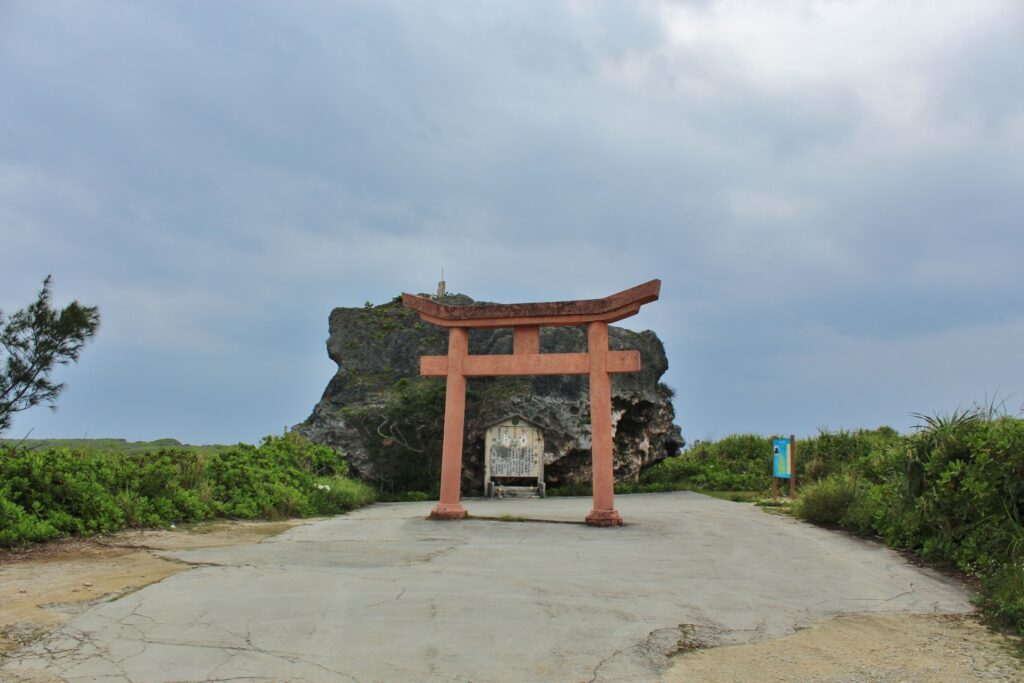
A Place of Worship with a Torii and Stone Monument
A torii gate stands in front of Obiiwa, and prayers came to be offered for a big catch, safe voyages, and family safety. The Sarahama district of Irabu Island had the most thriving fishing on the island in the past, including going on southern fishing expeditions, and with that kind of historical background too, Obiiwa became an object of faith, I think.
Because it's a giant rock that looks like it won't move no matter what, people felt something sacred in this rock and made it a place of prayer. When I passed through the torii too, my back naturally straightened and I felt a sacred feeling.
The Mysterious Stone Monument "Ten'ichi Tennō"
There's a mysterious stone monument in front of the torii inscribed "Ten'ichi Tennō." A Hinomaru is drawn on it too, and I thought "what is this?", but I couldn't find detailed information.
Whether it's related to local faith or has another meaning remains a mystery. But the presence of this monument conveys that Obiiwa isn't merely a tourist spot but a place of faith.
Revered as a Sacred Object
Obiiwa came to be revered as a "goshintai" (sacred object) of folk faith, and it's still a place where local people offer prayers today. When I visited too, I saw someone who seemed to be a local pressing their hands together in prayer, and really felt this is still a place of faith.
When visiting as a tourist too, I think you should visit with respect, not forgetting that this place is a place of faith.
Around Obiiwa Are Toriike Pond and Beaches
There are other sights around Obiiwa, so visiting them together is good.
Toriike Pond Is Within Walking Distance
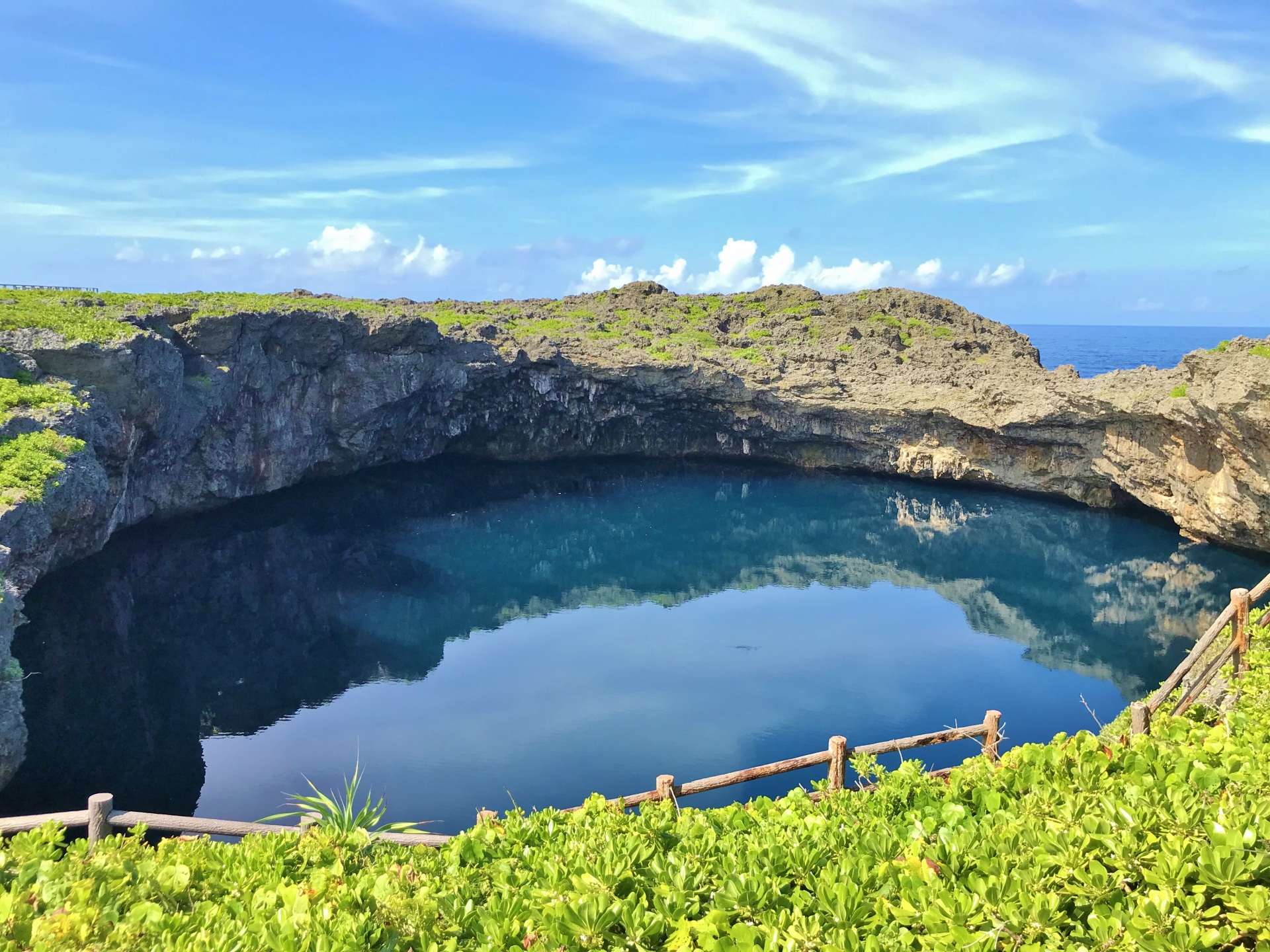
About 800 metres north of Obiiwa is Toriike Pond. Toriike Pond is a representative sight of Shimojishima, called the "Dragon's Eye" that sees through the world, known as a power spot where the world's dragons gather.
It's also a diving spot that overseas divers long for, with a special structure where two circular ponds, large and small, connect to the sea through a cave on the sea side, and the two ponds further connect underground.
It's about 10–15 minutes on foot from Obiiwa to Toriike Pond, so visiting both is recommended. I walked to Toriike Pond after seeing Obiiwa too, and the path was well maintained and easy to walk.
Nakanoshima Beach Is a Spectacle
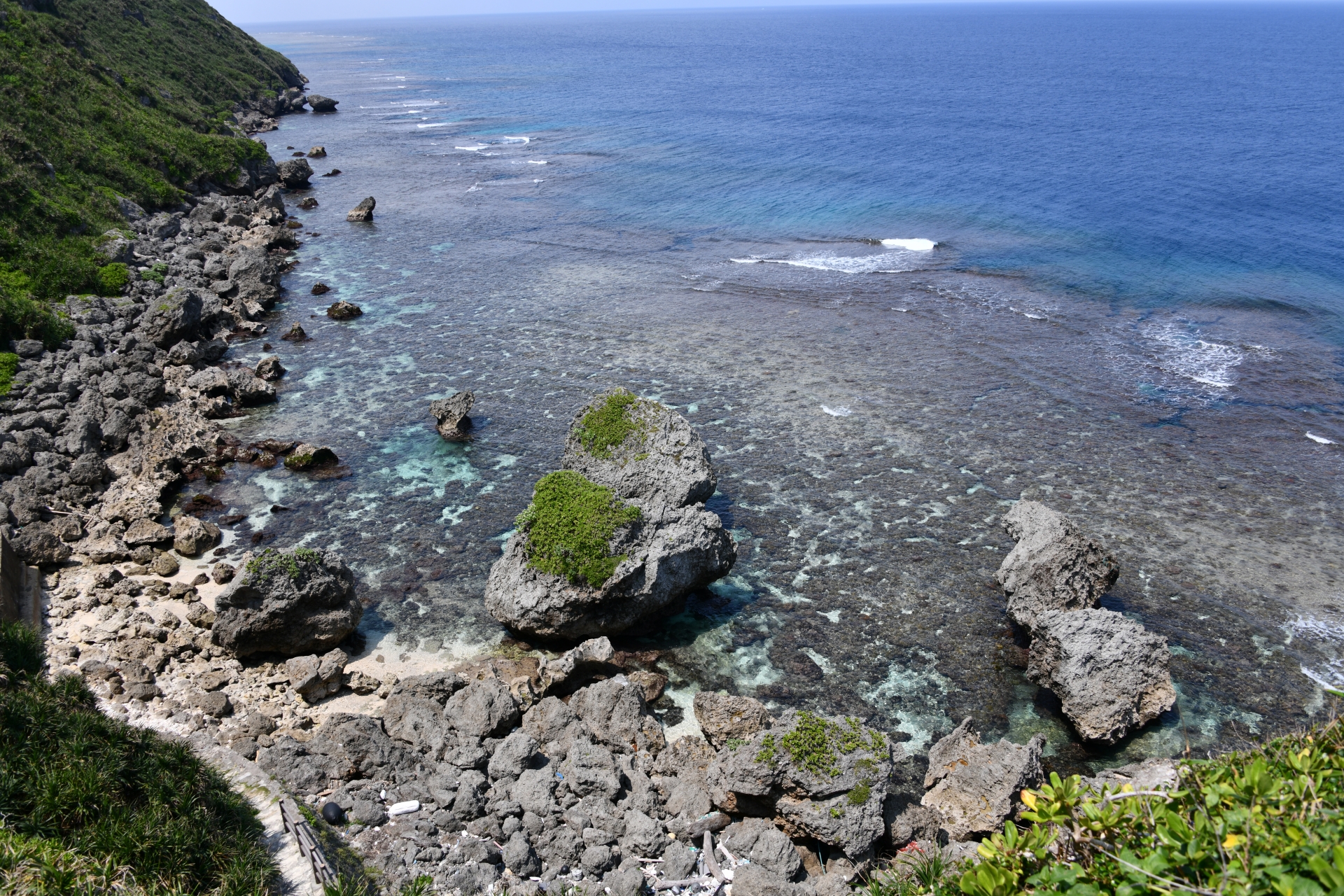
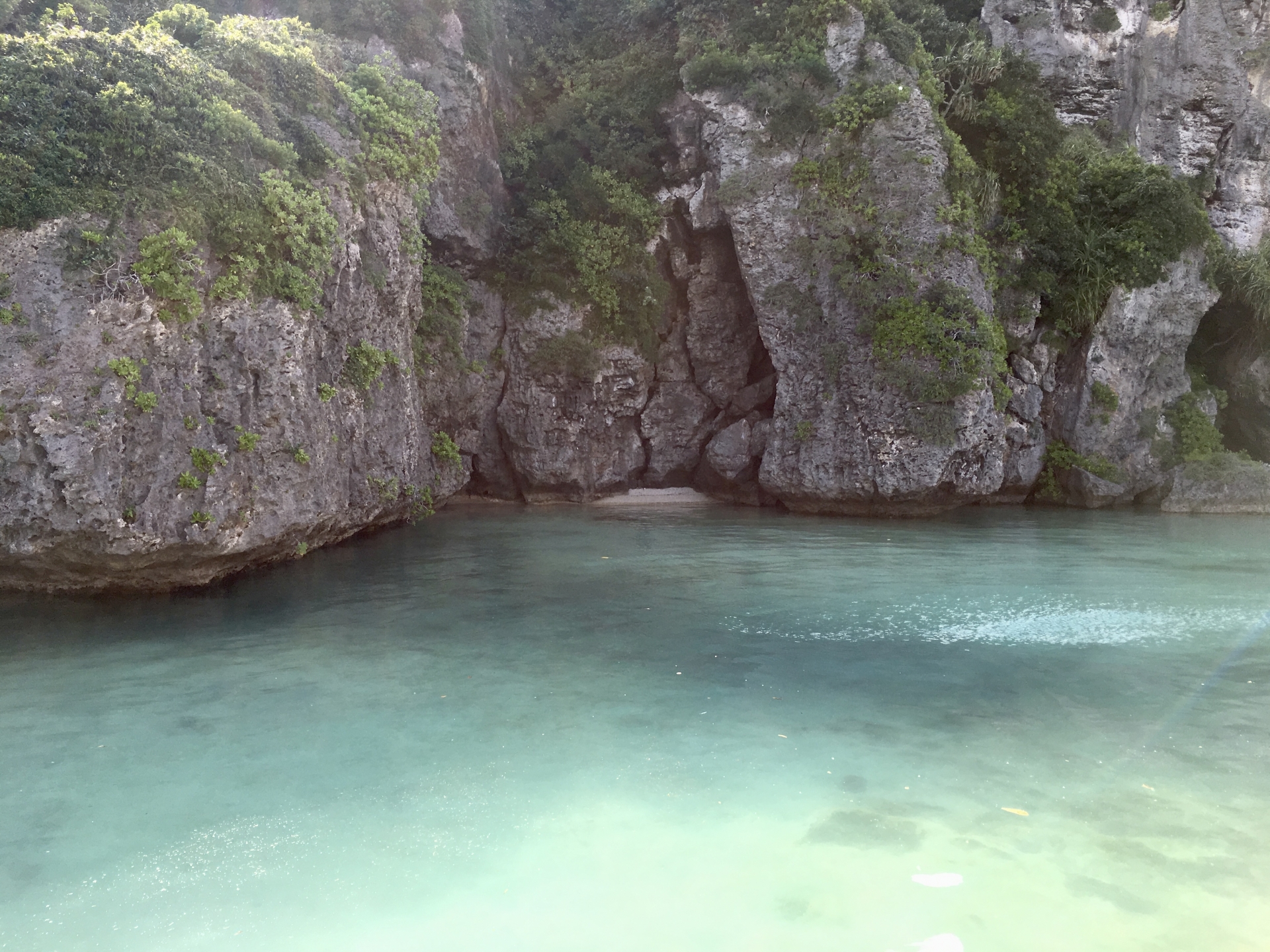
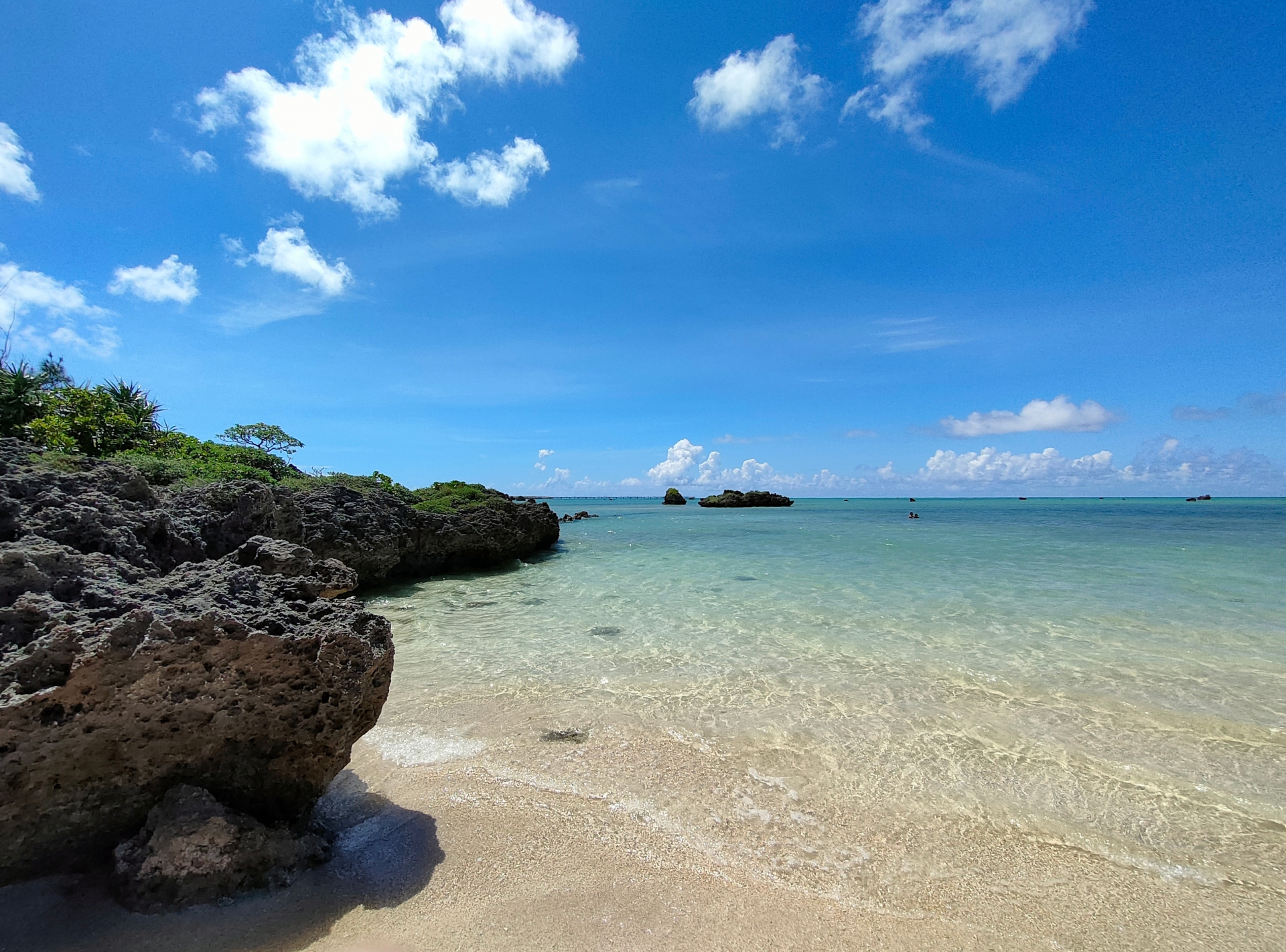
Near Obiiwa is Nakanoshima Beach, a beach beautiful with its highly clear sea and coral reef. It's also famous as a snorkelling spot, where you can see colourful fish and coral.
I dropped by Nakanoshima Beach too, and the sea's clarity was so high you could see the fish swimming. Relaxing at the beach after seeing Obiiwa is nice too.
Sawada-no-Hama Has Tsunami Stones Too
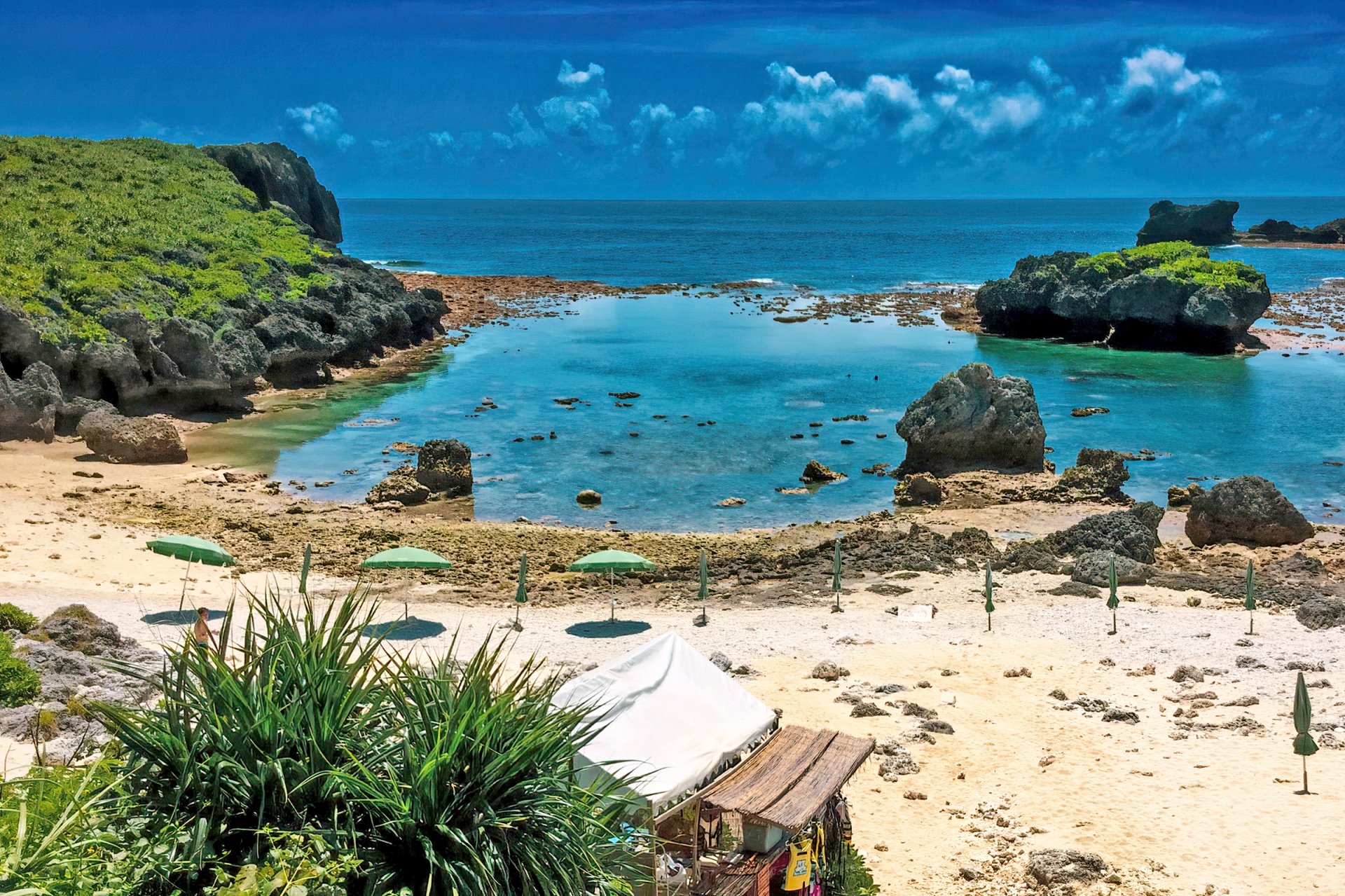
Tsunami stones are dotted across Sawada-no-Hama, stretching from Irabu Island to Shimojishima. It's a beautiful beach chosen among "Japan's 100 Best Beaches," with distinctive scenery of countless giant rocks scattered along the coast.
Some of these giant rocks are said to have been carried by the Great Meiwa Tsunami too, conveying the traces of the tsunami like Obiiwa. It's also known as a place with a beautiful sunset, so visiting in the evening is recommended.
Miyako Shimojishima Airport Is Close
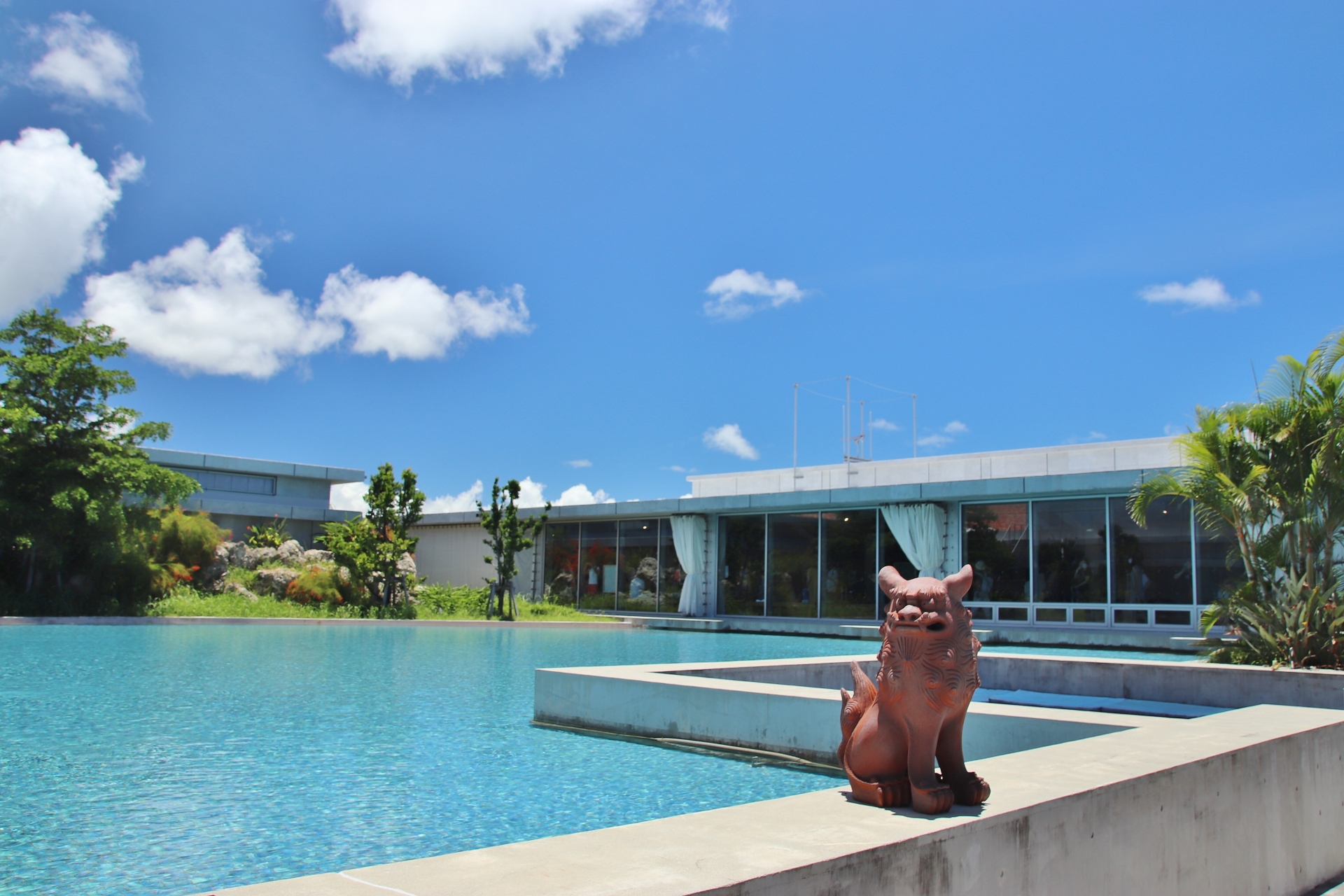
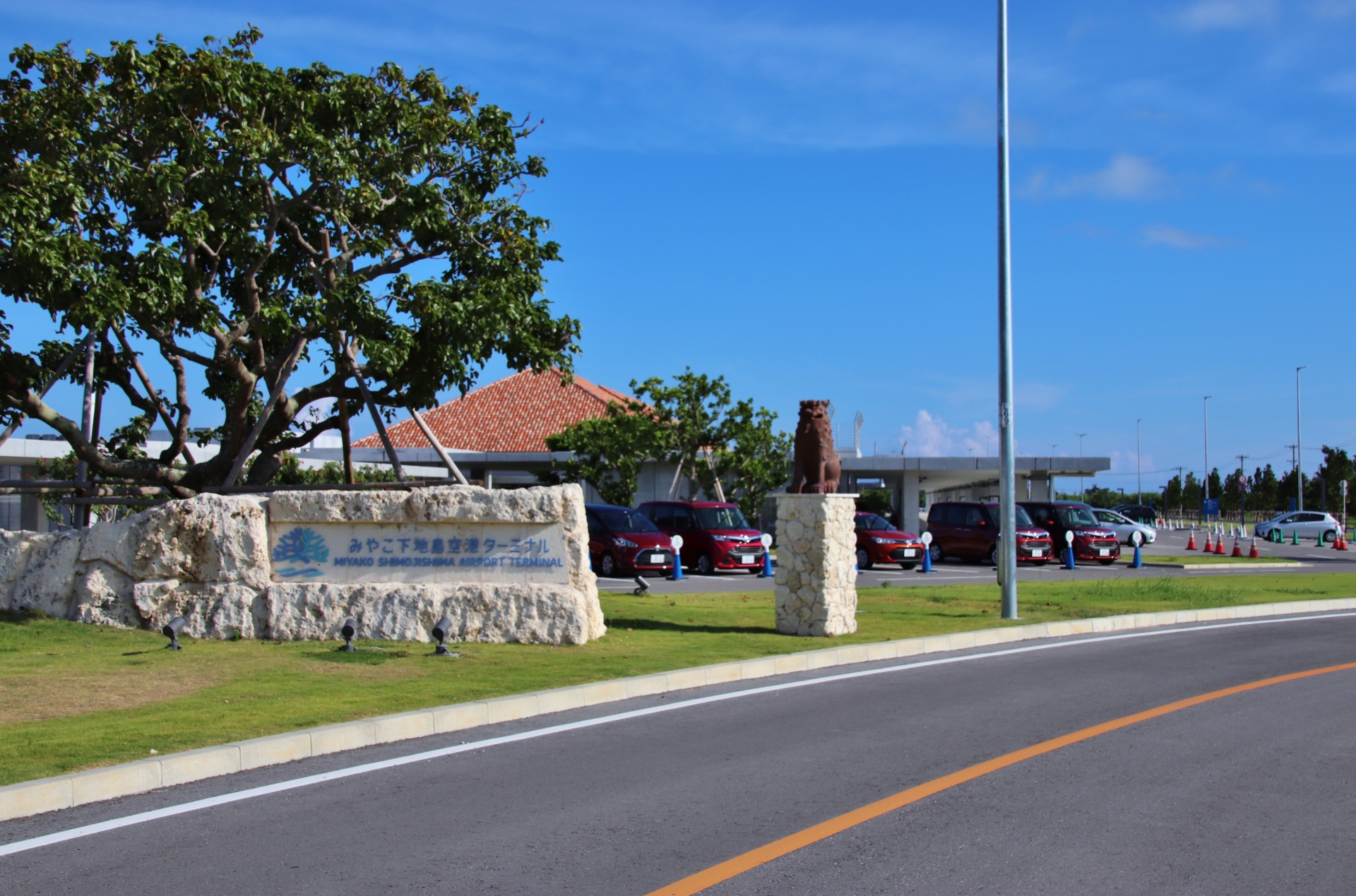
Miyako Shimojishima Airport is located about 10 minutes by car from Obiiwa, a new airport that opened in 2019. Direct flights come from Narita, Kansai, Chubu and elsewhere, making access convenient.
It's close from the airport to Obiiwa, so you can also visit right after arriving on Shimojishima. I've also headed directly from the airport to Obiiwa, and it was convenient, arriving quickly.
Things to Note and Prepare When Going to Obiiwa
Here are some things to note when going to Obiiwa.
The Road Isn't Paved
The road to Obiiwa isn't paved, and it rattles. An ordinary car can get there without trouble, but it shakes, so be careful. It's best to drive slowly, not going too fast.
I grew anxious at first about "is this road OK?", but actually going, it was no problem at all. You reach the car park in 1–2 minutes, so do bear with it and press on.
A Rental Car Is Needed
Going by public transport is difficult, so a rental car is needed. Shimojishima is inconvenient to get around without a car, so rent a car on Miyako Island and cross the Irabu Bridge to go.
The car park is large, with space for several cars, so it's almost never full. I've been many times, but the car park has never once been full.
Don't Miss the Sign
There's a sign at the entrance to Obiiwa, but it's easy to miss, so care is needed. After passing Nakanoshima Beach, there's a sign reading "Obiiwa" on the left, so when you find it, turn onto the side road.
I missed the sign and passed it at first too, and had to turn back. The sign is on the smaller side, so it's best to look carefully while driving.
There's No Toilet
Obiiwa has no toilet, so it's best to use the toilet beforehand. Toriike Pond and Nakanoshima Beach have toilets, so using them before going is recommended.
I didn't know at first and was stuck when I noticed there was no toilet after arriving at Obiiwa. I recommend using one beforehand.
Sun Protection Is Needed
There's almost no shade around Obiiwa, so sun protection is needed. It's best to bring a hat, sunglasses and sunscreen. The sun is especially strong in summer, so don't forget heatstroke countermeasures too.
When I went in summer too, the sun was strong, and my eyes hurt without a hat and sunglasses. Don't forget to stay hydrated.
Have Respect as a Place of Worship
Obiiwa is an object of folk faith and is a place of worship, so visiting with respect is important. Take care not to make a loud fuss or climb on the rock.
When I visit too, I make a point of viewing quietly and being considerate of those around when taking photos. It's an important place for the local people, so keeping good manners as a tourist matters.
The Lesson of Tsunami Learned from Obiiwa
Visiting Obiiwa makes you think about the threat of tsunami.
Really Feeling the Power of the Tsunami
Standing before Obiiwa, you really feel the power of the tsunami. The power of the tsunami that carried a giant boulder 12.5 metres tall, 60 metres in circumference and 20,000 tonnes in weight up onto a cliff 50 metres from the coast is beyond imagination.
After seeing Obiiwa too, I thought "if a tsunami of the same scale came now," and was chilled. I remembered the footage of the Great East Japan Earthquake tsunami and felt the terror of nature's power anew.
The Repeated History of Tsunami
There are research results that in the Sakishima Islands, tsunami on the same scale as the Great Meiwa Tsunami occurred 4 times at intervals of about 600 years. In other words, there's a possibility it will come again.
Miyako Island has a traditional ritual called "Naapai," with several hundred years of tradition, praying for "tsunami protection," a kind of evacuation drill held once a year. I think a message from our forebears is contained within the tradition.
The Importance of Passing It Down
Obiiwa was left during the construction of Shimojishima Airport in order to leave "something to pass down." The other tsunami stones were all destroyed, but only Obiiwa was left.
I think too, "I'm glad Obiiwa was left." With heritage that conveys this kind of history, we can keep from forgetting the threat of tsunami. Obiiwa teaches us the importance of passing things down.
Raising Disaster-Prevention Awareness
By visiting Obiiwa, you can raise your disaster-prevention awareness. Okinawa is near the Nankai Trough, and it's said a great earthquake will come eventually. Even on a southern island, where many who fled the Great East Japan Earthquake may have come, there's no room for complacency.
Since visiting Obiiwa too, my awareness of tsunami changed. I really felt the importance of always being prepared for a disaster that could come at any time.
Frequently Asked Questions and Answers
Here are answers to commonly asked questions about Obiiwa.
Q1: Where is Obiiwa?
On the west coast of Shimojishima. The address is 1742 Sawada, Irabu, Miyakojima City, Okinawa.
Q2: How do you get there?
About 10 minutes by car from Miyako Shimojishima Airport. About 800 metres on foot from Toriike Pond.
Q3: Is there a car park?
Yes. There's a large space with room for several cars.
Q4: How big is Obiiwa?
About 12.5 metres tall, about 59.9 metres in circumference, estimated weight 20,000 tonnes.
Q5: When was it carried?
It's said to have been carried by the Great Meiwa Tsunami (1771), but there are various theories.
Q6: What's the origin of the name?
Because the middle of the rock is sunken, so it looks like a person wearing an obi (sash).
Q7: Is an admission fee needed?
No. You can view it free.
Q8: How long does it take?
About 10–15 minutes. About 20 minutes even taking photos and viewing slowly.
Q9: Is there a toilet?
No. You need to use the toilet beforehand.
Q10: Can you visit it together with Toriike Pond?
You can. It's about 10–15 minutes on foot from Obiiwa to Toriike Pond.
Q11: Can you pray there as a place of worship?
You can. Prayers for a big catch, safe voyages, and family safety are offered.
Q12: What is the Great Meiwa Tsunami?
A tsunami from the Yaeyama Earthquake that occurred in 1771, which produced nearly 10,000 victims.
It Will Keep Remaining as a Giant Boulder Conveying the Memory of the Tsunami
What I felt most strongly visiting Obiiwa many times was that this is a place that must absolutely keep being preserved, as a giant boulder conveying the memory of the tsunami.
A giant rock 12.5 metres tall, 60 metres in circumference and 20,000 tonnes in weight sits enshrined atop a cliff 50 metres from the coast. Witnessing that sight, you can't help but feel the tremendousness of the tsunami's power.
The Great Meiwa Tsunami occurred in 1771, the worst catastrophe in Okinawan history, producing nearly 10,000 victims. A death toll of 2,548 across the whole Miyako Islands, and just under 12,000 across all of Sakishima including Yaeyama. There were places where settlements completely vanished, and the scale of the damage is beyond imagination.
Whether Obiiwa was carried by the Great Meiwa Tsunami or by an earlier tsunami is debated, but either way there's no doubt a giant tsunami struck this land. And there are research results that in the Sakishima Islands, tsunami on the same scale as the Great Meiwa Tsunami occurred 4 times at intervals of about 600 years. In other words, there's a possibility it will come again.
Standing before Obiiwa, you're overwhelmed by its sheer size. You think "to carry up a rock this big," and really feel the power of the tsunami. You remember the footage of the Great East Japan Earthquake tsunami and feel the terror of nature's power anew.
The middle of the rock is sunken, so it looks like a person wearing an obi, which is why it's called Obiiwa. This hollow is a trace eroded by the waves, and this rock was once near the sea surface on the coastal cliff. It was carried over the cliff by a tsunami. It's an unbelievable story, but the rock being before your eyes is the proof.
Obiiwa is also an object of folk faith, with prayers offered for a big catch, safe voyages, and family safety. A torii gate stands, and seeing the local people pressing their hands together in prayer, you really feel this isn't merely a tourist spot but a place of faith.
During the construction of Shimojishima Airport, the other tsunami stones were all destroyed and used in the construction, but only Obiiwa was left at the request of the town at the time. It was probably to leave "something to pass down," I think. Had Obiiwa been destroyed too, the memory of the tsunami might have faded. I want to thank the people who left it.
Miyako Island has a traditional ritual called "Naapai," with several hundred years of tradition, praying for "tsunami protection," a kind of evacuation drill held once a year. This tradition is said to have existed before the Great Meiwa Tsunami, and a message from our forebears is contained within the tradition. The people of Miyako know the importance of passing down the memory of the tsunami, I think.
If you come to Shimojishima, you absolutely should stop by Obiiwa. Pass Nakanoshima Beach, find the sign, and turn onto the side road. The road isn't paved and rattles, but you reach the car park in 1–2 minutes. Get out of the car, pass through the torii, and stand before Obiiwa.
In that moment, you're overwhelmed by the force of the giant rock. Look up and it's so big you can't see the sky. Walk around it and really feel the rock's size. Look at the sunken middle and think "it really does look like it's wearing an obi." Go round the back and look at the cliff and really feel "the tsunami went over this height."
By visiting Obiiwa, you can learn the threat of tsunami. You can really feel the terror of nature's power. And you can raise your disaster-prevention awareness. Obiiwa teaches us the importance of always being prepared for a disaster that could come at any time.
Toriike Pond is close too, so visiting both is recommended. Touch the memory of the tsunami at Obiiwa, and feel the beauty of Shimojishima's nature at Toriike Pond. Enjoy the sea's clarity at Nakanoshima Beach, and watch the sunset at Sawada-no-Hama. Shimojishima has many highlights, but Obiiwa is absolutely not to be missed.
As a giant boulder conveying the memory of the tsunami, Obiiwa will keep remaining from now on too. We need to learn from this rock, not forget the threat of tsunami, and pass it down to the next generation. Obiiwa is a witness conveying a past tragedy, and a warning to the future.
If you come to Shimojishima, be sure to stop by Obiiwa. And stand before this giant rock and touch the memory of the tsunami. Really feel the power of nature, and raise your disaster-prevention awareness. Because Obiiwa is a place that teaches us something important.