- Preparing for the Irabu Bridge Closure and Power Cuts
- The Irabu Bridge Closes with a Storm Warning
- Getting Information When a Typhoon Approaches Is a Lifeline
- Preparing for Power Cuts Is Essential
- How to Spend the Time During a Typhoon
- The Hotel's Typhoon Response
- Points to Note After a Typhoon
- Should You Avoid Travelling in Typhoon Season?
- Frequently Asked Questions and Answers
- A Typhoon on a Remote Island Is Completely Different from the City
Preparing for the Irabu Bridge Closure and Power Cuts
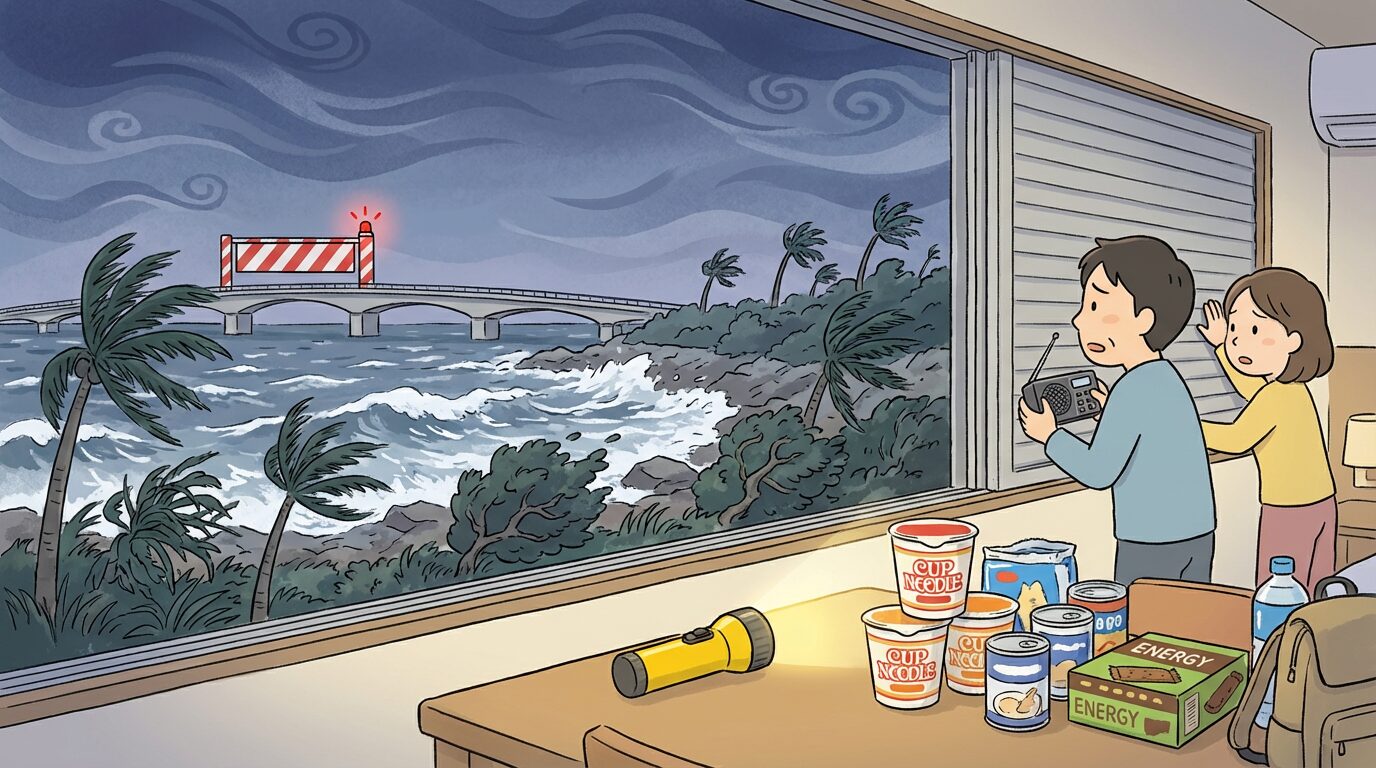
When I first experienced a typhoon on Irabu Island, the hotel front-desk staff explained "there's a possibility the Irabu Bridge will be closed tomorrow," and from the moment I was surprised — "huh, closed?" — I started to feel the gravity of a typhoon on a remote island.
When I heard "if a storm warning is issued the bridge becomes impassable and you can't cross to Miyako Island," I asked "then what do we do?" and was answered "there's nothing for it but to wait on the island until the typhoon passes," and for the first time I understood the situation of the island being completely isolated.
It's completely different from experiencing a typhoon in the city — if the bridge is closed you can't go shopping, you can't go to hospital, you can't board a plane. The reality of having no choice but to ride out the typhoon in a completely isolated state tells the harshness of a typhoon on a remote island.
I'll introduce life on Irabu Island when a typhoon approaches in detail, based on my experience of actually going through typhoons many times. Since I'll write about the Irabu Bridge closure criteria, preparing for power cuts, how to spend the time and the hotel's response, I hope those planning to stay on Irabu Island in typhoon season will use it as a reference.
The Irabu Bridge Closes with a Storm Warning
When a typhoon nears, the Irabu Bridge is closed and you can't go back and forth between Irabu Island and Miyako Island. This bridge closure is the biggest point of typhoon response for both islanders and tourists.
A Wind Speed of 25 m/s Is the Closure Guideline
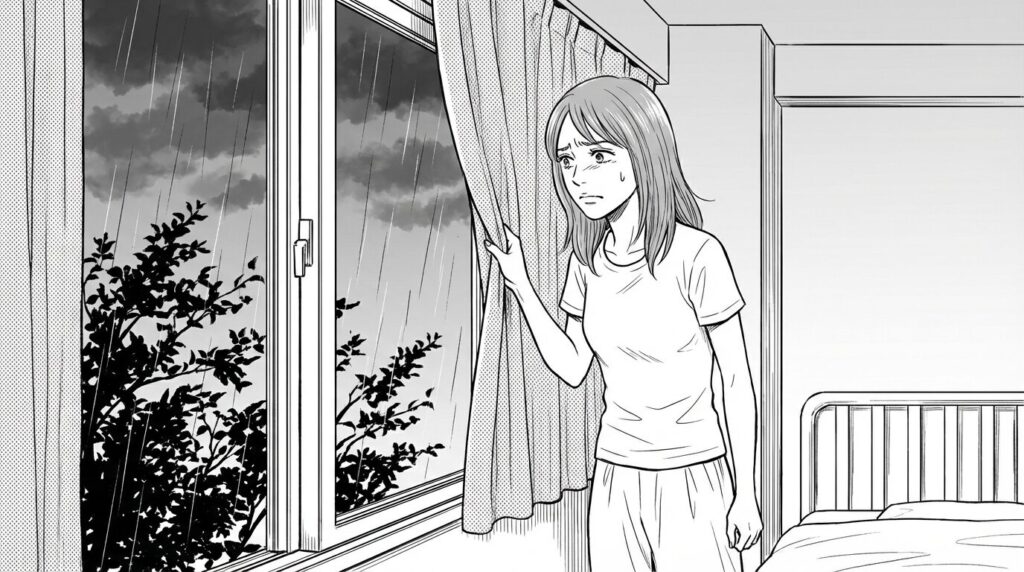
According to Okinawa Prefecture materials, when a storm warning is issued and winds of 25 m/s blow, the Irabu Bridge is closed by traffic regulation. A wind speed of 25 m/s is a fairly strong wind, a level where standing is difficult, a dangerous state where trees snap and signboards fly.
The Irabu Bridge is a 3,540-metre bridge crossing the sea, so driving it in strong wind becomes extremely dangerous. Light, tall vehicles like light vans get buffeted by crosswinds to the point of nearly toppling, so for the bridge's safety it's always closed when a storm warning is issued.
There's Advance Notice About 2 Hours Before
When closing the gates, advance notice is given about 2 hours before, and an announcement like "the Irabu Bridge will be closed at 4 p.m." goes out via the media and the disaster-prevention radio. Two hours is a tight time — people on Irabu Island have to decide whether to cross to Miyako Island or stay on the island, and people on Miyako Island have to judge whether to cross to Irabu Island or stay on Miyako Island.
I once received notice 2 hours before a closure and agonised over what to do. In the end I decided to stay on the island, but there was the anxiety of not knowing whether that judgement was right until the typhoon passed.
The Closure Work Is Done in About 20 Minutes
The closure work is done in about 20 minutes, and staff of the Prefectural Miyako Civil Engineering Office close the Miyako Island side gate and then close the Irabu Island side. Once the work is complete, no one can pass after that, and the island becomes completely isolated.
I've seen the closure work in person, and the way the staff swiftly closed the gates with practised hands had something that made me feel they must have repeated the same work many times before.
Closures Can Reach 77 Hours
During Typhoon No. 6 in 2021, the closures of the Irabu Bridge, Kurima Bridge and Ikema Bridge reached 77 hours. Closed from 9 a.m. on the 21st and lifted on the afternoon of the 24th, it works out that the bridges were impassable for more than 3 days.
77 hours is longer than you'd imagine, and during that time you're in a state of being completely shut in on the island. As a petrol station employee said, "I was off for 3 days," the island's economic activity stops too.
Getting Information When a Typhoon Approaches Is a Lifeline
When a typhoon approaches, getting accurate information is more important than anything, and without information you can't make appropriate judgements.
Check the Latest on the JMA Website
Checking typhoon information frequently on the Japan Meteorological Agency website is basic, and especially on the Miyako Island Local Meteorological Office page you can get detailed information such as the typhoon's track, expected maximum wind speed and rainfall.

When a typhoon was approaching, I too checked this site about once an hour, following the typhoon's track and changes in its strength. A slight change in the predicted track can greatly change the impact on Irabu Island, so checking the latest information is essential.
Miyakojima City's Disaster-Prevention Email Service
If you register in advance for Miyakojima City's disaster-prevention email service, things like storm-warning issuance, Irabu Bridge closure information and evacuation orders arrive in real time by email. This is incredibly convenient — important information comes in as a push notification without you having to go get it yourself.
Even when visiting on a trip, registering just for the duration of your stay is reassuring. Registration is easy, so I recommend registering as soon as you arrive on Irabu Island.
Disaster-Prevention Radio and TV/Radio
Each village on Irabu Island has disaster-prevention radio speakers, and information like "a storm warning has been issued. The Irabu Bridge will be closed at 4 p.m." goes out. It's audible even inside a hotel or guesthouse, so information comes in even without going out.
Typhoon information goes out on TV and radio too, so it's important to have multiple information sources. Keep TV and radio usable too, in case the internet becomes unavailable.
Preparing for Power Cuts Is Essential
During a typhoon there's a high chance of a power cut, so advance preparation is important.
Torch and Mobile Battery
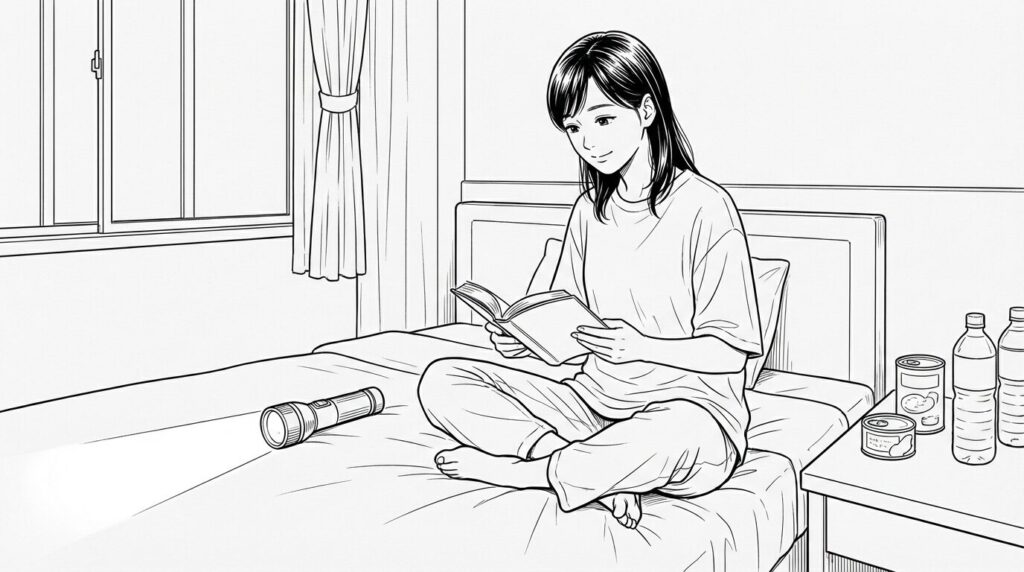
To prepare for a power cut, a torch and a mobile battery are essential items, and hotels often provide them, but it's reassuring to have your own too. A phone light works, but it drains the battery, so it's better to have a dedicated torch.
Charge the mobile battery fully and charge the phone fully too. If the power cut drags on you won't be able to charge, so it's important to always charge up before the typhoon approaches.
Securing Drinking Water and Food
A power cut can stop the water supply too, so secure drinking water in plastic bottles. It's best to buy while you can at FamilyMart Miyako Irabu. Just before a typhoon stock can run low, so acting early is important.
Food is the same — prepare things you can eat without cooking, like cup noodles, bread and snacks. If you're staying at a hotel meals are provided, but having your own food just in case is reassuring.
Fill the Bathtub with Water
Since a power cut can cut off the water, filling the bathtub with water lets you use it to flush the toilet or wash your hands. It can't be used as drinking water, but it's useful as household water.
I always made sure to fill the bathtub with water before a typhoon, and it saved me when the water was actually cut off.
Prepare Cash
A power cut makes ATMs unusable and credit-card terminals stop working too, so preparing cash is important. Withdraw cash at the ATM before the typhoon comes and keep it in your wallet.
Even though cashless payment has spread, during a power cut only cash works, so you'll want to prepare at least about ¥10,000 (about US$67).
How to Spend the Time During a Typhoon
When a typhoon is approaching you can't go out, so you need to spend the time safely inside a hotel or guesthouse.
Stay Away from Windows
Since the typhoon wind can break window glass, it's important to stay away from windows. Especially during the time band when the wind is strongest, it's best to take refuge in a place without windows, like the centre of the room or the bathroom.
I once got scared hearing the window glass shake violently and took refuge in the bathroom. In reality the window didn't break, but considering the worst case, being in a safe place is important.
Absolutely Don't Go Out
Going out in the middle of a typhoon is something to absolutely avoid — being hit by flying objects, being buffeted and falling, it's full of danger. I understand the feeling of "just to the convenience store," but it's life-threatening, so absolutely don't go out.
The wind can temporarily weaken when you enter the eye of the typhoon, but strong wind blows again afterwards, so don't let your guard down. Until the typhoon has completely passed, waiting indoors is the iron rule.
Pass the Time with Reading and Films
When there's no power cut, pass the time watching films or reading on your phone or tablet. If you download content in advance, you can enjoy it even without an internet connection.
I download books on Kindle and films on Netflix to watch during the typhoon. Precisely because there's time, you can enjoy long films you don't usually watch or books you couldn't read.
If the Power Goes Out, Cards or Board Games
If the power goes out and your phone or tablet becomes unusable, passing the time with cards or board games is good. Some hotels lend them out, and bringing your own is recommended too.
If travelling solo, writing a diary, mulling things over, or making it time for reflection you can't usually do is good too. Precisely because of the extraordinary situation of a typhoon, you can have time to face yourself.
The Hotel's Typhoon Response
If you're staying at a hotel, the hotel side handles typhoon response too, so basically you'll be fine if you follow their instructions.
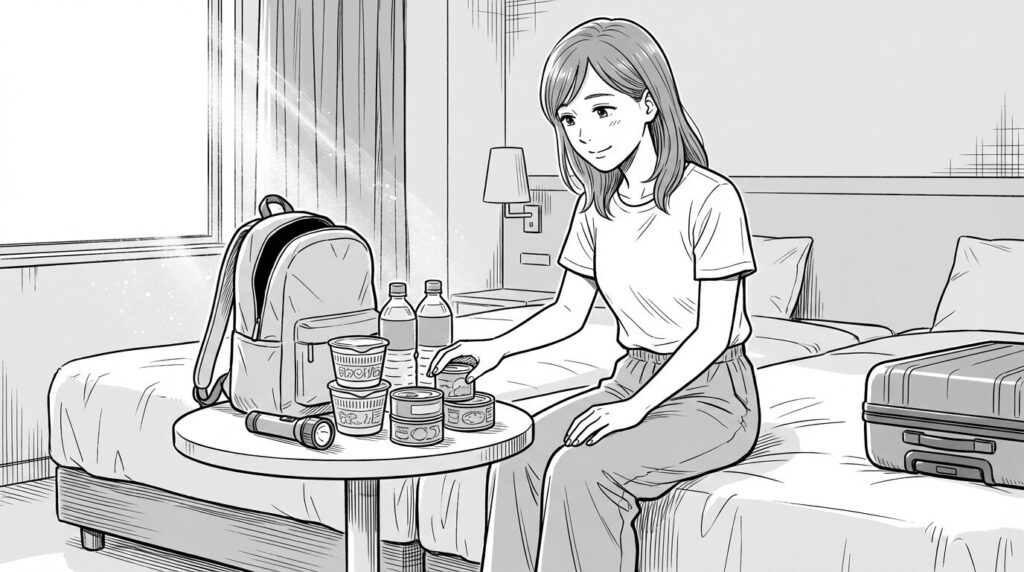
Food and Water Stockpiles
Many hotels stockpile food and water in preparation for typhoons, and even if a power cut makes cooking impossible, they provide simple meals like onigiri and bread. Checking with the hotel staff is reassuring.
At the hotel I stayed at, there was an explanation the day before the typhoon that "tomorrow's meals may be simple meals," and onigiri and bread were actually handed out. The taste is inferior to a normal meal, but in an emergency it's plenty welcome.
Lending of Torches and Mobile Batteries
Some hotels lend out torches and mobile batteries. If you don't have your own, it's good to ask at the front desk.
Sharing Typhoon Information
Hotel staff often share the latest typhoon information too, regularly telling you things like "the typhoon is currently at such-and-such position and is expected to come closest around such-and-such time." When getting information yourself is hard, you can rely on the staff's information.
Safety Instructions
When the wind gets strong, instructions like "stay away from the windows" or "stay in the central part of the building as much as possible" may be given. Hotel staff are used to typhoon response, so following their instructions is the safest.
Points to Note After a Typhoon
Even after a typhoon passes, there are a few points to be careful about.
Don't Go Out Right Away
Even after a typhoon passes, it's best not to go out right away. Even if the wind weakens, fallen trees and scattered debris can be strewn on the roads, and power lines can be hanging down. Dangerous conditions continue, so it's important to wait until safety is confirmed.
Wait for the Bridge Closure to Be Lifted
The Irabu Bridge closure is lifted after the storm warning is lifted and Prefectural Miyako Civil Engineering Office staff have confirmed safety. Even if you rush to the bridge in haste, it may still be closed, so it's important to wait for official notice of the lifting.
During Typhoon No. 6 in 2021, the closure was lifted on the afternoon after the storm warning was lifted, and you could see cars that had waited and waited crossing the bridge one after another. It was the first lifting in 77 hours, so everyone had a look of relief.
Checking the Damage Situation
Check whether there's damage to your car or around your lodging. Debris can scratch the car or break the window glass. If there's damage, contact the hotel staff or your insurance company.
Check Flight Operation Status
Flight cancellations can continue after a typhoon, so you need to check the operation status of your return flight. If it's cancelled, you have to judge whether to arrange a replacement flight or extend your stay.
Should You Avoid Travelling in Typhoon Season?
Whether you should visit Irabu Island in typhoon season (mainly July to October) is a judgement that varies by person.
Pros and Cons
The pros of typhoon season are that travel costs are cheap and there are few tourists. You can book hotels and flights relatively cheaply, and the beaches are empty too.
The con is the risk of encountering a typhoon — the bridge may be closed and you're shut in on the island, or your flight may be cancelled and you can't get home. A long-awaited trip can be ruined by a typhoon.
A Flexible Schedule Is Needed
If travelling in typhoon season, a flexible schedule is needed, and it's important to have leeway so you can change plans if a typhoon comes. If for work reasons you absolutely have to be home by a certain day, it's safer to avoid typhoon season.
I once had a flight cancelled by a typhoon and got home 2 days later than planned. It affected my work and was tough, so since then I avoid travelling in typhoon season before important commitments.
Consider Typhoon Insurance
It's good to check whether your travel insurance covers cancellations and no-shows due to typhoons. If you have insurance, even if a typhoon throws off your plans, the financial loss can be kept to a minimum.
Frequently Asked Questions and Answers
Let me sum up and answer questions often asked about life on Irabu Island when a typhoon approaches.
Q1: At what wind speed is the Irabu Bridge closed?
25 m/s is the guideline, and it's closed when a storm warning is issued.
Q2: When is closure notice given?
There's advance notice about 2 hours before. It's announced via the media and disaster-prevention radio.
Q3: If the bridge is closed, how long is it impassable?
It depends on the typhoon's scale. As short as a few hours, as long as 77 hours (more than 3 days).
Q4: What's the chance of a power cut?
High. During a typhoon it's best to prepare assuming a power cut is nearly certain.
Q5: What do I need to prepare for a power cut?
A torch, mobile battery, drinking water, food and cash are essential.
Q6: Do hotels handle typhoon response?
Many hotels handle typhoon response, with food and water stockpiles, lending of torches and so on.
Q7: Can I go out during a typhoon?
Absolutely not. It's life-threatening, so stay indoors until the typhoon has completely passed.
Q8: Where do I get typhoon information?
The JMA website, Miyakojima City's disaster-prevention email, disaster-prevention radio, TV and radio.
Q9: Should I avoid travelling in typhoon season?
If you can take a flexible schedule there's no problem, but if you absolutely have to be home on a certain day, it's safer to avoid it.
Q10: What do I do if my flight is cancelled?
Arrange a replacement flight or extend your stay. Contact the airline to confirm the response.
Q11: When will I know the bridge closure is lifted?
After the storm warning is lifted and the Prefectural Miyako Civil Engineering Office finishes confirming safety. Information goes out via disaster-prevention email and TV.
Q12: Should I take out typhoon insurance?
If travelling in typhoon season, taking out insurance covering cancellations and no-shows due to typhoons is reassuring.
A Typhoon on a Remote Island Is Completely Different from the City
What I felt most strongly from experiencing a typhoon on Irabu Island is that a typhoon on a remote island is completely different from the city — in the city even when a typhoon comes, trains and buses run, convenience stores and supermarkets are open, and you can respond right away if anything happens.
But on a remote island, if the bridge is closed you're completely isolated — you can't go shopping, you can't go to hospital, you can't call for help. You're placed in a situation where you have to manage on your own. This sense of isolation can't be understood without actually experiencing it.
Irabu Island when a typhoon is approaching is completely different from the usual leisurely atmosphere, with the whole island wrapped in tension. The locals are used to it so they respond calmly, but for tourists it's an anxious time.
But that's exactly why advance preparation becomes important. Prepare a torch, mobile battery, drinking water, food and cash, check typhoon information frequently, and follow the hotel staff's instructions. If you do the basics firmly, you can ride out the typhoon safely.
If you're planning to stay on Irabu Island in typhoon season, please keep the contents of this article in mind. The Irabu Bridge closure criteria, preparing for power cuts, how to spend the time during a typhoon, the hotel's response. Whether you know these greatly changes how you handle a typhoon.
A typhoon is a natural disaster so you can't avoid it completely, but with thorough preparation you can keep damage to a minimum. What matters above all is protecting your life, and absolutely don't take reckless action. Waiting in a safe place until the typhoon passes is the wisest choice.
It's a shame to encounter a typhoon when you visited to enjoy Irabu Island's beautiful sea and nature, but think of that too as one experience of remote-island travel, and please get through it with safety first. Once the typhoon passes, the beautiful Miyako-blue sea returns again. Until then, it's important to prepare thoroughly and wait.