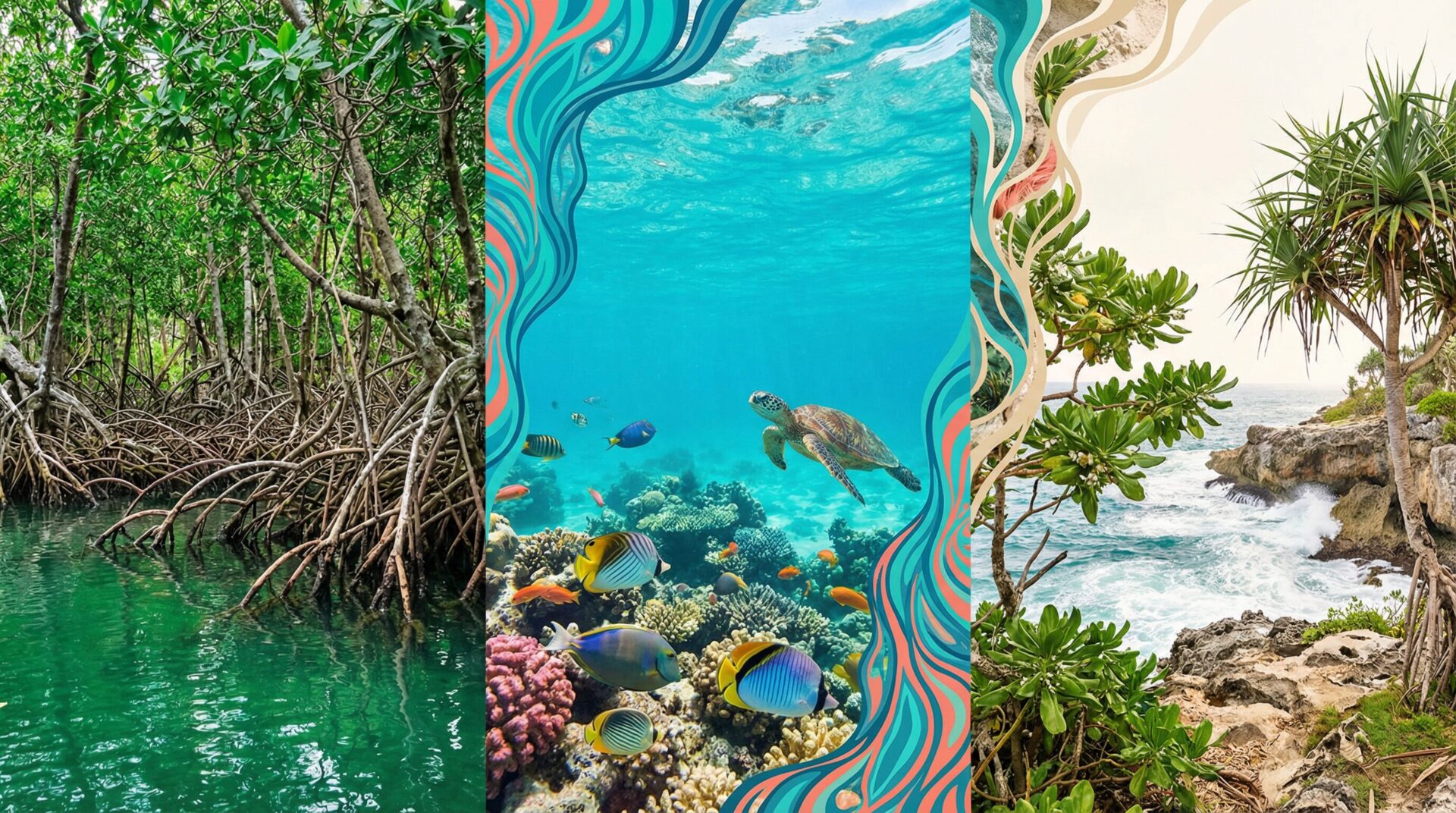
The first time I passed by the Kuninaka inlet, I was surprised by the view looking down from atop the bridge. An emerald-green channel densely grown with green mangroves. "Huh, there's a place like this?" My image of Okinawa's mangroves was that they were at river mouths, but this is a channel between two islands. And yet a splendid mangrove forest spreads out.
And when I snorkelled at Nakanoshima Beach, I was overwhelmed by the world inside the sea. Colourful coral reef, the tropical fish swimming around it, and a sea turtle that suddenly appeared. "There are this many creatures," I nearly cried out underwater (through my mask, though).
Irabu Island and Shimojishima have a distinctive ecosystem. Mangrove tidal flats, coastal plants, coral reefs, tropical fish, and a brackish zone where fresh water and seawater mix. These combine exquisitely to create a rich natural environment.
This time, I'll explain the ecosystem and plants of Irabu Island and Shimojishima in detail. "What creatures are on the island?" "Where do I go to observe them?" I'll answer all those questions.
- The Kuninaka Inlet Mangrove Tidal Flat | A Rare Non-River-Mouth Mangrove Even Within the Prefecture
- A Mangrove Specialty Species | The Limited Habitat of the Mangrove Whelk
- Coastal Plants | The Tough Plants Living on Uplifted-Coral-Reef Islands
- Coral Reefs and Tropical Fish | A Paradise Inside the Sea
- Water and Creatures Overflowing from the Freshwater Lens | The Distinctive Environment of the Brackish Zone
- To Protect the Ecosystem of Irabu Island and Shimojishima
The Kuninaka Inlet Mangrove Tidal Flat | A Rare Non-River-Mouth Mangrove Even Within the Prefecture
Between Irabu Island and Shimojishima there's a channel called the "Kuninaka inlet."
It's a long, narrow channel 50–100 metres wide and about 3 kilometres long, with a peculiar terrain of many small bays. And this inlet has a non-river-mouth mangrove tidal flat that's rare even within the prefecture.
A "Non-River-Mouth" Mangrove, Rare in Okinawa
Normally, mangroves grow at river mouths.
They're plants adapted to the brackish zone where fresh water and seawater mix, and famous mangrove forests like Kesaji Bay on Okinawa's main island and the Nakama River on Iriomote Island are all at river mouths. But the Kuninaka inlet of Irabu Island and Shimojishima has no river. Even though it's a channel between two islands, mangroves grow.
This is an incredibly rare thing.
The Kuninaka inlet mangrove tidal flat exists because groundwater overflowing from the freshwater lens mixes with seawater to form a brackish zone. It's a mysterious place where mangroves grow despite there being no river.
When I first looked down at the mangroves from "Nakayone Bridge," I wondered "mangroves in a place like this?" But learning the mechanism of the freshwater lens, I was convinced. Groundwater springs out, mixes with seawater, and a brackish zone forms. So mangroves grow. The mechanism of nature really is profound.
Four Kinds of Mangrove Growing Up to 4 Metres High
The Kuninaka inlet mangrove tidal flat grows four kinds of mangrove tree.
- Yaeyama mangrove
- Oriental mangrove
- Kandelia (Mehirugi)
- Grey mangrove (Hirugidamashi)
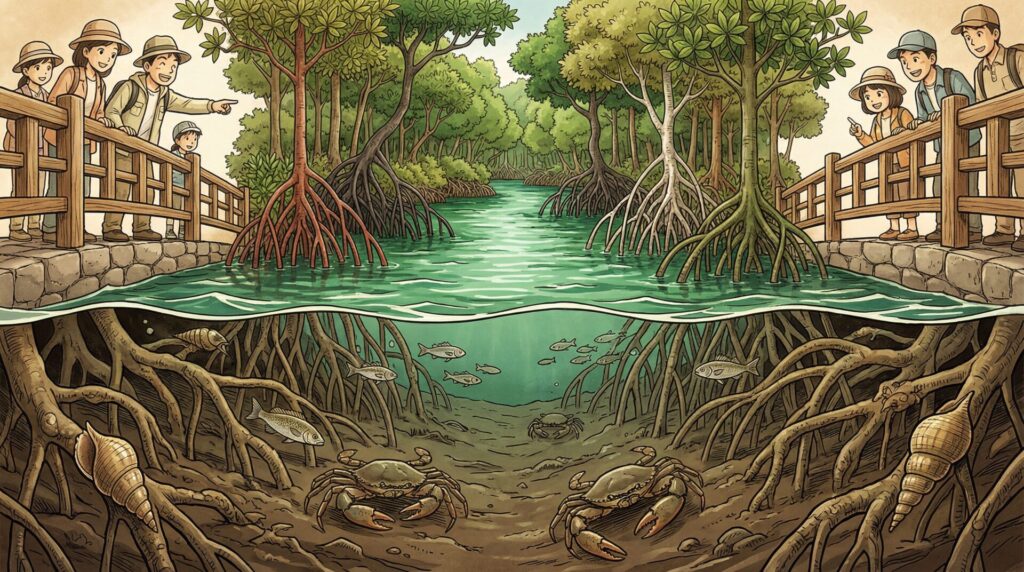
These mangroves grow up to about 4 metres high. Looking down from atop the bridge, the mangrove leaves spread right at eye level, and in some places it becomes like a green tunnel.
The Yaeyama mangrove has distinctive roots called "buttress roots" that spread out like boards. The Oriental mangrove and Kandelia put out winding "knee roots" from the ground. These roots, while anchoring in the tidal-flat mud, also play the role of breathing roots for taking in air.
When I first observed the mangrove roots carefully, I was moved — "what a complex shape." To breathe even in the mud, they became such a complex root shape. The evolution of creatures is amazing, isn't it.
The Three Bridges Where Mangroves Concentrate
The Kuninaka inlet's mangroves concentrate especially around the following three bridges.
- Nakayone Bridge
- Taiko Bridge
- Kuninaka Bridge
From these bridges, you can look down at the mangrove tidal flat. Nakayone Bridge and Taiko Bridge in particular are recommended spots for mangrove observation. Looking down from atop the bridge, the contrast of the emerald-green water and the mangroves' green is beautiful and photogenic.
At low tide the mud flat appears and the mangrove roots are exposed. At this time you can observe creatures like crabs and gobies active. When I first visited at low tide, I was surprised — "ah, there are loads of crabs!" Small crabs scuttle around the mangrove roots. I realised a tidal flat is a treasure trove of creatures.
Used as a Mud-Crab Fishing Ground Too
The Kuninaka inlet mangrove tidal flat is a sightseeing spot and, at the same time, an important fishing ground for the locals.
It's used especially as a fishing ground for the mud crab (mangrove crab). The mud crab is a large crab living in mangrove areas, called "Aman" in Okinawa and eaten. Because the edge of its shell is jagged like a saw, it's called nokogirigazami (saw crab) in Japanese.
At eateries in Sarahama and Irabu, dishes using mud crab are occasionally served. Crab soup and steamed crab — incredibly delicious. When I first ate it, I thought "is this a crab caught in the Kuninaka inlet?" A sightseeing spot, and a fishing ground. It's a place where the locals' lives and tourism coexist.
A Mangrove Specialty Species | The Limited Habitat of the Mangrove Whelk
The Kuninaka inlet mangrove area is home to a very interesting creature.
It's a large sea snail called the mangrove whelk (Terebralia palustris).
A Limited Habitat Even in Okinawa
The mangrove whelk is a large sea snail living in mangrove areas, with limited habitats even within Okinawa Prefecture. The mangrove area of Irabu Island's Kuninaka inlet channel is one of its precious habitats.
According to surveys, many individuals have been confirmed near the base of the Yaeyama mangrove. Around mangrove roots is a home for various creatures. The mangrove whelk is one of them.
What's interesting is that it's been pointed out the mangrove whelk may have settled accompanying artificially planted mangroves. In other words, part of the Kuninaka inlet's mangroves were planted by human hands, and the mangrove whelk may have come in along with them.
Nature and human activity mix to form the present ecosystem. That's the Kuninaka inlet's mangroves.
When I first heard this story, I thought "nature conservation isn't simple." It's not that mangroves planted by humans have no value. Precious creatures settle there, and an ecosystem forms. The relationship between nature and humans is really complex and interesting.
Coastal Plants | The Tough Plants Living on Uplifted-Coral-Reef Islands
Walking the coastline of Irabu Island and Shimojishima, distinctive plants come into view.
Uplifted-coral-reef islands have thin soil and are exposed to strong sea wind and intense sunlight. It's a harsh environment for ordinary plants, but the plants living here are tough plants adapted to that harsh environment.
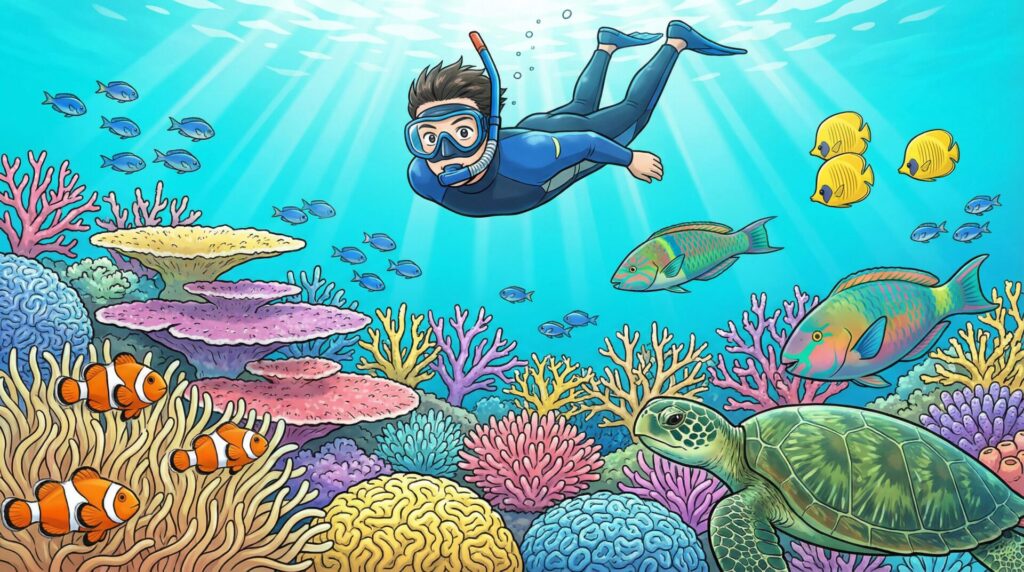
Uplifted-Coral-Reef Plants Around Toriike Pond
Shimojishima has ponds of limestone-cave origin dotted about, beginning with "Toriike Pond," designated a prefectural natural monument.
Around these ponds, on the sea cliffs and rocky shores, uplifted-coral-reef plants like beach naupaka and screw pine (Pandanus) flourish.
Beach naupaka is a shrub with glossy, thick leaves. It's a plant often seen along the coast, strong against salt damage and enduring strong wind. The leaves are shiny to prevent moisture evaporation. It's an adaptation for surviving in a harsh environment.
The screw pine (Adan) is an even more distinctive plant. It bears fruit like a pineapple, and aerial roots (roots extending into the air) come out from the trunk. When I first saw a screw pine, I was surprised — "what is this strange-shaped tree!" Like an alien plant out of a sci-fi film.
The screw pine plays an important role as a windbreak too. With screw pines growing along the coast, they protect inland plants and farmland from typhoon winds. The people of old knew the windbreak effect of the screw pine and sometimes planted it deliberately. As mentioned in the history of Shimojishima too, there's a record that in 1767 the planting of screw pines was instructed so horses could shelter from wind and rain.
When I visited Toriike Pond, seeing beach naupaka and screw pines growing around it, I thought "these plants must be incredibly tough." In the sea wind and strong sunlight, they grow their leaves this lushly green. You feel the strength of the plants living on an uplifted-coral-reef island.
The Plant Communities Spreading on Sea Cliffs and Rocky Shores
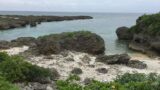
Shimojishima's coastline has many sea cliffs (cliffs formed by wave erosion) and rocky (boulder-strewn) shores.
Places like this have almost no soil. The coral-limestone bedrock is exposed, and the places where sand or soil accumulates are limited. But plants grow even in such places. They root in the gaps of the rock, living on scant soil and moisture.
Driving along the coast, there are many moments you're surprised — "plants in a place like this?" Green plants growing in a boulder-strewn place. You're moved by the strength of their life force.
The coastal plants of Irabu Island and Shimojishima don't just grow there — they play an important role supporting the island's ecosystem. They make soil, provide a home for other creatures, and prevent coastline erosion. Each small plant protects the island's nature.
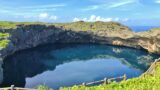
Coral Reefs and Tropical Fish | A Paradise Inside the Sea
The appeal of the sea of Irabu Island and Shimojishima is, above all, the coral reefs and tropical fish.
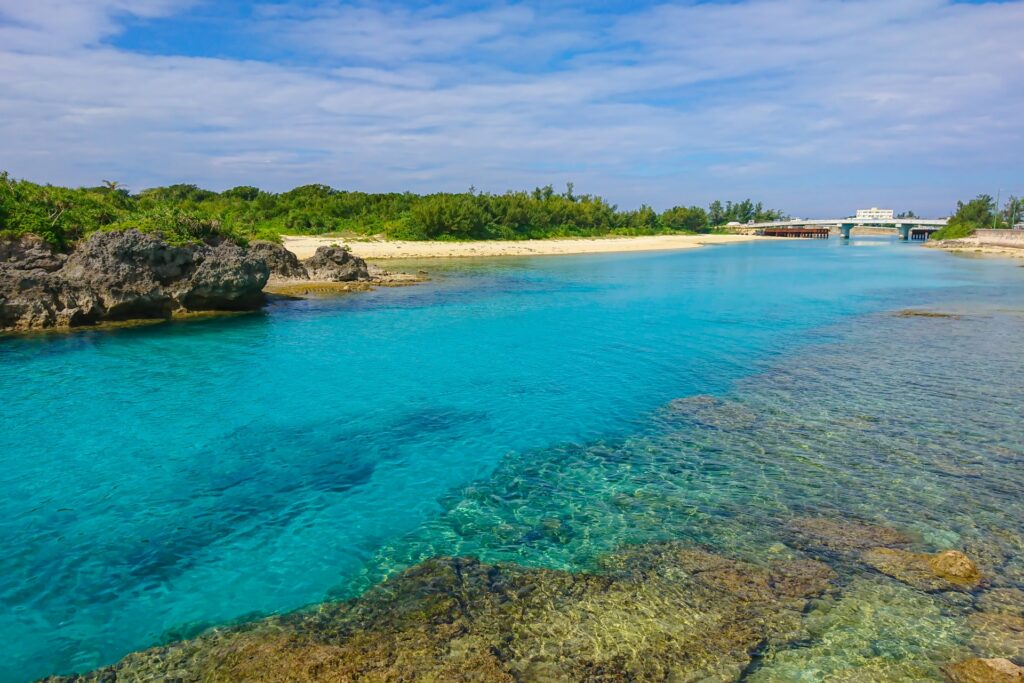
The Coral Reef of Nakanoshima Beach
Nakanoshima Beach is the most popular snorkelling spot on Shimojishima.
You can easily access the coral reef by beach entry, and inside the reef colourful coral reefs spread. Table coral, branch coral, brain coral, various kinds of coral are packed densely, just like a garden inside the sea.
When I first snorkelled at Nakanoshima Beach, the moment I put my face in the water "wow!" slipped out (through my mask, though). The whole view before me was coral reef, with colourful tropical fish swimming around it. Clownfish flit about inside the sea anemones. Blue fish, yellow fish, striped fish — truly like an aquarium. No, more than an aquarium. I was moved that this is the natural sea.
Around the coral reef, various tropical fish live.
- Clownfish: orange body with white stripes, living inside sea anemones
- Damselfish: small blue and yellow fish, swimming in schools
- Butterflyfish: yellow body with black stripes, swimming gracefully
- Wrasse: colourful body, swimming swiftly
- Parrotfish: large blue and green fish, eating coral
And if you're lucky, you can sometimes meet a sea turtle. When I first saw a sea turtle, I was surprised — "huh, the real thing?!" You can observe a sea turtle swimming leisurely at a distance of a few metres. You can't have an experience like that just anywhere, can you.
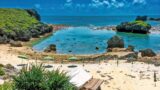
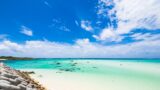
The Reef and Creatures Around 17END
17END is a phantom beach at the southern end of Shimojishima Airport.
At low tide a white sandy beach appears, and tide pools form inside the reef. These tide pools are actually a treasure trove of creatures.
Inside the reef the waves are calm, and seawater pools in the shallows. Here, small fish, crabs, shrimp, hermit crabs and the like live. You often see children searching for creatures in the tide pools.
Because the reef blocks the waves and forms tide pools, even beginners can enjoy snorkelling safely. Even on days with high waves, inside the reef is relatively calm. So the beaches of Irabu Island and Shimojishima are recommended for snorkelling beginners too.
When I first went to 17END, I was surprised that the wave height was completely different outside and inside the reef. Outside the reef white waves stand, yet inside it's as calm as a mirror. I realised "a coral reef is a natural breakwater."
To Protect the Coral Reef
Coral reefs are the foundation of the sea's ecosystem.
Because there's coral, tropical fish can live. Because there are tropical fish, big fish gather too. If the coral reef is healthy, the whole sea's ecosystem becomes rich. But coral is a very delicate creature, weak to environmental change.
In recent years, coral bleaching from rising seawater temperatures has become a problem worldwide. Irabu Island and Shimojishima are no exception. Warming, ocean pollution, crown-of-thorns starfish outbreaks — there are many factors threatening coral.
What we tourists can do is not damage the coral. Don't touch, step on or kick the coral while snorkelling. Use sunscreen with coral-friendly ingredients (chemical ingredients can bleach coral). Take your rubbish home.
Small things, but if each person's actions add up, it becomes a big change. To leave the beautiful coral reef for the next generation too, I want to start with what I can do.
Water and Creatures Overflowing from the Freshwater Lens | The Distinctive Environment of the Brackish Zone
The Kuninaka inlet between Irabu Island and Shimojishima has a distinctive water environment.
Groundwater overflowing from the freshwater lens mixes with seawater. This environment where fresh water and seawater mix is called a "brackish zone."
What Is a Brackish Zone?
A brackish zone is a place where fresh water and seawater mix.
Usually a river mouth becomes a brackish zone. A place where a river's fresh water mixes with the sea's seawater. But Irabu Island and Shimojishima have no river. And yet there's a brackish zone. That's because groundwater overflowing from the freshwater lens flows into the Kuninaka inlet.
Environmental-education materials introduce how groundwater overflowing from Irabu Island's freshwater lens pools between Irabu Island and Shimojishima, and various creatures live there.
A brackish zone is a very special environment with the features of both fresh water and seawater. And creatures adapted to this special environment live there.
A Nursery for Crabs, Small Fish and Other Creatures
The brackish zone is home to various creatures like crabs and small fish.
The crabs at the base of the mangroves are species adapted to the brackish zone. Tough creatures that can live in both fresh water and seawater. Observe the tidal flat carefully and you can see many small crabs walking about.
Many small fish grow in the brackish zone too. Fish that are neither freshwater fish nor complete saltwater fish, adapted to the brackish zone. There are many fish that favour brackish zones, like gobies and mullets.
The brackish zone is a very important place for creatures. For many fish, the brackish zone is a spawning ground and a nursery for fry. Rich in nutrients, with few predators, suited to fry growing. If the brackish zone disappeared, many fish would decline.
The Kuninaka inlet's brackish zone may look plain in appearance. But for the ecosystem it's a very important place. A place that nurtures the lives of many creatures.
When I first learned the importance of the brackish zone, I thought "even if it doesn't look flashy, there are important places." Superb-view spots like 17END and Toguchi-no-Hama are wonderful, but plain places like the Kuninaka inlet are also important places supporting the ecosystem. Both must be protected.
To Protect the Ecosystem of Irabu Island and Shimojishima
So far, I've explained the ecosystem and plants of Irabu Island and Shimojishima.
To sum up, it's like this:
- Mangrove tidal flat: a non-river-mouth mangrove rare even within the prefecture, spreading in the Kuninaka inlet, with four kinds of mangrove growing
- Mangrove whelk: a precious large sea snail living in mangrove areas
- Coastal plants: tough plants adapted to a harsh environment, like beach naupaka and screw pine
- Coral reefs and tropical fish: colourful coral reefs, tropical fish and sea turtles spreading around Nakanoshima Beach and 17END
- Brackish zone: groundwater overflowing from the freshwater lens mixes with seawater, becoming a nursery for crabs and small fish
Irabu Island and Shimojishima have truly rich nature.
Mangroves, coastal plants, coral reefs, tropical fish, the brackish zone. They don't exist independently — they're all connected to form one ecosystem. The mangroves become spawning grounds for fish, the coral reefs become nurseries for fry, the coastal plants protect the coastline, and the brackish zone nurtures diverse creatures.
But this rich ecosystem won't necessarily continue forever. Through environmental change, human activity and various factors, it could easily be broken.
What we tourists can do is cherish nature. Be quiet when approaching mangroves, don't touch the coral, take your rubbish home, use coral-friendly sunscreen. Obvious things, but with each person being conscious, nature is protected.
If you visit Irabu Island and Shimojishima, please by all means enjoy this rich ecosystem too. Observe the mangroves, gaze at the coastal plants, snorkel at the coral reef, and search for creatures in the brackish zone. Not mere sightseeing, but an experience of touching nature. That's the true appeal of Irabu Island and Shimojishima.
And to leave this beautiful nature for the next generation too, I want to keep a heart that cherishes nature.