- Why That Indigo Is Frightening Yet Beautiful
- What Is Toriike Pond? A Mysterious Pond Designated a National Place of Scenic Beauty
- The True Nature of That "About to Be Sucked In" Indigo
- The Promenade from the Car Park to the Pond Is Unexpectedly Hot
- Two Terrifying Legends Passed Down at Toriike Pond
- Toriike Pond as a Diving Spot
- The Vitality of Ryukyu Limestone and Plants Is Amazing
- 7 Tips to Enjoy Toriike Pond to the Fullest
- Frequently Asked Questions (FAQ)
- Toriike Pond Is Frightening and Beautiful
Why That Indigo Is Frightening Yet Beautiful
The moment I first saw Toriike Pond, my feet froze.
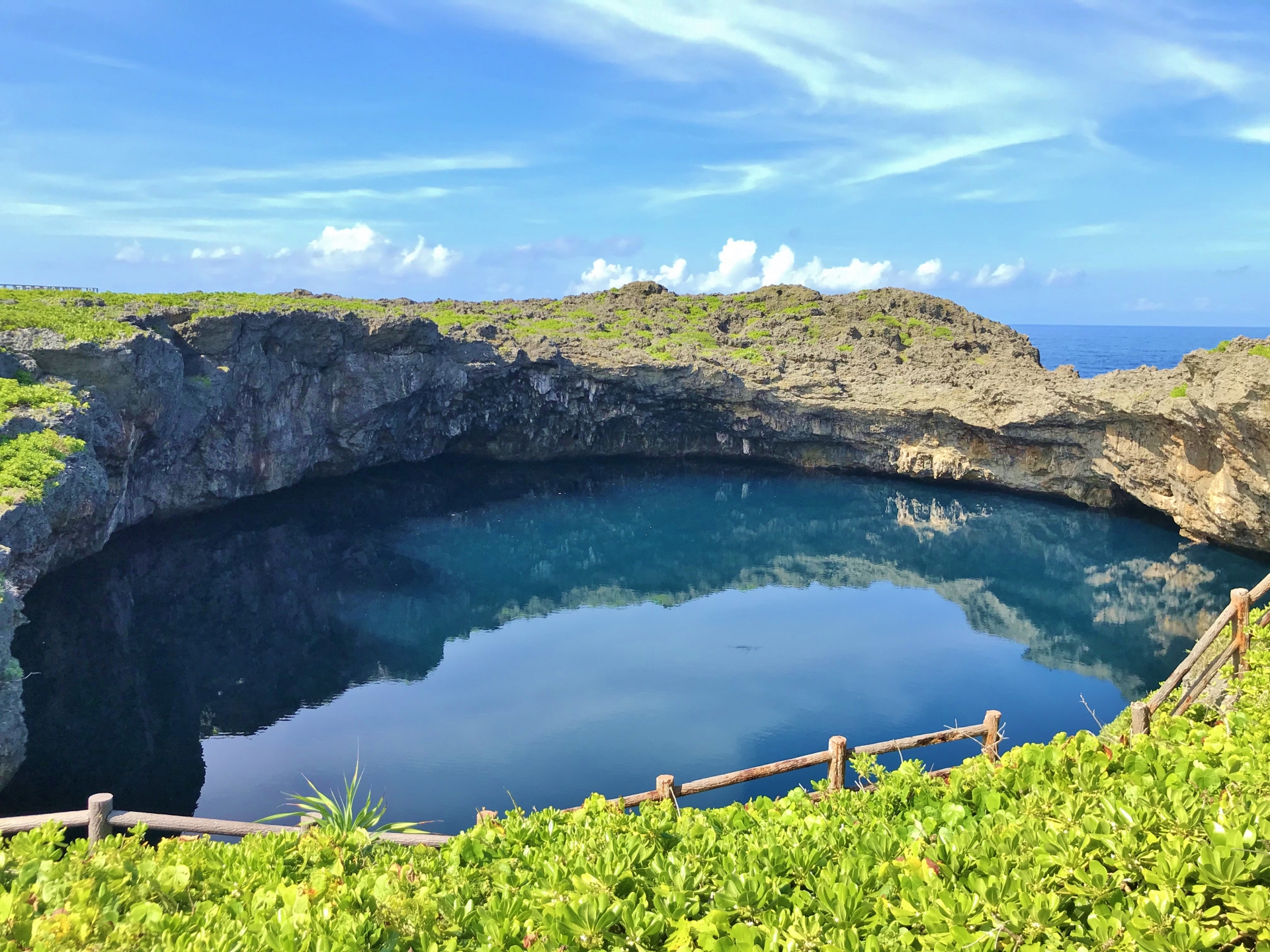
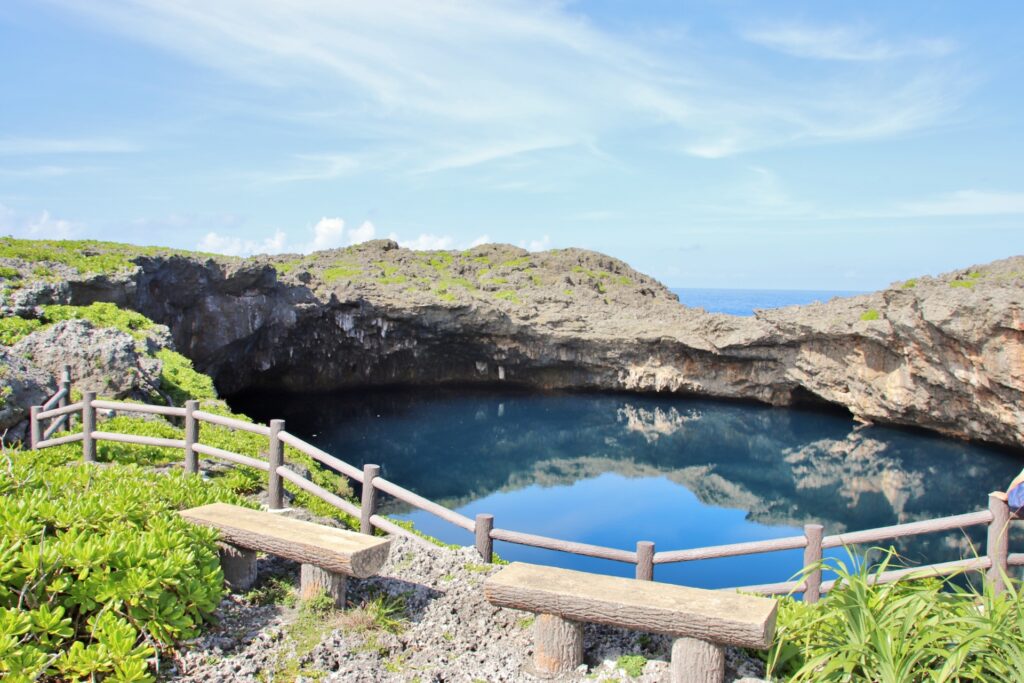
A deep indigo, or navy blue. Anyway, a deep, deep blue where the bottom isn't visible at all. Because I'd heard "pond," I'd somehow held a cuter image on my own, but it was completely different. What spread before me was a mysterious, slightly frightening water surface that the words "about to be sucked in" fit perfectly.
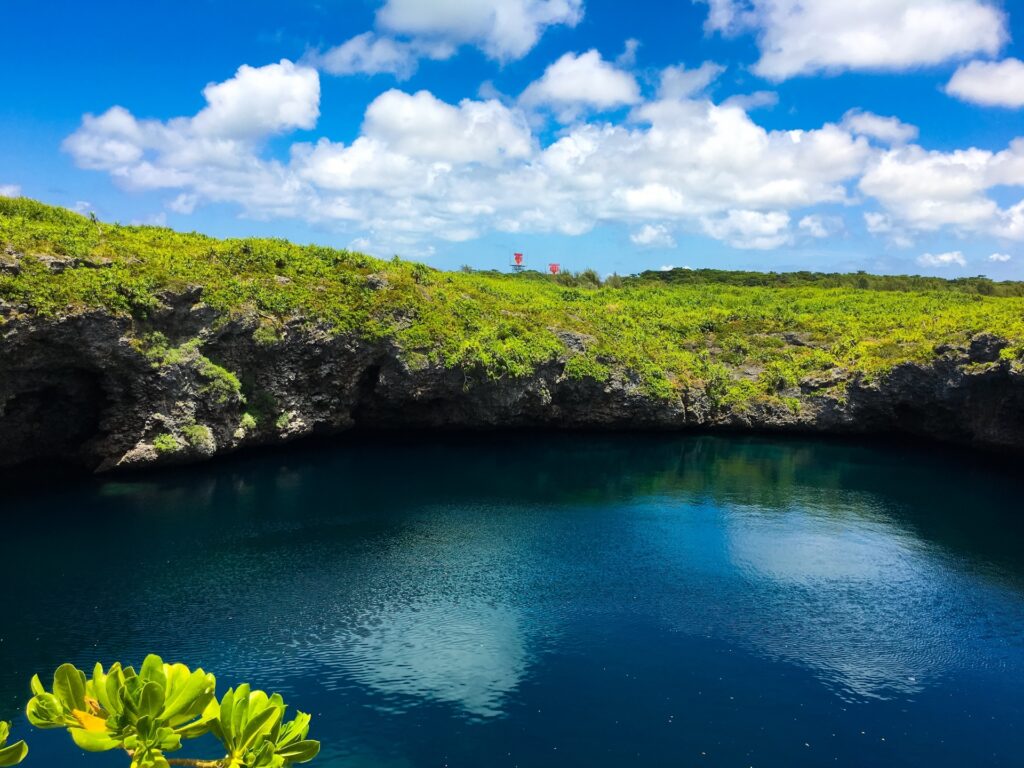
I do think it's beautiful. Undoubtedly beautiful. But at the same time, what is this — this sense of fear.
Approach the pond's edge and peer in, and your heart jumps. I'd heard the water depth is 45 metres, but is it this deep? And this pond connects to the sea underground. "Wait, really?" I went.
And furthermore, the promenade you walk from the car park to the pond is hot. There's almost no shade, and I nearly died from the midsummer reflected heat. I hadn't brought water, and I seriously regretted it.
This time, I'll write all about Toriike Pond's appeal and frightfulness, and the points to note I understood from actually going. If you visit Shimojishima, it's an absolutely unmissable spot.
What Is Toriike Pond? A Mysterious Pond Designated a National Place of Scenic Beauty
Toriike Pond is two circular ponds, large and small, on the west coast of Shimojishima.
Strictly it's Shimojishima, but it's common to tour it as a set with Irabu Island sightseeing. Cross the Irabu Bridge to Shimojishima. You can tour it in a day along with 17END and Nakanoshima Beach.
This pond isn't just a pond. On 28 July 2006 it was designated a National Place of Scenic Beauty and a Natural Monument. A dual designation of Place of Scenic Beauty and Natural Monument was apparently the first in 33 years. That's how precious a place it is.
The Size and Depth of the Two Ponds
The large pond on the sea side (the first pond):
- Diameter: about 75 metres
- Water depth: about 45 metres
The small pond on the land side (the second pond):
- Diameter: about 55 metres
- Water depth: about 25 metres
These two ponds look separate from above ground, but they connect underground. What's more, the sea-side pond also connects to the open sea outside through an underground cave. That's why it's named "Toriike (pass-through pond)."
When I first learned this, I was very surprised. I mean, in appearance they're completely independent ponds, yet below the surface they're all connected. Nature is amazing.
How It Formed
It was apparently originally a limestone cave.
That's how it came to its current form — the ceiling part collapsed from wave erosion. In technical terms, it's a type of karst landform called a "collapse doline." Look around the pond and there's rugged Ryukyu limestone everywhere.
This limestone isn't just rock. Look closely and various plants grow from the gaps in the rock. Adan and other tropical plants desperately put down roots in such a harsh environment. I was somehow moved by that vitality.
The True Nature of That "About to Be Sucked In" Indigo
Toriike Pond's biggest feature is, after all, that colour.
Deep indigo. Navy blue. A deep, deep blue.
It's completely different from an ordinary beach's blue. Not emerald green either. A darker, deeper, unfathomable blue. The first time I saw it, honestly I was a little frightened.
Why It's This Colour
The secret of this colour lies in the water depth, water temperature and salinity.
Since Toriike Pond connects to the sea, seawater comes in. But rainwater also collects in the upper part of the pond. So the salinity differs completely by water depth.
- Upper layer: low salinity (much rainwater) → pale green
- Middle layer: the boundary (thermocline, chemocline) → swaying
- Lower layer: high salinity (seawater) → deep blue
What divers often call the "swaying zone" is this boundary. At the border of fresh water and seawater, the water looks like it's swaying. Fantastical, but frightening after all.
The Water Level Changes with the Tides
Since it connects to the sea, the pond's water level changes with the ebb and flow of the tides.
At high tide the water level rises, at low tide it drops. Isn't it strange that a pond is affected by the tide level? But that, I think, is proof this pond is alive.
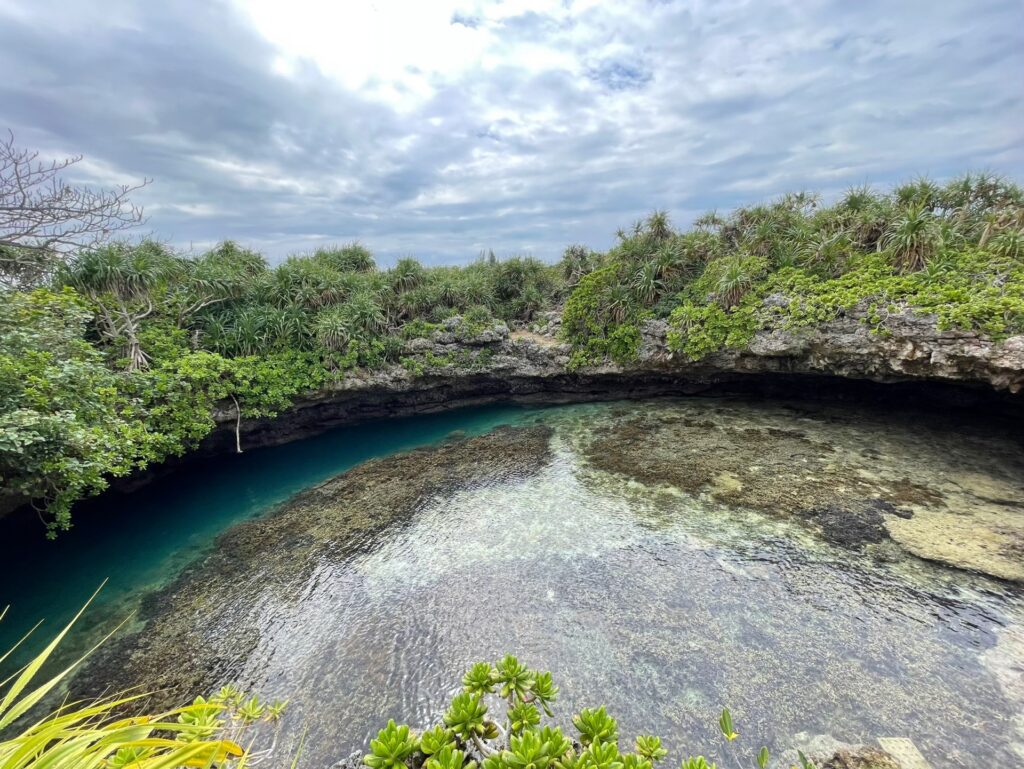
When I went, it was just near high tide, and the water surface was very calm. There was no wind either, and the sky was reflected like a mirror. That stillness was again somehow eerie.
The Promenade from the Car Park to the Pond Is Unexpectedly Hot
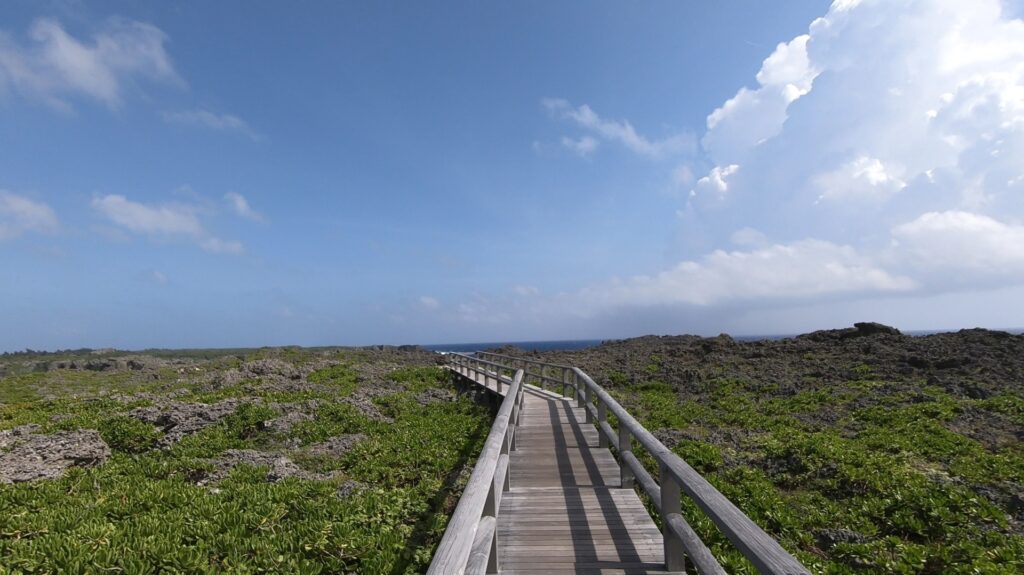
The toughest part of the journey to Toriike Pond was the promenade.
From the car park to the pond, about 300 metres. You'd think it's no big distance, right? But this is unexpectedly tough.
Why It's Tough
There are 3 reasons.
1. There's almost no shade
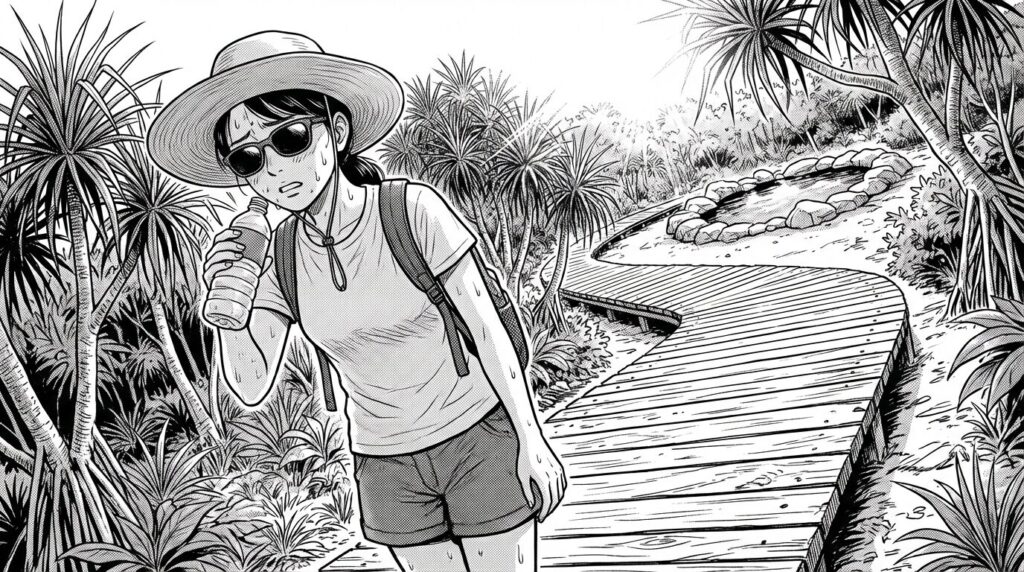
The promenade is overgrown with adan trees, but it's not completely covered. The sun beats down mercilessly through the gaps between the trees. A midsummer midday is seriously hell.
2. The reflected heat is harsh
The boardwalk (promenade) is a bright colour and reflects the sunlight. With reflection from below and direct sunlight from above, you're in a sandwich state. Sunglasses and a hat are essential.
3. There's no wind
Because the trees are overgrown, no wind passes through. Muggy. Stifling.
When I went, it was around 2 in the afternoon in midsummer, and the temperature was about 32°C (90°F). I hadn't brought water and seriously regretted it. I even thought about turning back partway.
What You Should Bring
If you go to Toriike Pond, don't forget the following:
- Water (500 ml or more): without this you'll die. Seriously.
- A hat: sun protection essential.
- Sunglasses: the reflected glare hurts your eyes.
- Insect repellent spray: in the evening, mosquitoes come out.
- Sunscreen: your arms and neck get burnt.
There's a toilet at the car park, but no shop. No vending machine either. Prepare in advance or you're stuck.
Two Terrifying Legends Passed Down at Toriike Pond
Toriike Pond has two terrifying legends remaining from long ago.
Both tell of this pond's mysterious, eerie atmosphere. Truth of the legends aside, looking at this pond makes you think "something might be there."
The Yunaitama (Mermaid) Legend
Long, long ago, there was a village on Shimojishima.
A certain fisherman caught a Yunaitama (a dugong, or a human-faced fish). Since it was rare, thinking to show everyone at the next day's gathering, he was drying it over a charcoal fire.
Late that night, the child of the neighbouring house suddenly began to cry. Whatever was done, it wouldn't stop crying. When the mother went outside, a voice came from afar.
"Yunaitama, oh Yunaitama, why do you not return?"
Then the Yunaitama being dried over the charcoal fire answered.
"I am now being grilled over a charcoal fire. Please come for me quickly."
The mother and child grew terrified and hurried to flee to Irabu Island. The next morning, a great tsunami surged onto Shimojishima, and the village was washed away. Where the fisherman's house and the neighbouring house had stood, a large hole was left.
That's the present Toriike Pond, they say.
The Stepchild Legend
This is a sadder tale.
Long ago, a fisherman living on Shimojishima was widowed. He took a second wife for the sake of the remaining child, but eventually, once the second wife bore her own child, she came to resent the first wife's child (the stepchild).
One day, when the husband went out fishing, the second wife took the two children out to Toriike Pond. She laid the stepchild, the elder brother, on a slippery, smooth rocky spot, and her own child, the younger brother, on a rugged rocky spot.
In the middle of the night, the second wife woke and pushed the child sleeping on the slippery rocky spot into the pond. Then she carried the remaining child home on her back.
The child on her back asked, "what happened to my brother?"
The kind elder brother had swapped places because the younger brother said "the rocks are rugged and I can't sleep." The second wife realised she had mistakenly dropped her own child into the pond.
The second wife returned to Toriike Pond, and threw herself into the pond too, ending her life.
Once a year, as if mourning this mother and child, the pond's colour is said to turn red. In reality it's apparently a red tide, though.
What the Legends Tell
What both legends have in common is "if you fall into the pond, you can't come back up."
In fact, the pond's edge is an overhang. Once you fall, climbing back up by yourself is nearly impossible. So there's a theory that people of old made such scary tales as a warning "not to throw yourself in here."
When I stood at the pond's edge, my legs truly trembled. There's no fence, so step a little forward and you'd fall. Looking at that deep indigo, you feel about to be sucked in.
Toriike Pond as a Diving Spot
Toriike Pond is one of Japan's leading diving spots.
But it's absolutely not recommended for beginners. It's a high-difficulty course even for pros, and dangerous without skill and experience.
The Route from the Open Sea into the Pond
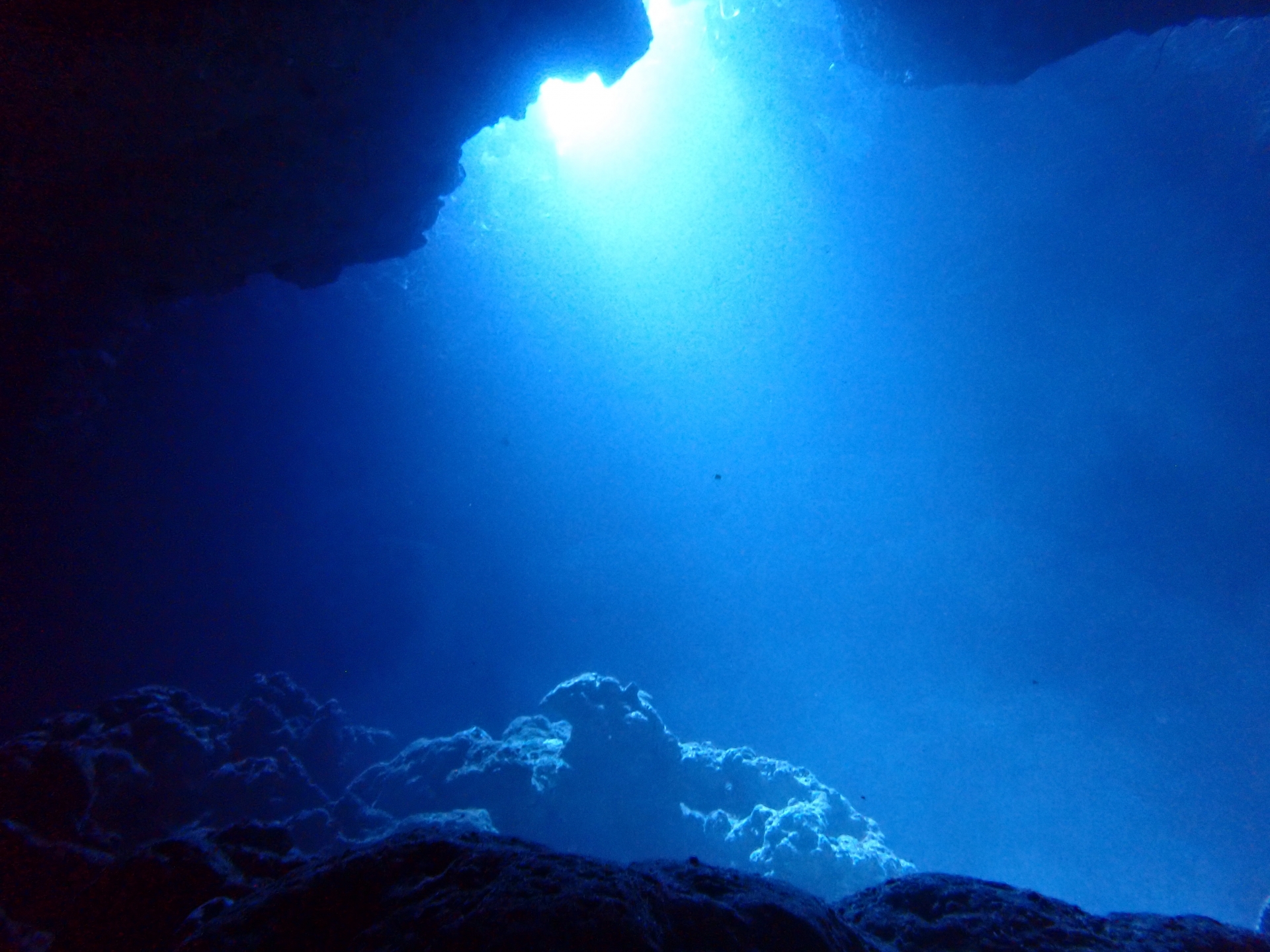
Divers enter from the open sea and come into the pond through the underground cave.
Inside the cave it's pitch dark, and you can't see anything without a light. The water is deep, and there's current too. Without proper buoyancy control, you hit rocks or fall.
Pass through the cave and enter the pond, look up and you can see the sky. From there you slowly ascend and your face emerges at the pond's surface.
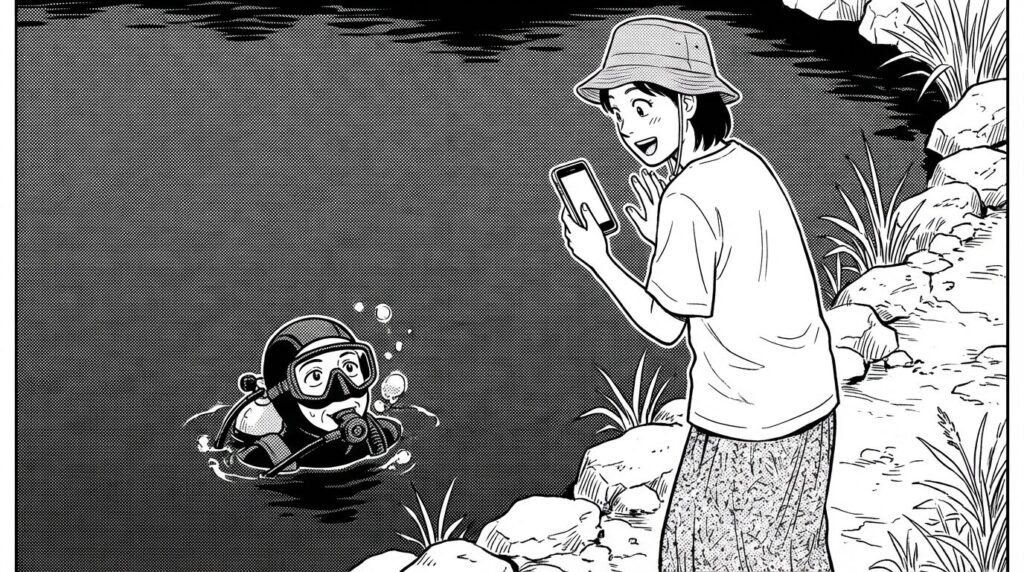
When I was gazing at the pond, a diver happened to surface. Suddenly a human appeared from that deep blue, and I was incredibly startled. The diver waved too, and it was somehow a strange sight.
The Difficulty of Toriike Pond Diving
When I asked a local diving shop, I was told this.
"Toriike Pond is for advanced divers. Without skill and experience, we decline."
The skills needed:
- Firm buoyancy control: falling inside the cave is dangerous
- Smooth ear equalisation: if you can't equalise when returning from the pond, you can't get back
- Attentiveness not to lose sight of the guide: it's easy to lose the guide in the low-visibility pond
- Calm judgement: handling trouble calmly even if it occurs
Having a diving licence doesn't mean anyone can dive. That's how high the difficulty is.
But for those who can dive, it's apparently a lifetime-memory dive. The experience of passing through the cave into the pond while watching the swaying zone (thermocline) can't be done elsewhere.
The Vitality of Ryukyu Limestone and Plants Is Amazing
What I noticed walking around Toriike Pond was the vitality of the plants.
The pond's surroundings are full of rugged Ryukyu limestone. There's almost no soil in such a place. Yet various plants grow from the gaps in the rock.
Adan Trees
What grows abundantly along the promenade is adan (screw pine).
The leaves are thorny, and it bears fruit like a pineapple. A tropical plant, often seen in Okinawa. But Toriike Pond's adan is somehow hardy.
It puts down roots as if clinging to the gaps in the rock. With no soil, I wondered how it's growing.
Other Plants
Besides adan, various plants grow.
- Monpanoki (tree heliotrope): a tree that often grows along the coast
- Beach morning glory: a flower that blooms on the sand
- Hamago (beach vitex): a small purple flower
All of them live in a harsh environment. Strong sunlight, salt-laden wind, rocky land. Even so, they live desperately.
People who come to see Toriike Pond tend to look only at the pond, but I want you to pay attention to the surrounding plants too. You can feel the strength of nature.
7 Tips to Enjoy Toriike Pond to the Fullest
Let me summarise the tips for enjoying Toriike Pond, understood from actually going.
① Go in the Morning or Evening
Midday is too hot.
Since the promenade has almost no shade, going at midday will kill you. Recommended is the morning (9–11) or the evening (after 16:00).
The evening especially makes the pond's colour soften and beautiful. The colour of the water surface changes with the sun's angle.
② Bring Water
This is a must.
Since there's no vending machine at the car park, prepare in advance. Bring at least one 500 ml bottle.
③ Bring Insect Repellent Spray
Mosquitoes come out in the evening.
The promenade has many trees, so there are insects. Getting bitten is itchy and ruins your hard-won sightseeing.
④ Don't Get Too Close to the Pond's Edge
There's no fence, so be careful.
The pond's edge is an overhang, and once you fall you can't come back up. When taking photos too, step back a little.
⑤ Walk Slowly Around the Pond
Don't rush.
There's a promenade around the pond, and you can see it from various angles. Depending on the spot, the pond's colour looks different. Walking slowly and looking for your favourite angle is fun.
However, the promenade to the "Nabesoko-ike (mini Toriike Pond)" further beyond the pond was broken by the 2016 typhoon and is closed. Don't try to force your way there.
⑥ Lucky If You Meet a Diver
If you're lucky, a diver surfaces from within the pond.
A human suddenly ascends, so you're startled, but that too is an experience unique to Toriike Pond. Some divers wave to you.
⑦ Tour It as a Set with 17END
Toriike Pond alone might feel a bit lacking.
17END at the north end of Shimojishima Airport is about 5 minutes by car from Toriike Pond. A spectacular spot where white sand and a transparent sea spread out. Touring them as a set is recommended.
Frequently Asked Questions (FAQ)
Can I Swim in Toriike Pond?
You can't swim.
Entering the pond itself is prohibited. Diving is permitted, but that too is for advanced divers only. Ordinary tourists just gaze from the pond's edge.
How Long Does It Take?
From arriving at the car park to coming back, about 30 minutes to 1 hour.
Walk the promenade round trip, walk slowly around the pond, take photos. With about an hour like that, it's plenty.
Is There a Car Park?
There is. Free.
A car park wide enough for large buses to park too. It gets crowded in busy tourist periods, but basically you can park.
Is There a Toilet?
There's one at the car park.
Neatly maintained. However, there's no shop or vending machine, so prepare drinks in advance.
Is It Accessible by Wheelchair?
It is.
The promenade is barrier-free and passable by wheelchair. However, part of the area around the pond has steps, so having a helper is reassuring.
Is It OK with Children?
It's OK, but caution is needed.
Since there's no fence at the pond's edge, don't take your eyes off small children. Holding hands and viewing from a spot away from the pond is safe.
When Is the Best Season?
Autumn to winter (October to March).
In this period the northeast wind blows and the sea becomes calm. Diving is easier too. Conversely, in summer (June to September) the south wind blows and the waves get high. For sightseeing alone, summer is no problem, but heat protection is essential.
Toriike Pond Is Frightening and Beautiful
Toriike Pond is, in a word, a "frightening and beautiful" place.
That deep indigo, I still can't forget it. About to be sucked in, yet unable to look away. Since the bottom isn't visible, you don't know what's there. Such fear and fascination coexist.
The promenade is hot, the pond's edge has no fence, the legends are scary. But even so, it's worth going. It's well-deserving of its National Place of Scenic Beauty designation.
If you visit Irabu Island and Shimojishima, Toriike Pond can't be missed.
Tour it together with 17END and Nakanoshima Beach, and savour all of Shimojishima's appeal. Just don't forget water and insect repellent spray.
Look at Toriike Pond's deep indigo and come feel the mystery of nature. Once you see that colour, you surely won't be able to forget it.