The first time I came to Irabu Island was getting on for ten years ago now.
At the time I'd only recently started living on Miyako Island, and I remember an islander telling me, "Irabu Island has a strange place." I didn't really understand what "strange place" meant, and since they told me with a laugh I figured it wasn't a scary kind of story, and listened. Apparently there's a hole that suddenly opens up in the very middle of a sugarcane field, and going inside it's like another world.
I let it wash over me with a "hmm," but when I actually crossed the Irabu Bridge and stood at that place, I thought, "ah, this is a strange place." The surroundings were ordinary fields, the sunlight dazzling, with the sound of cicada-like insects, and yet the moment I peered over the stone wall, the air shifted in an instant. There was another world spreading underground.
Irabu Island's power spots are probably mostly that kind of place. Not an easy-to-grasp spectacle like a postcard, but a feeling of "huh, something's different here" that comes first. That's what's interesting, but going without knowing anything is often a waste. Visit after properly knowing the background — what history there is, why here is called a power spot — and how you feel is completely different.
In this article, I've tried to sum up Irabu Island's power spots as carefully as possible, from history and legend to practical information. Not as tourist spots, but as a reference for a journey of going round while properly facing this island's mystery.
- Irabu Island and Power Spots, Their Deep Connection
- Delving into the History and Legends of Irabu Island's Power Spots
- 5 Recommended Power Spots on Irabu Island
- Nudokubi Abu: a Sanctuary Hidden in the Sugarcane Fields
- Obiiwa: the Prayer Conveyed by a 20,000-Tonne Rock
- Toriike Pond: a Sacred Pond Holding the Dragon's Eye and a Mermaid Legend
- Makiyama Observatory: Where a Spectacle and the Memory of War Coexist
- Sawada-no-Hama: a Healing Beach Guarded by Gajumaru and Reef Rocks
- A City-Designated Historic Giant Limestone Rock
- How Locals and Local Guides Describe Feeling the Energy
- How to Enjoy a Power-Spot Tour of Irabu Island
- A Practical Guide and Photo Spots for Touring Irabu Island's Power Spots
- Manners and Nature Conservation When Visiting Power Spots
- FAQ: Touring Irabu Island's Power Spots
- Activities to Enjoy Alongside a Power-Spot Tour
- Maybe the Whole Island of Irabu Is a Power Spot
Irabu Island and Power Spots, Their Deep Connection
Irabu Island's History and Cultural Background
Irabu Island is a remote island located northwest of Miyako Island, part of Miyakojima City. Partly because you could only cross by boat until the Irabu Bridge opened in 2015, a remote-island air still remains within the island today. The population is about 5,000, it has a history of prospering on bonito fishing, and fishermen's culture is alive here and there on the island.
The whole Miyako Island area is actually a place where faith and daily life are very close. Sacred sites enshrining gods called "utaki" are dotted across the island, naturally blending into the islanders' lives. An utaki is considered a sacred place where a god descends, and many are originally places men or outsiders can't set foot in. For Miyako islanders, faith isn't something you recall only at special events — it's always nearby, when you go out to sea and when you till the fields.
The people of Irabu Island are the same, with reverence for the land passed down from ancestors, and awe for what dwells in nature, still living today. Many of the places called power spots were originally places the locals offered prayers, or places carved into the islanders' memory over a long time.
By knowing that context before visiting as a "tourist spot," this island's power spots gain real depth.
What Is a Power Spot in the First Place?
Thinking about it again, the word "power spot" has a vague definition. There's a theory it's a place where the earth's energy concentrates, and there's also the interpretation of simply "a place that makes you feel energised when you go." If you say there's no scientific basis, that's that, and whether to believe it is up to each person.
However, regarding Irabu Island's power spots, there's often a clear reason that makes you feel "there's something there." A stalactite cave formed over tens of thousands of years, a giant boulder carried by a tsunami, the geological miracle of two ponds connecting underground — they're all places where "something far beyond the human time scale" has piled up.
Places popular as tourist spots usually draw people because they're "picturesque." But Irabu Island's power spots are a little different, with the feeling of "a different kind of time flows here" coming first. For people who like that, I think Irabu Island is without a doubt an island you'll be hooked on.
Delving into the History and Legends of Irabu Island's Power Spots
When talking about Irabu Island's power spots, what you can't avoid is the connection with the island's history. Especially striking is the relationship with the Great Meiwa Tsunami of 1771.
The Great Meiwa Tsunami was a disaster of unimaginable scale that swallowed the whole Miyako Islands, and according to records the wave height is said to have exceeded 30 metres. The giant boulder thrown up by this tsunami is "Obiiwa," and the islanders, witnessing that overwhelming power of nature, came to feel something sacred in the rock. It's a place where nature's violence and the prayers of the humans who survived it overlap.
Toriike Pond has the "Yunaitama legend" passed down. It's a story where a stepchild, fleeing abuse, threw themselves into the pond and was protected by a mermaid (Yunaitama), and a tradition still remains that the dead are reborn into another life in the pond. That this pond, also called the "Dragon's Eye," is revered as a sacred site of rebirth is because of such layered legend.
About Nudokubi Abu, there are even local islanders who say, "I thought of it as rather a scary place." Human bones have been found in other nearby caves, and it seems to be a place the locals didn't approach much for a long time. But that's closer to a sense of "it's a place with something special, so don't carelessly set foot in it" than of avoiding it because it's frightening — I heard this when I lived on Miyako Island.
Irabu Island's legends are all deeply tied to "the weight of living." Tsunami, war, the fishermen's life-risking journeys to sea — precisely because it's a land where such weight of life has piled up, the power spots here are not light.
5 Recommended Power Spots on Irabu Island
Nudokubi Abu: a Sanctuary Hidden in the Sugarcane Fields
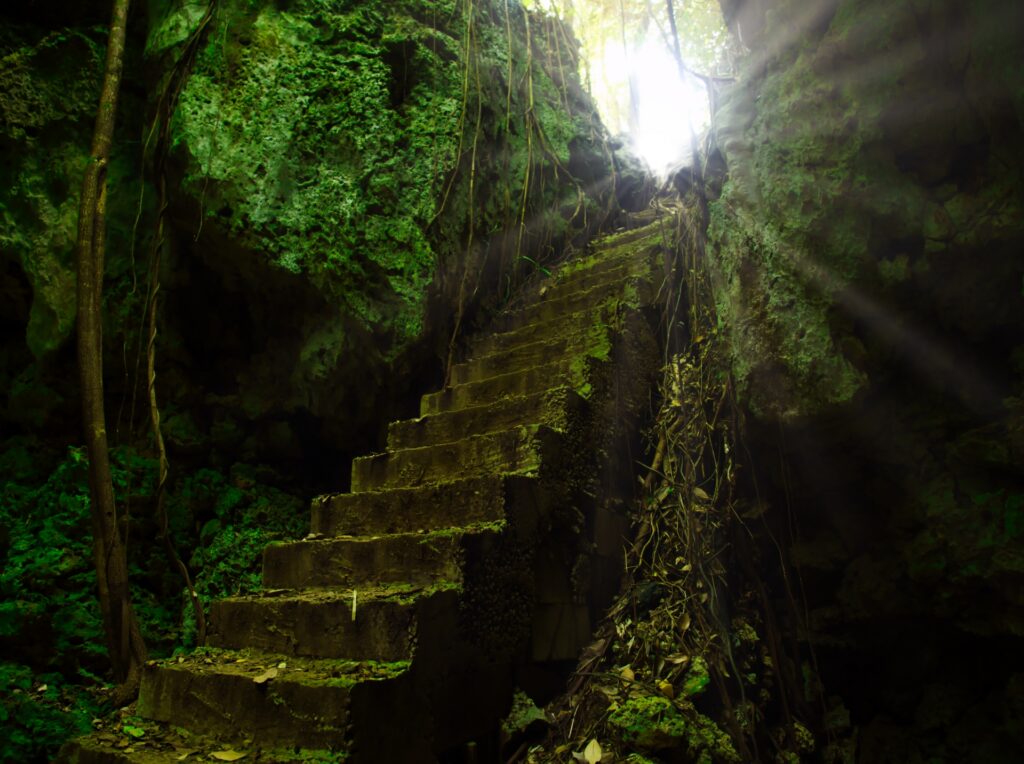
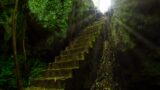
Drive a while after crossing the Irabu Bridge and you enter an area where sugarcane fields spread. There, a small dense forest suddenly appears, with a sign reading "Historic Site: Nudokubi Abu." This is the entrance to Nudokubi Abu.
Nudokubi Abu is Miyako dialect, with "Nudokubi" meaning throat and "Abu" meaning vertical shaft. True to the name it's a vertical-shaft cave, 22 metres deep, with a large mouth 3 metres wide and 25 metres long. Descend the stairs and there's a hall, with stalactites developed on the right side, and gajumaru roots hanging from the ceiling to the ground. The faint sound of dripping water can be heard.
The stalactites that formed this cave grew over a span of time for which ten thousand years is nowhere near enough. With that before your eyes, intertwined with the gajumaru roots, it gives off an indescribable life force. Since it was used as an air-raid shelter during the war, the stairs are maintained, and the remains of a hearth survive at the back.
There's no monument to a specific god here, no altar. That's exactly why, conversely, the feeling of "there's nothing, yet something is here" is strong. It's a place protected by the locals since ancient times as an utaki-like presence, now registered as a historic site of Miyakojima City. Visiting is free, but always bring a torch and trainers. There are many mosquitoes in summer too, so don't forget insect repellent. The cave interior is cool even in high summer.
Obiiwa: the Prayer Conveyed by a 20,000-Tonne Rock
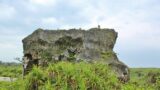
The giant boulder sitting atop the cliff on the south side of Toriike Pond is Obiiwa. With out-of-spec dimensions of 12.5 metres tall, 59.9 metres in circumference and 20,000 tonnes in weight, it's said to have been thrown up onto the cliff by the Great Meiwa Tsunami of 1771. Considering the cliff is 10 metres high, you can imagine how much energy the tsunami had.
The origin of the name Obiiwa comes from there being a hollow in the central part of the rock, which looks just like a person wearing an obi (sash). Perhaps from that appearance, it's now enshrined by the local people as a sacred object for prayers of safe voyages, a big catch, and family safety. It may be the place the phrase "a power spot created by great nature" fits best.
Standing before it, you're simply overwhelmed. It's not that anything happens, or that the air changes. Just the fact that this rock was thrown up here in that great tsunami, and is still here over 250 years later, is more than enough to feel "something."
Access is about 10 minutes by car from Shimojishima Airport. There's parking space, and the rock is a short walk along a path. Given its current character as an utaki, it's a place to visit quietly and with respect.
Toriike Pond: a Sacred Pond Holding the Dragon's Eye and a Mermaid Legend
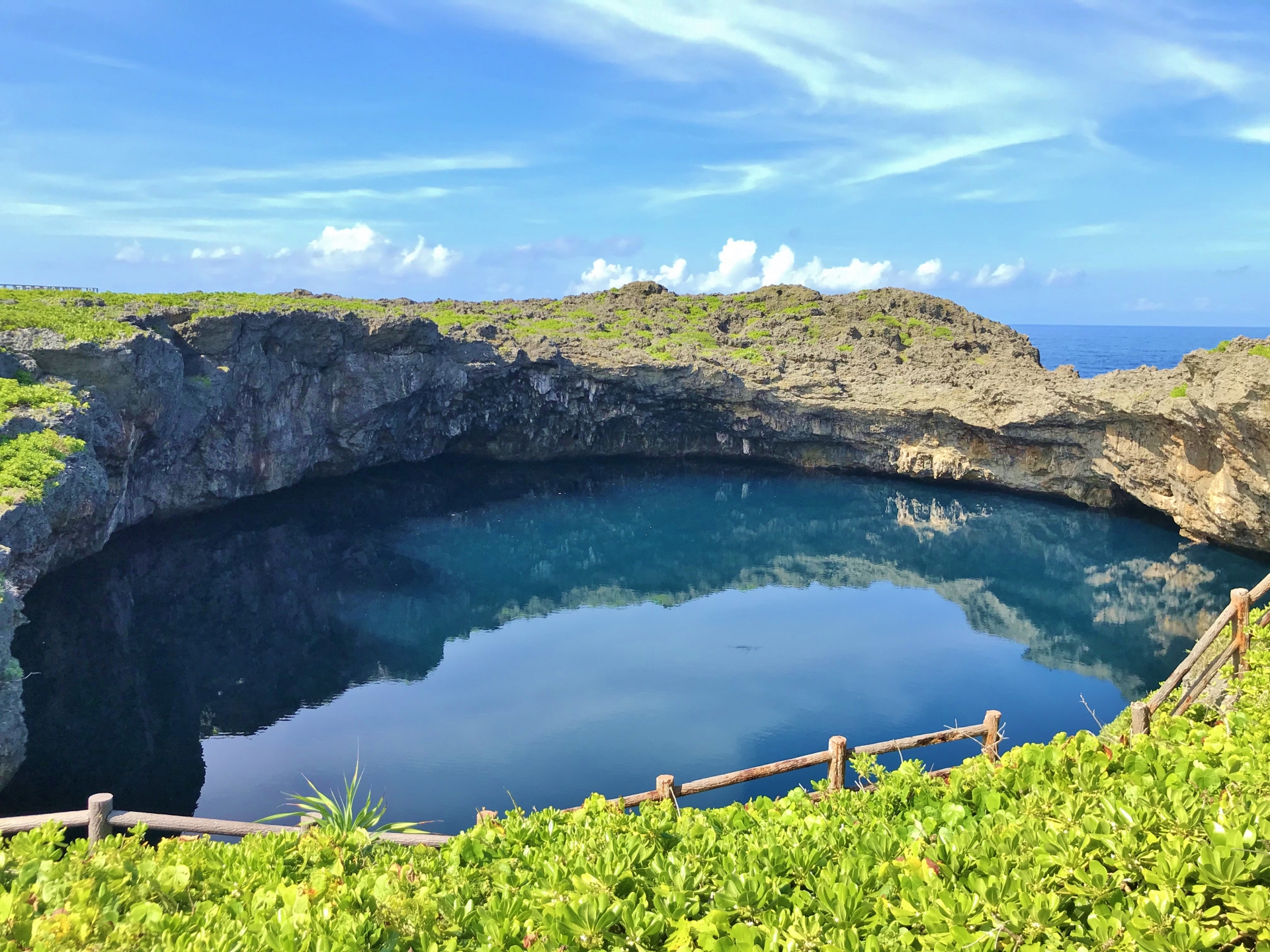
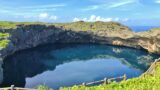
Toriike Pond on Shimojishima is a nationally designated Natural Monument and a power spot representative of the Irabu Island–Miyako Island area. Two ponds that look cut off from the sea are actually connected underground, the water level changing with the sea's tides, and the water colour changes by time of day and season. That mysterious mechanism brings a mystical atmosphere to this area.
The pond is also called the "Dragon's Eye," with a belief that it's a place where dragons gather. Also, along with the aforementioned Yunaitama legend (mermaid legend), a tradition remains that a stepchild entered the pond to flee abuse and was protected by a god as they were. There are also traditions that it's a sacred site of rebirth, with benefits for finding love and marital harmony, and its fame as a power spot is the foremost on Irabu Island.
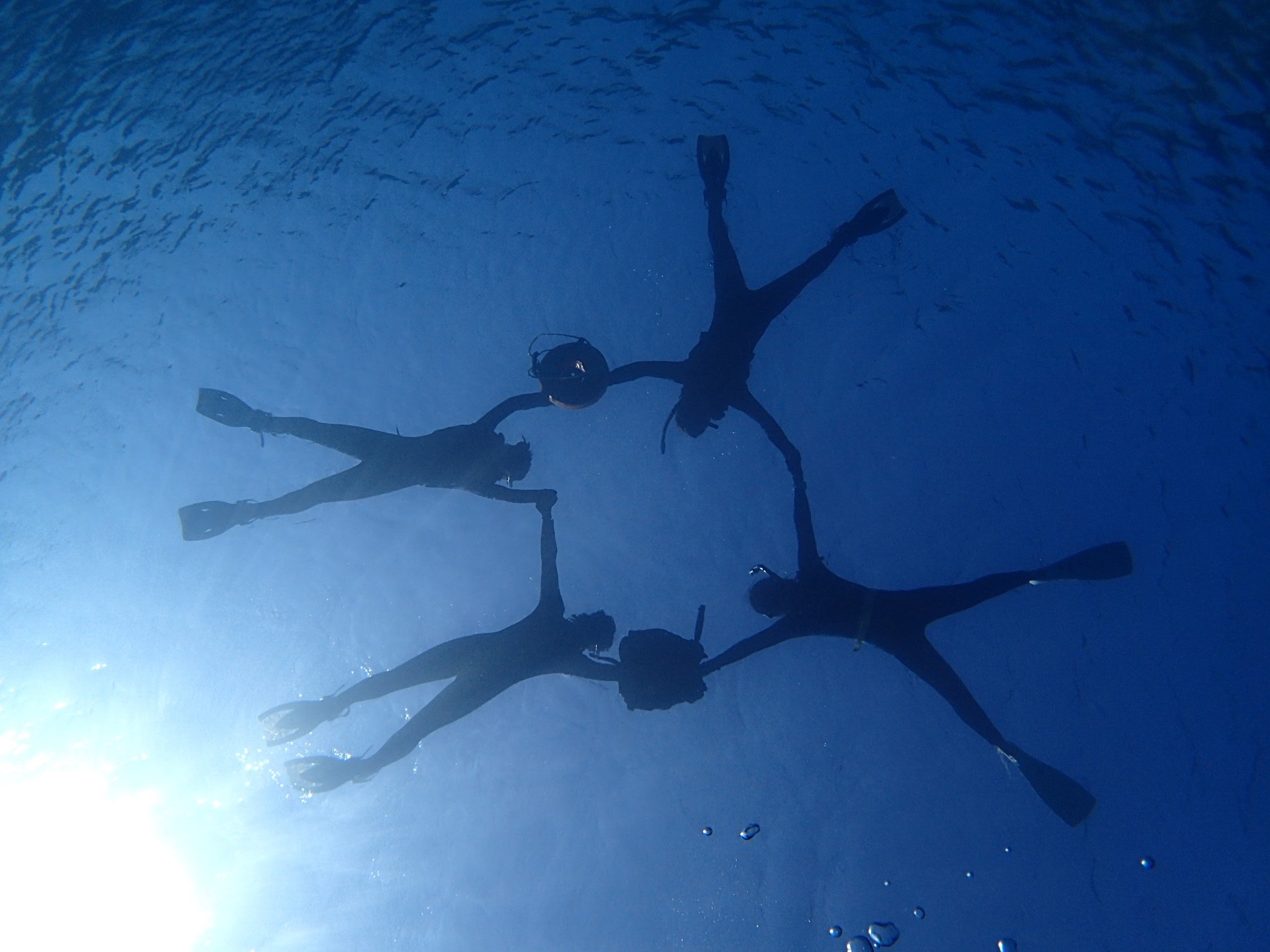
It's also renowned as a diving spot, visited by divers from all over the world. The scenery of looking up at the pond's entrance from underwater is apparently stunning. You can't access it by snorkelling, but just standing at the pond's edge conveys a more-than-sufficient mystical atmosphere.
A path is maintained, and walking about 5 minutes from the entrance you can reach the pond's edge. Car park available, free. The sun is strong, so a hat and water are essential.
Makiyama Observatory: Where a Spectacle and the Memory of War Coexist
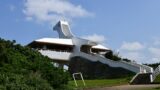
Makiyama Observatory is at the highest point on Irabu Island, with an observatory shaped like a migratory bird called the sashiba as its landmark. From the observatory you can survey the Irabu Bridge, Miyako Island, and on fine days as far as Ikema Island and Kurima Island. The sight of the gradient sea called Miyako blue spreading 360 degrees is a spectacle that makes the testimony "taking a deep breath here, I feel I receive energy" easy to understand.
Right beside the observatory is a spot called the "Happiness Air-Raid Shelter." It's an air-raid shelter dug during the war but never actually used, because the war ended around the time the construction finished, and from that historical coincidence it got the name "Happiness Air-Raid Shelter." Proceed through the dark hole and at the end the Miyako-blue sea appears like a frame of light. The contrast of darkness and light may be closer to an artistic experience than a power spot.
It's also known as a famous sunset spot, and visiting in the hours when the sun tilts, the sea and sky dye in an orange-and-purple gradient. The observatory is free, with a car park and toilet fully provided, so you can drop by casually. It's close to the Irabu Bridge too, so its appeal is also being easy to work into a drive course around the island.
Sawada-no-Hama: a Healing Beach Guarded by Gajumaru and Reef Rocks
Sawada-no-Hama is Irabu Island's largest beach, chosen among "Japan's 100 Best Beaches" in 1996. It may not often be introduced as a power spot, but I can't leave it out.
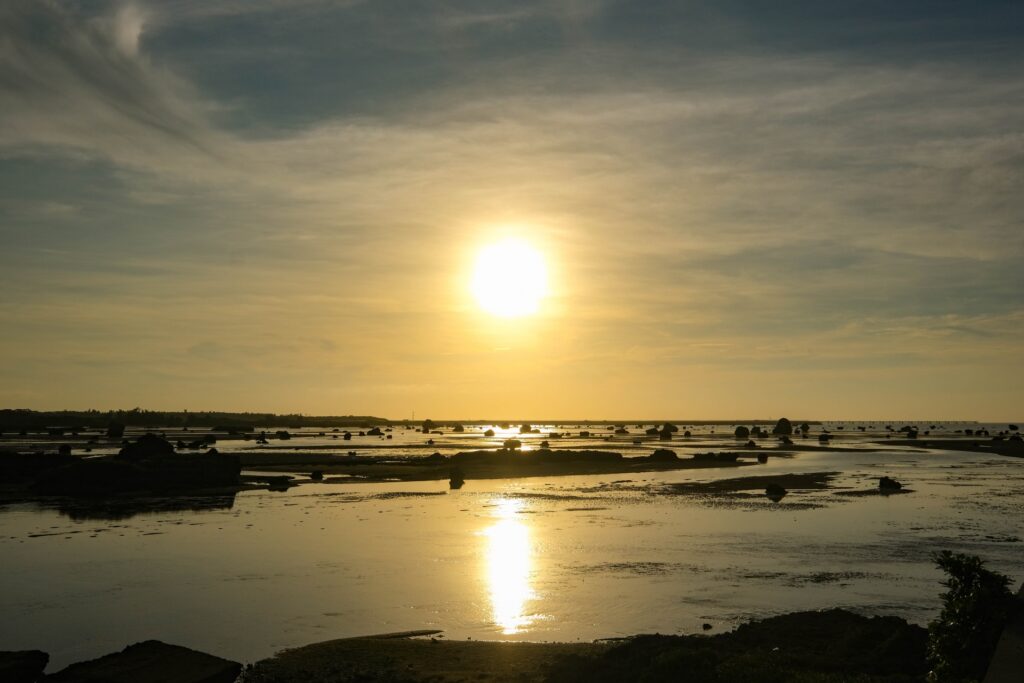
Offshore of the beach, several reef rocks thrown up by a tsunami are dotted about. The countless rocks that show their faces at low tide, and the wide sand against that backdrop, create scenery somehow like another planet. At dusk, when the green of the sugarcane fields, the white sand, the clear sea and the silhouettes of the reef rocks overlap, it's enough to make you feel "is this a real place?"
There's a big gajumaru tree near the beach, and standing under that tree there's a distinctive sense of security. In Okinawa the gajumaru is considered a tree where a spirit called "Kijimuna" dwells, and it's been cherished by the islanders. The beach where that gajumaru grew over long years has, strangely, a calm air drifting about.
The sunset hours are especially beautiful, and just spending the evening here gives a sense of fatigue draining away. Irabu Island Guide Picnic runs sunset SUP tours based here, so you can also have the luxurious experience of gazing at the sunset from the water.
A City-Designated Historic Giant Limestone Rock
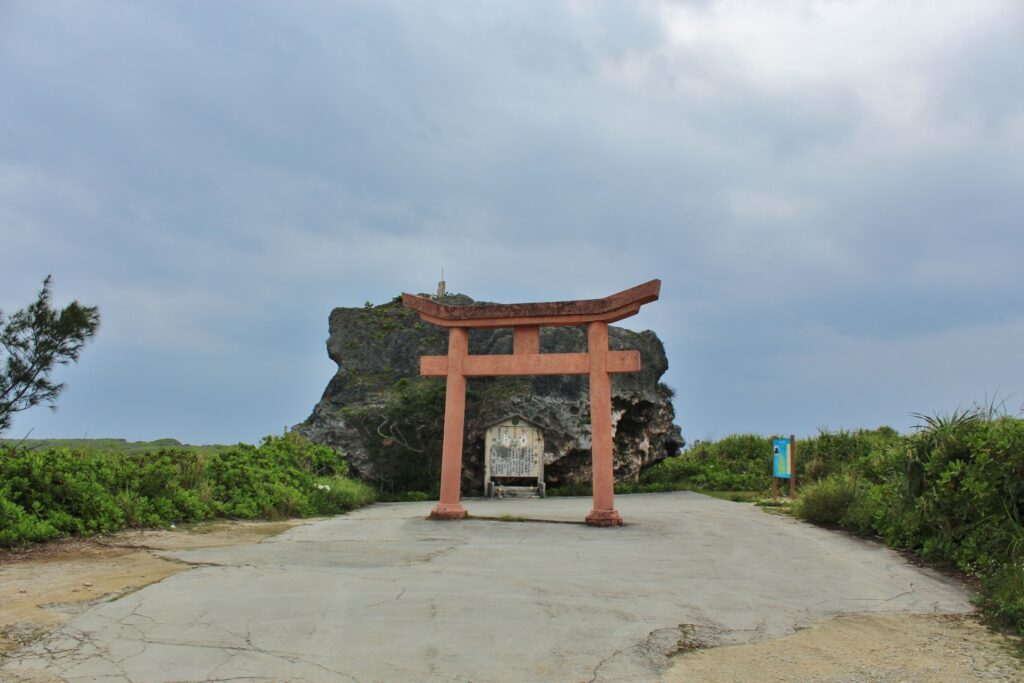
Yamatobu Rock is a giant limestone rock on the east side of Irabu Island, designated a city historic site. Locally it's also called "Yamatobu-giss," and the origin of the name is actually unknown, but it's been familiar by this name since long ago.
Lost for words at the overwhelming scale
Height: 25 metres
Diameter: 18 metres
Weight: over 30,000 tonnes
A height of 25 metres is about an 8-storey building. Incredibly tall. A diameter of 18 metres is about the width of a 6-storey apartment block. Incredibly thick. A weight of 30,000 tonnes is unimaginable. Even told it's about 5,000 elephants, you can't grasp it anymore.
But standing before it in person, it has force beyond the numbers. "I've never seen a rock this big," everyone thinks.
How Locals and Local Guides Describe Feeling the Energy
Writing "what kind of power can you gain?" in a power-spot article is a little embarrassing, but actually listening to locals and guides, interestingly they often use the expression "feel the energy." Just what that means, though, differs quite a lot from person to person.
From a story I heard from an island-born guide, about Nudokubi Abu there were the words: "Locals didn't approach the place much. I don't even know if it's a good place, but the power is certainly especially strong." Rather than capturing a power spot uniformly as "a place of good energy," the sense of revering it as "a place with special energy" may be closer to the islanders' true feeling.
There are people who say of Obiiwa "the flow of my work changed after I offered a prayer," and people who say "I was simply overwhelmed and couldn't think of anything." About Toriike Pond there's the talk "it's a twin pond so it works for matchmaking," and there are also accounts like "I got goosebumps seeing the moment the water colour changed."
In the end, whether you "feel" the energy changes completely with the sensitivity of the one who comes, that day's condition, and how much background you know. Rather than coming to "receive" something, the feeling of just standing in that place is, I think, better suited to Irabu Island's power spots.
If you have a chance to talk with a local, do ask. They sometimes casually tell you stories absolutely not written in any guidebook.
How to Enjoy a Power-Spot Tour of Irabu Island
Points for Going Round Efficiently by Rental Car
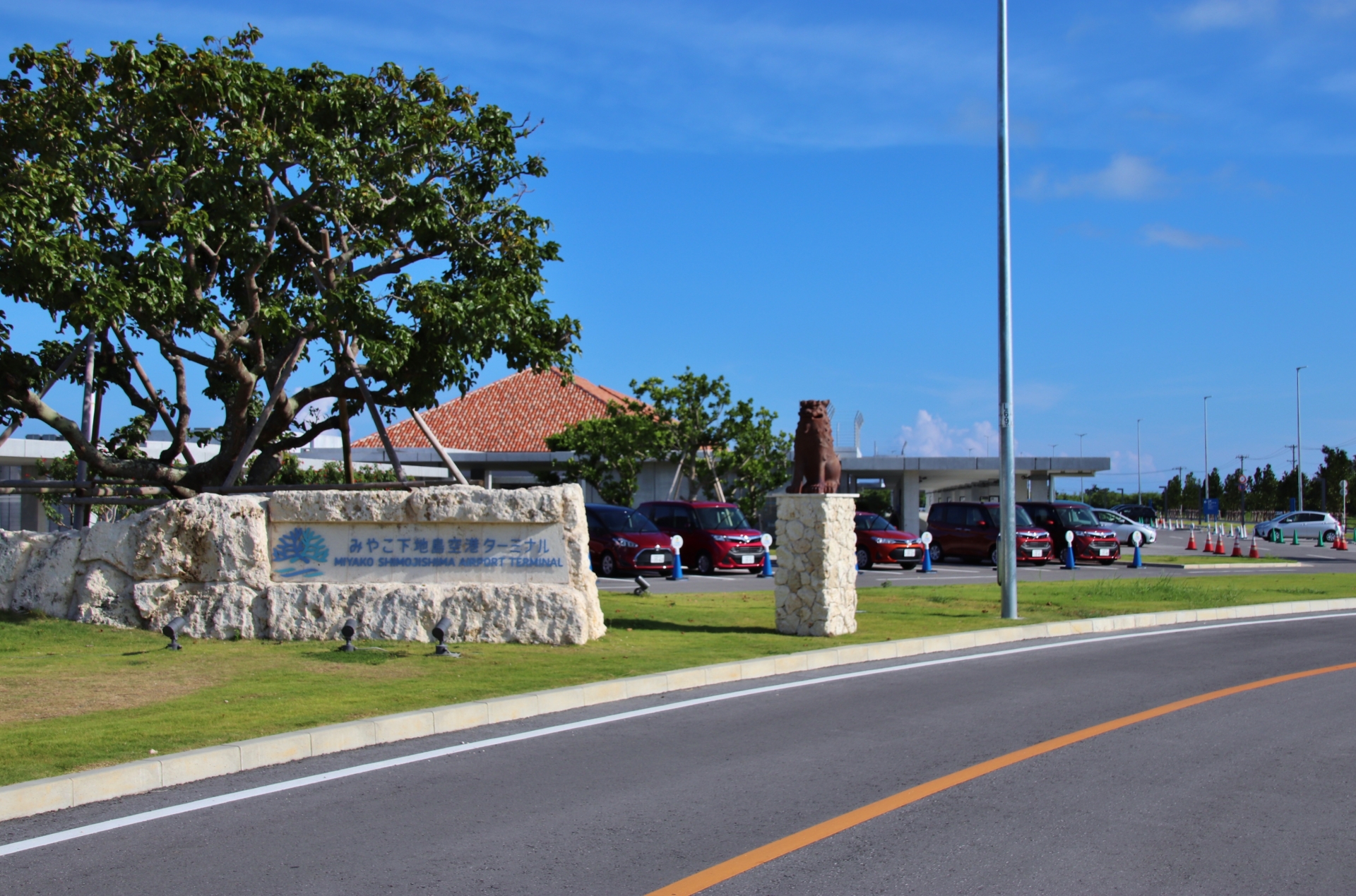
Since Irabu Island has almost no public transport, a rental car is essential for a power-spot tour. It's common to rent at Miyako Airport or Shimojishima Airport, and you enter the island crossing the Irabu Bridge from Miyako Island.
Irabu Island's area isn't that large, but the roads are intricate, and inside the sugarcane fields Google Maps sometimes doesn't guide you accurately. Nudokubi Abu especially is hard to find, so relying on GPS while confirming with locals is reliable. I recommend reading blogs and articles on how to get there in advance.
To go round all the main power spots in one day, the flow of touring Nudokubi Abu, Obiiwa and Toriike Pond in the morning, then taking it easy at Makiyama Observatory and Sawada-no-Hama in the afternoon is good. Toriike Pond and Obiiwa are close so you can go round efficiently, and visiting Makiyama Observatory in the evening lets you see the sunset. If you want to see Sawada-no-Hama's sunset too you need a little travel, but both are so beautiful it's hard to choose.
As for car parks, Toriike Pond, Makiyama Observatory and Sawada-no-Hama have proper car parks. Nudokubi Abu has no parking space, so you end up finding a place to park nearby yourself. Obiiwa has space to park too, but it's narrow.
The Experience of Touring with a Local Guide
Going round on your own and going round with a local guide differ completely in the depth of the experience. Power spots especially have many stories not out in the open, so having a guide who knows the island's culture and history inside out gives a level deeper understanding.
There are guides like "Irabu Island Guide Picnic" who, rather than mere sightseeing guidance, tell you about access to photogenic spots and the island's history as a set. The reason there are many reviews saying "they took me to places not listed in guidebooks" is a strength unique to island-born guides.
In the busy tourist season (summer holidays, Golden Week) guide tours fill up easily, so once your travel dates are set, booking early is wise.
A Practical Guide and Photo Spots for Touring Irabu Island's Power Spots
The Best Times to Avoid Crowds
Irabu Island's tourists have surged since the Irabu Bridge opened in 2015. Popular spots like Toriike Pond and Makiyama Observatory have many people during Golden Week, Obon and the New Year period. If you want to enjoy power spots quietly, the early morning (8–10 am) or late evening (after 4 pm) is the time to aim for.
Nudokubi Abu has a low profile to begin with, so there's almost no one whenever you go. Conversely, that also means there's no one around to ask for help even if the road is hard to find. If going for the first time, it's better to visit during the bright morning. In the evening the cave interior gets even darker, and it's easier to get lost on the surrounding field roads.
For weather, a fine day is by far recommended. Toriike Pond's water colour changes with the sunlight, and at Makiyama Observatory, when cloudy you sometimes can't see the surrounding islands. Nudokubi Abu is mystical regardless of weather, but after rain the footing is muddy and dangerous.
Instagram-Worthy Photo Spots and Tips
For Nudokubi Abu, the angle of looking up at the surface light from inside the cave where the gajumaru roots hang is overwhelmingly photogenic. Shoot in portrait orientation and a circle of light appears beyond the hole, for a mystical shot. A smartphone camera is enough, but a camera with image stabilisation or a usable night mode lets you express the cave's darkness well.
For Obiiwa, the rock's size is hard to convey, so including a person in the shot conveys the force more easily. Pulling back with a wide-angle lens brings out the rock's whole form and presence more easily.
Toriike Pond's water-surface colour changes dramatically with the angle the light comes in. Early in the morning the whole pond shines blue and is beautiful. To make use of the water-surface reflection, the tip is to shoot from a low position, so look for a point where you can stand right at the pond's edge.
For Makiyama Observatory, the survey from the observatory is of course the standard, but photos capturing the tunnel of light streaming in from the "Happiness Air-Raid Shelter" are also spreading on Instagram. Inside the shelter is dark, so pointing your smartphone towards the light at the exit naturally makes a striking composition.
For Sawada-no-Hama, the standard is a landscape composition including the offshore reef rocks and the sea silhouette in the sunset hours. At low tide the reef rocks increase for more complex scenery, so checking the tide level before visiting is good. Including the sugarcane fields and the sea together in the frame brings out the Irabu-Island character.
Manners and Nature Conservation When Visiting Power Spots
Quietly, with Respect
Many power spots are also places of faith for the locals. Talking loudly or behaving in a tourist-spot mood can hurt the locals' feelings. Nudokubi Abu and Obiiwa especially hold special meaning for the islanders, so please be conscious of spending time quietly.
Taking photos is fine, but it's best to avoid heavy use of flash inside the cave. There may be creatures like bats, and it can affect the cave's structures. The feeling of "I want to take a stone home as a memento" is understandable too, but taking out rocks or stones from a historic site like Nudokubi Abu is prohibited.
With power spots, attention tends to turn to "receiving" something. But seen from Irabu Island's islanders, those places are closer to a sense of being "a place to be together with" rather than "a place that gives." Visit with the mindset of being grateful and leaving something at the place, and it may become a different experience.
One thing I personally think is important: the air of "I only came for the social-media appeal" particularly sticks out at this kind of place. It's not that there's any policing, or that anyone gets angry, but you'll end up feeling later "I couldn't properly face that place." That's a waste. You can take Instagram photos, and it's not bad that sharing increases people interested in Irabu Island. But first, stand in the place, and try putting your smartphone away for a little while. In the silence of nothing, what this island has built up over a long time flows properly into you.
To Protect the Natural Environment
Always take your rubbish home. This isn't limited to Irabu Island but is true of all Okinawa, but at places like Nudokubi Abu with almost no manager, visitors' awareness directly affects the environment.
Don't touch the plants and creatures inside the cave or in nature. Gajumaru roots are more delicate than they look, and keep touching them and they get damaged. The vegetation at Toriike Pond's edge can also collapse if you step in too much. At places where a path is maintained, the iron rule is not to go off the path.
I'd like to touch a little on sunscreen too. Many people probably tour power spots alongside water activities, but sunscreen containing a lot of chemical ingredients adversely affects coral and marine life. To protect Miyako and Irabu Island's sea for a long time, I'd like to spread the habit of choosing mineral-based sunscreen. The accumulation of these small considerations leads to leaving this island's beauty for the next generation.
FAQ: Touring Irabu Island's Power Spots
Can you go to Nudokubi Abu alone?
You can, but since the road is hard to find, the first time may be a little uneasy. Save the location on Google Maps in advance, and on-site head there while asking locals, which is safe. The cave interior is dark to explore alone, so go during the bright hours with a torch.
What clothing is suitable for a power-spot tour?
Easy-to-move-in clothes you don't mind getting dirty are basic. Nudokubi Abu has parts where you walk pushing through grass, so sandals are an absolute no. Trainers or sports shoes, and in summer having long sleeves prevents both mosquitoes and sunburn.
Can you enjoy it without any psychic sense?
Rather than expecting a power spot as a "spiritual experience," visiting with the feeling of "touching a place where long history has piled up" is probably far more enjoyable. Irabu Island's power spots have an enjoyment that doesn't require a spiritual context.
Activities to Enjoy Alongside a Power-Spot Tour
Approaching from Underwater with Snorkelling and Diving
The Toriike Pond area is also a famous spot for snorkelling and diving, where you can have the one-of-a-kind experience of looking up at the pond's entrance from underwater. It's a point visited by divers from all over the world, and on days with good sea conditions you can observe diverse creatures. Exploring hidden caves and landforms from the bottom of the sea is yet another mystical experience, different from visiting power spots from land.
Snorkelling at Nakanoshima Beach is also a not-to-be-missed activity on Irabu Island, popular for its high probability of meeting sea turtles. After touring power spots and having the feeling of "touching something big," getting into the sea seems to expand that feeling further. At least, that's how I felt.
Charging Energy with Miyako's Food Culture
After touring power spots, you get hungry. Irabu Island and the Miyako Island area have plenty of island-only cuisine.
Miyako soba can't be missed. A kind of Okinawa soba, it features thin noodles and a light pork-bone soup. The standard style topped with soki or three-layer pork sinks into your body. The slightly accented taste you can only eat at an island diner is irresistible. I have a memory that the Miyako soba eaten with a diner's chilled barley tea after sweating at Nudokubi Abu was exceptionally delicious.
For seafood you can eat the best on Irabu Island and Miyako Island. Miyako-Island mozuku especially is superb, and eating fresh mozuku as it is is the local way to enjoy it. It's a different thing from the packed mozuku sold at supermarkets, with a sliminess and firmness. Fresh sashimi too can sometimes be eaten incomparably reasonably compared with mainland prices at diners where you can get fish landed by island fishermen.
Tropical fruits like mango and island banana also taste completely different from the mainland. The juice of sugarcane grown in Irabu Island's sugarcane fields also has a distinctive green-ish sweetness, and on a hot afternoon it's the best possible replenishment.
Combine cafés in the Shimojishima area and restaurants in central Miyako Island, and do make the most of the island while enjoying the food too. The joy of travel isn't only power spots — the food of the people who have lived in that place often conveys the island's culture most realistically.
Maybe the Whole Island of Irabu Is a Power Spot
What I think anew while writing this article is that Irabu Island's power spots don't each exist independently.
Nudokubi Abu's stalactite cave, Obiiwa carried by the Great Meiwa Tsunami, Toriike Pond where a mermaid legend dwells, the sea where fishermen have offered prayers — all of it overlaps upon this small remote island. That accumulation creates the air of the whole place that is Irabu Island.
Even as the Irabu Bridge has opened and tourists have increased, something on this island remains unchanged. Going to the places called power spots suddenly makes you aware of it.
Seen from Miyako Island, Irabu Island is right there. But the sense that the air changes the moment you cross the bridge is common to people who've experienced Miyako Island life. That the islanders' words "beyond that bridge is a different island" aren't merely a geographical matter becomes clear as you actually keep crossing.
With a power-spot tour as the trigger for a journey, you may encounter a face of Irabu Island not listed in guidebooks. That, I feel, becomes the greatest reason to visit this island.
Step away from the bustle of daily life and try soaking a little in this island's time. Just beyond the bridge from Miyako Island, there's such a place. Surely, when you leave the island, you'll be thinking not "I'd like to come again" but "I'll come again." That, I think, is the greatest magic of the place that is Irabu Island.
Always check the latest information and opening status of each spot before visiting. Conditions can change depending on the weather and tide level.