- Overwhelmed by a Giant Rock
- What Is Yamatobu Rock? A Giant Limestone Designated a City Historic Site
- A Sacred Site Worshipped Locally as a Power Spot
- The Beauty of Nature Woven by Green Moss
- Captivated by the Fantastical Aqua of the Cove
- A Spectacular Point for Seeing the Irabu Bridge
- The Irabu Bridge Opening Monument and the Okinawa Reversion Monument
- The View Looked Down on from Makiyama Observatory Is the Best Too
- Points to Note on Parking and Stopping
- Full of Force Both Up Close and from Afar
- Viewing Is Free, No Charge, 24 Hours OK
- Enjoy It Together with the Surrounding Sights
- The Pros and Cons of Yamatobu Rock
- Frequently Asked Questions (FAQ)
- Q1: Where is Yamatobu Rock?
- Q2: Is there a car park?
- Q3: How much is admission?
- Q4: What are the viewing hours?
- Q5: How long does it take to view?
- Q6: Is the power spot for real?
- Q7: Can I go as a set with Makiyama Observatory?
- Q8: Is it OK with children?
- Q9: Can I view it on a rainy day?
- Q10: Is there a toilet?
- Q11: How big is it?
- Q12: Any photography tips?
- A Symbol of Irabu Island, Never Tiring However Many Times You Go
Overwhelmed by a Giant Rock
The first time I saw Yamatobu Rock was right after finishing crossing the Irabu Bridge and turning right at the first intersection. Through the windscreen, something abnormally large came into view, and "wait, what is that?" came out of me without thinking.
Ahead on the left, something like a cliff — no, a rock? An incredibly large rock is visible. A sheer cliff towering along the roadside.
"That's too big, isn't it? It's not a normal rock, right?" I exchanged looks with the friend who was with me.
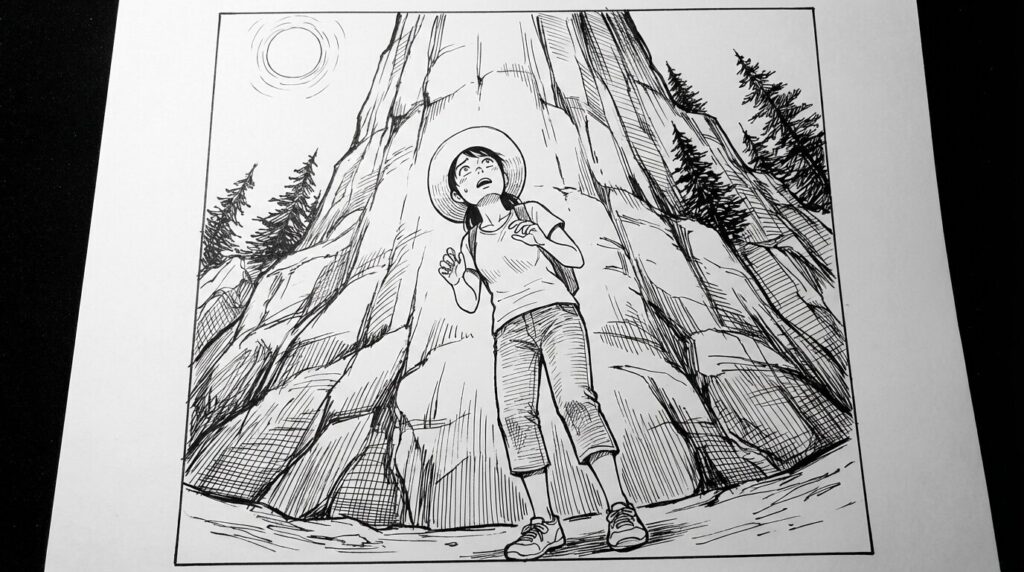
Driving closer, it kept getting bigger, and when I looked up passing beside it, it was high enough to hurt my neck. Incredibly high.
"This won't come crashing down, will it?" I got a little scared and pressed the accelerator past it.
But it stayed on my mind, so I did a U-turn and went back. I stopped the car on the shoulder, got out, crossed the road and walked up close to the rock.
Up close, it has even more force. Or rather, it's overwhelming. Height 25 metres. Diameter 18 metres. Weight over 30,000 tonnes. Even told the figures it doesn't click, but anyway it's huge.
Green moss covers the rock, and that's beautiful too, and the blue sea spreads right nearby, and I thought "there's no other place like this."
In this article, I'll write the appeal of Yamatobu Rock from the perspective of someone who has actually visited many times. Power spot, fishermen's faith, the beauty of the cove — I'll talk about it all. If you plan to go to Irabu Island, please absolutely drop by Yamatobu Rock. The experience of looking up at a giant rock.
What Is Yamatobu Rock? A Giant Limestone Designated a City Historic Site
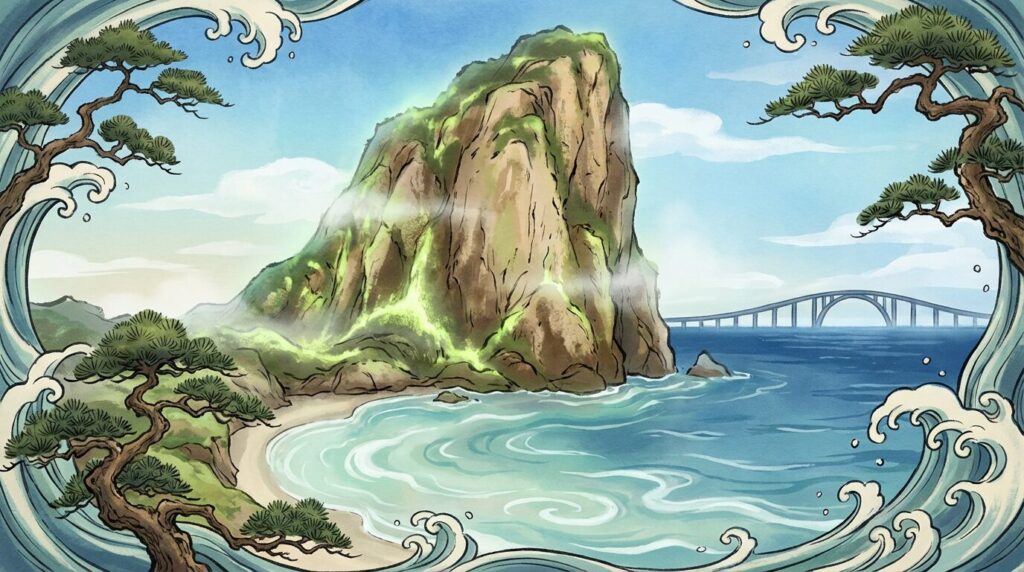
Yamatobu Rock is a giant limestone on the east side of Irabu Island, designated a city historic site. Locally it's also called "Yamatuubuugisu," and the origin of the name is actually unknown, but it's been familiarly known by this name since long ago.
Lost for Words at the Overwhelming Scale
Height: 25 metres
Diameter: 18 metres
Weight: over 30,000 tonnes
Height 25 metres is about an 8-storey building. Incredibly high. Diameter 18 metres is about the width of a 6-storey apartment. Incredibly thick. Weight 30,000 tonnes is unimaginable. Told it's like 5,000 elephants, I still don't get it.
But standing before it in person, there's force beyond the figures. "I've never seen a rock this big," everyone thinks.
A Single Monolith of Travertine (Limestone)
Yamatobu Rock is made of a limestone called travertine. What's surprising is it's a complete monolith. No seams. A single giant rock.
This was exposed to the surface by crustal movement. Tomori limestone was pushed up by faulting and so on, becoming its current form. A story from tens of thousands of years ago.
On nearby Makiyama, traces of past quarrying remain, showing that people of old used this limestone as building material.
A Landmark of Irabu Island's First Settlement
The place where people first settled on Irabu Island, Shimomaki (Tsumyagi). The landmark for the entrance to its coast was apparently this Yamatobu Rock.
Being big, it's easily visible even from a distance. People of old used it as a landmark — "when you can see Yamatobu Rock, the coast is near."
Even now, seeing this rock, I realise "I've come to Irabu Island." That's how amazing its presence is.
Location and Access
Address: 923 Ikemasoe, Irabu, Miyakojima City, Okinawa
Access: about 30 minutes by car from Miyako Airport, right after turning right at the first intersection after crossing the Irabu Bridge
Finish crossing the Irabu Bridge, turn right at the first intersection, drive 5–10 minutes along the road, and a giant rock is visible on the left. That's Yamatobu Rock. It's easily visible even from a distance, so you'll hardly miss it.
A Sacred Site Worshipped Locally as a Power Spot
Yamatobu Rock is famous locally as a power spot too, revered as a special place.
Feeling an Overwhelming Energy
A giant rock towering up, and just seeing its figure you feel energy. "Somehow I feel power," everyone says. A mysterious megalith.
Going close, the air feels different. Quiet, a sacred atmosphere. A natural power spot, not touristy.
When I first went too, standing before the rock, I had a sensation of my spine straightening. It might be my imagination, but I certainly felt something.
A Guardian Deity the Local Fishermen Press Their Hands Together For
When local fishermen go out to sea, they apparently always press their hands together towards Yamatobu Rock from offshore. It's a custom continuing from long ago, praying for safety and wishing for a safe return.
Yamatobu Rock is a guardian deity for the fishermen.
When I heard this from a local, I understood — "ah, that's why it has such a sacred atmosphere." It's not a tourist spot but a sacred site rooted in the locals' daily life.
A Place to Visit Quietly and with Respect
Since Yamatobu Rock is a sacred place, when you visit you need to behave quietly and with respect. Don't make a noise, damage the rock or dirty it.
Taking photos is totally fine, but always take your rubbish home. It's an obvious thing, but important.
I too pressed my hands together a little before the rock. "May the trip end safely." It's a place that makes you feel that way.
The Beauty of Nature Woven by Green Moss
Green moss grows on Yamatobu Rock, and this is beautiful too.
Vivid Moss Covering the Rock
Green moss grows densely on the rock's surface. Incredibly beautiful. After rain especially, it becomes an even more beautiful, vivid green.
The moss further enhances the rock's beauty, a real beauty of natural form. Take a photo and it makes a picture. You could keep looking at it forever. It's healing.
The Contrast of the Sea's Blue and the Moss's Green
The blue sea spreads right nearby, and the contrast of that blue and the moss's green is truly beautiful. The beautiful sea colour called Miyako blue and the moss's green combine to create a view you can't see elsewhere.
Go on a fine day and it's simply the best. The blue and green are vivid, and your hand can't stop taking photos.
Captivated by the Fantastical Aqua of the Cove
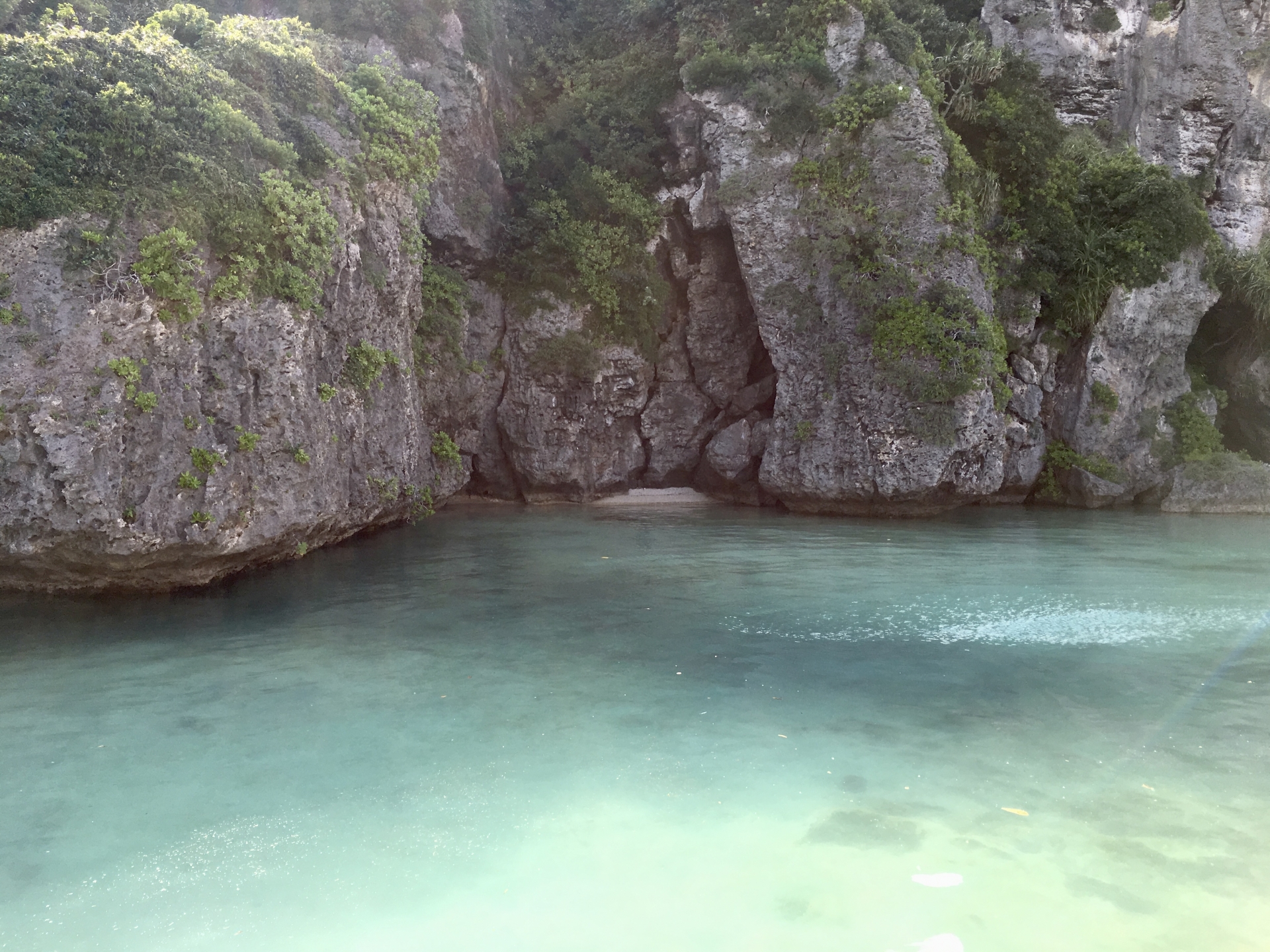
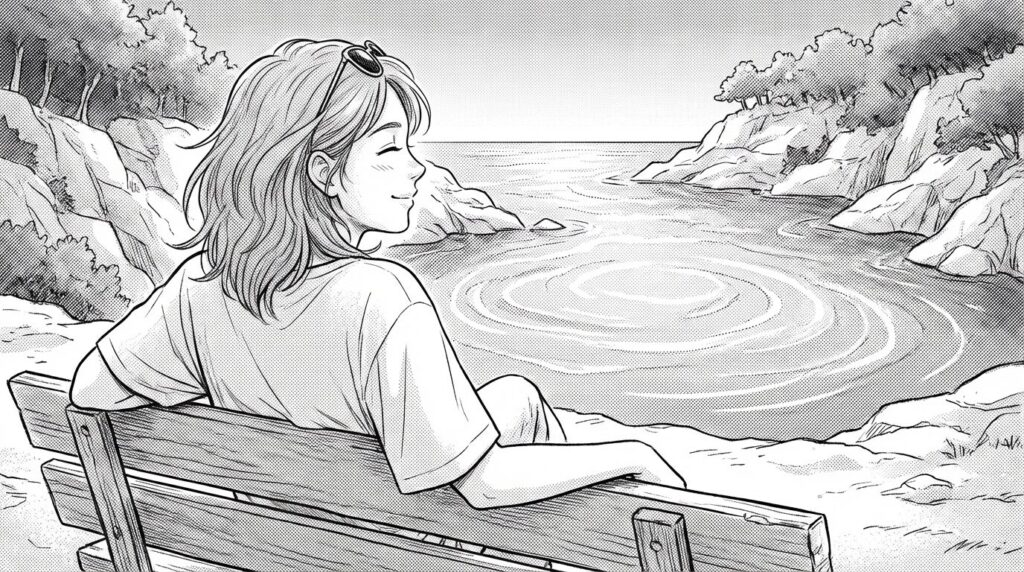
On the south side of Yamatobu Rock there's a small cove, and the colour of this cove's water surface is distinctive and fantastical.
A Mysterious Aqua Like Cloudy Water
The cove's water surface is an aqua like a cloudy light blue. It's transparent, but feels a little cloudy. A mysterious colour.
"I've never seen a sea this colour," I thought. A distinctive aqua, different from the usual sea blue.
An Expression That Changes with the Tides
The water-surface colour apparently changes with the ebb and flow of the tides and the angle of sunlight. It's completely different at high tide and low tide, and different morning and evening too.
When I went it was just past noon, but I want to go at a different time too. I want to see how the colour changes.
A Place Like a Secret Beach
The cove is small but beautiful, like a secret beach. There are hardly any tourists and it's quiet.
Swimming looked a little difficult, but just gazing was satisfying. I love this kind of hidden-gem place.
A Spectacular Point for Seeing the Irabu Bridge
The area near Yamatobu Rock is actually also a spectacular point for seeing the Irabu Bridge.
The Whole Bridge Looks Beautiful
Looking at the Irabu Bridge from near Yamatobu Rock, you can see the whole bridge. All the way from Miyako Island to Irabu Island.
The white bridge spanning the blue sea is truly beautiful, and I thought "this is the best as a photo spot too."
Photograph Yamatobu Rock and the Irabu Bridge Together
You can take a photo with both Yamatobu Rock and the Irabu Bridge in it. The giant rock, the long bridge and the blue sea. All of it makes a picture.
The sea colour is the beautiful Miyako blue too, the best photo spot. Photogenic for sure.
The Irabu Bridge Opening Monument and the Okinawa Reversion Monument
Near Yamatobu Rock, two monuments stand.
The Irabu Bridge Opening Monument
The Irabu Bridge opened in 2015. At 3,540 metres, it's the longest toll-free bridge in Japan.
A monument commemorating its opening stands near Yamatobu Rock; the Irabu Bridge is the bridge connecting Miyako Island and Irabu Island, and with this bridge, Irabu Island became more familiar.
Since my first time to Irabu Island was after the bridge was built, I can't imagine the era without the bridge, but I think it's thanks to this bridge that I came to be able to visit casually.
The Okinawa Reversion Monument
On 15 May 1972, Okinawa reverted to Japan. There's a monument commemorating that too. It reads "reversion commemorative project," and 2025 marks 53 years since reversion.
A place where you can feel Okinawa's history. Looking at the monument, you reflect on Okinawa's complex history.
The View Looked Down on from Makiyama Observatory Is the Best Too
Yamatobu Rock is visible from Makiyama Observatory too.
Seen from the Observatory, a Different Kind of Force
Makiyama Observatory is right above Yamatobu Rock, and looking towards the Irabu Bridge from the observatory, Yamatobu Rock pokes out.
Seen from above, the rock's size is clear. "Ah, that rock was this big," you realise anew.
The Recommended Route Is Counterclockwise
If you loop Irabu Island counterclockwise, seeing Yamatobu Rock after Makiyama Observatory is recommended.
Look down on the whole from Makiyama Observatory, then go up close to Yamatobu Rock and look up. Seeing it from both perspectives is more fun.
I toured this route too, and when I saw it from the observatory I thought "so that's Yamatobu Rock," and when I actually looked up at it up close I was overwhelmed — "wow, it's incredibly huge." Being able to see it from both perspectives feels like a bonus.
Points to Note on Parking and Stopping
Yamatobu Rock has no dedicated car park. This is the only inconvenient point.
Brief Roadside Stopping Is the Basic
When viewing, stop briefly on the shoulder. However, since there are curves before and after, you have to think carefully about where to stop.
Stopping in the middle of a curve is dangerous, so choose a straight section as much as possible.
A Stopping Space Just Before Yamatobu Rock
Just before Yamatobu Rock, on the right, there's a space that looks like you could park. Some people park there and head over on foot.
I parked there too, but only 1–2 cars can park, so if someone's there first you have to give up.
A Parking Space on the Opposite Side of the Road Too
On the opposite side of the road, towards where the opening monument is, there's a parking space. There's also a method of parking there and crossing the road to head to Yamatobu Rock.
Caution When Crossing the Road
When crossing the road, watch for cars. The traffic isn't that heavy, but being a curve, cars can come suddenly.
Check left and right well and cross. If you have small children, always hold hands.
Full of Force Both Up Close and from Afar
Yamatobu Rock has force whether seen up close or from afar.
The Overwhelming Presence Seen Up Close
Go up close to the rock and look up, and it's incredibly big. Overwhelming. Enough to worry a little, "won't it come crashing down?"
But it's been there for tens of thousands of years, stable.
I thought "scary" at first too, but looking at it for a while, I felt this rock's stability and the history of it having been here for long years, and conversely I felt reassured.
The Overwhelming Presence Seen from Afar
When crossing the Irabu Bridge, it's visible from afar. "What on earth is that!?" everyone is surprised. It stands out even from a distance. The presence is amazing.
The surprise of "wait, what is that?" when I first saw it, I still remember.
To Shoot the Whole, Photograph from a Distance
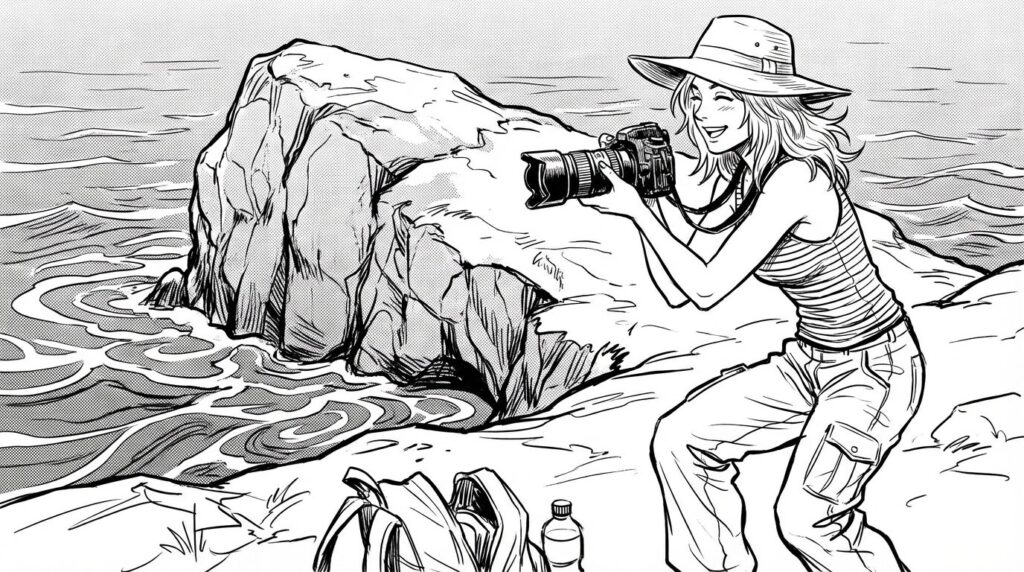
If you want to photograph the whole of Yamatobu Rock, you need to shoot from a distance. It's too big, and up close it doesn't all fit.
About the distance of the opposite side of the road is just right. I too first tried to shoot up close, noticed "it doesn't all fit," and re-shot from a distance.
Viewing Is Free, No Charge, 24 Hours OK
Viewing Yamatobu Rock is free, with no charge.
No Admission Fee, Easy to Drop By
There's no admission fee at all. You can view it free. The ease of dropping by is nice.
Viewable 24 Hours, but Daytime Is Recommended
There's no time limit on viewing either, and you can see it anytime, 24 hours. But at night it's dark, so going in the daytime is recommended.
Go at night and you can't see the rock well, and you can't take photos. Going in the bright daytime hours is definitely better.
Viewing Takes About 10 Minutes
Viewing takes about 10 minutes. Look up at the rock, take photos, and it's over quickly. It's not a place to stay long.
But in those 10 minutes, you can have an overwhelming experience. Short, but dense time.
Enjoy It Together with the Surrounding Sights
There are lots of sights around Yamatobu Rock.
Makiyama Observatory
Makiyama Observatory is 1 minute by car. Very close. A spectacular spot where you can take in the whole Irabu Bridge, recommended to go as a set.
Irabu Bridge
The Irabu Bridge is right there. 5 minutes by car. The sea seen from the bridge is beautiful, and just driving feels good.
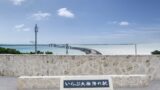
Toguchi-no-Hama
Toguchi-no-Hama is about 15 minutes by car. White sand, blue sea. Chosen among Japan's 100 Best Beaches, the best beach for swimming.
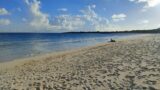
17END
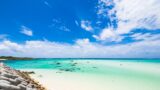
17END is about 20 minutes by car. The end of the Shimojishima Airport runway, called the phantom beach. The emerald-green sea is truly beautiful.
The Pros and Cons of Yamatobu Rock
Let me summarise the good points and the points that catch my attention, felt from actually visiting many times.
Pros
Overwhelming force
A giant rock 25 metres high, 18 metres in diameter, over 30,000 tonnes. Overwhelming whether seen up close or from afar.
A power spot
You feel energy in the sacred atmosphere. A guardian deity the local fishermen press their hands together for.
Free to view
No admission fee, viewable 24 hours. Easy to drop by.
Right near the Irabu Bridge
Right after crossing the Irabu Bridge and turning right. Easy access.
A spectacular point for seeing the Irabu Bridge
From near Yamatobu Rock you can see the whole Irabu Bridge. A photo spot.
The green moss is beautiful
The green moss growing on the rock is beautiful. The beauty of natural form.
The cove's aqua is fantastical
The cloudy-light-blue aqua of the small cove on the south side is beautiful.
You can feel history
The Irabu Bridge opening monument and the Okinawa reversion monument are nearby.
Cons
No dedicated car park
You can only stop briefly on the shoulder. With curves before and after, you need to think about where to stop.
You have to cross the road
From the stopping space, you have to cross the road to Yamatobu Rock. Caution for cars is needed.
It looks like it might collapse, which is scary
Up close you get a little scared, "won't it come crashing down?" In reality it's stable, though.
No facilities at all
No toilet, no vending machine, no shop.
The whole is hard to photograph
Up close it's too big and doesn't all fit in the photo. You need to shoot from a distance.
The rock's boundary is hard to tell
It's hard to tell where Yamatobu Rock ends and the mountain begins.
It's over in a short time
Viewing takes about 10 minutes. It's not a place to stay long.
Frequently Asked Questions (FAQ)
Let me gather the questions often asked about Yamatobu Rock.
Q1: Where is Yamatobu Rock?
923 Ikemasoe, Irabu, Miyakojima City, Okinawa. On the east side of Irabu Island, below Makiyama Observatory. Right after turning right at the first intersection after crossing the Irabu Bridge.
Q2: Is there a car park?
There's no dedicated car park. Stop briefly on the shoulder, or park in the stopping space on the opposite side of the road.
Q3: How much is admission?
Free. Viewing is open.
Q4: What are the viewing hours?
Viewable 24 hours. But going in the daytime is recommended. It's dark at night.
Q5: How long does it take to view?
About 10 minutes. Look up at the rock, take photos, and it's over quickly.
Q6: Is the power spot for real?
A sacred place the local fishermen press their hands together for. Many people say "I feel power."
Q7: Can I go as a set with Makiyama Observatory?
You can. If anything, going as a set is recommended. Look down from Makiyama Observatory, and look up close at Yamatobu Rock.
Q8: Is it OK with children?
It's OK. But since you have to cross the road, always hold small children's hands.
Q9: Can I view it on a rainy day?
You can. But the rock gets wet and slippery, so caution is needed.
Q10: Is there a toilet?
There isn't. Go in advance at Makiyama Observatory or another place.
Q11: How big is it?
25 metres high, 18 metres in diameter, over 30,000 tonnes. About the height of an 8-storey building.
Q12: Any photography tips?
To shoot the whole, from about the opposite side of the road. Shooting up close brings out the force. Including the blue sea and green moss together is beautiful.
A Symbol of Irabu Island, Never Tiring However Many Times You Go
Yamatobu Rock is a place you absolutely have to see if you go to Irabu Island. The experience of looking up at a giant rock is truly overwhelming.
The surprise of first seeing Yamatobu Rock, I still can't forget. "What is that," I thought, and it stood out incredibly even from afar, and when I approached by car and looked up passing beside it, "it's big" came out aloud.
I'd never seen a rock this big. 25 metres high, 18 metres in diameter, over 30,000 tonnes. Even told the figures it doesn't click, but seeing it in person you realise "it's this big."
I stopped the car on the shoulder, got out, crossed the road and went up close to the rock, and up close it has more force, and looking up my neck hurt.
I got a little worried "won't it come crashing down," but it's been there for tens of thousands of years, stable. Green moss grows on the rock, beautiful, the beauty of natural form.
Looking at the rock's south side, there's a small cove, the aqua like a cloudy light blue, fantastical. "I've never seen a sea this colour," I thought. Transparent yet a little cloudy, a mysterious colour.
The colour apparently changes with the tides and the angle of sunlight, making you want to come see it many times.
Hearing it's famous as a power spot too, I certainly felt energy. The air is different. Quiet. A sacred atmosphere.
Local fishermen apparently always press their hands together towards this rock from offshore when they go out to sea, revering it as a guardian deity. I too pressed my hands together a little before Yamatobu Rock. "May the trip end safely."
The Irabu Bridge opening monument and the Okinawa reversion monument are nearby too; the Irabu Bridge opened in 2015, 3,540 metres, the longest toll-free bridge in Japan. With this bridge, Irabu Island became more familiar.
The Okinawa reversion monument commemorates Okinawa's reversion to Japan on 15 May 1972, and 2025 marks 53 years since reversion. You can feel Okinawa's history.
Looking at the Irabu Bridge from near Yamatobu Rock, you can see the whole bridge, and the white bridge spanning the blue sea is beautiful. The sea colour is the beautiful Miyako blue too.
I took a photo. With both Yamatobu Rock and the Irabu Bridge in it. The best photo spot.
From Makiyama Observatory too, Yamatobu Rock is visible. Makiyama Observatory is right above Yamatobu Rock, and looking towards the Irabu Bridge from the observatory, Yamatobu Rock pokes out.
Seen from above, the rock's size is clear. I went to Yamatobu Rock after Makiyama Observatory. Looping Irabu Island counterclockwise, look down on the whole from Makiyama Observatory, then go up close to Yamatobu Rock and look up. Seeing it from both perspectives is more fun.
On Makiyama, traces of past quarrying remain, where limestone was mined. It was used as building material. Looking at the quarry traces, you can feel Irabu Island's history. How people of old lived, how they built the island.
Since Yamatobu Rock is a sacred place, visit quietly. Don't make a noise. Behave with respect. Taking photos is fine, but don't damage or dirty the rock. Take your rubbish home.
Viewing is open. There's no admission fee. You can see it anytime, 24 hours. But at night it's dark, so going in the daytime is recommended.
Viewing takes about 10 minutes. It's not a place to stay long, but in those 10 minutes you can have an overwhelming experience.
That there's no dedicated car park is a little inconvenient, and you stop briefly on the shoulder or park in the stopping space on the opposite side of the road. Since there are curves before and after, you need to think carefully about where to stop.
When crossing the road, watch for cars. The traffic isn't that heavy, but being a curve, cars can come suddenly.
No toilet, no vending machine, no shop. Go in advance at Makiyama Observatory or another place.
But even so, Yamatobu Rock is worth seeing. A symbol of Irabu Island. It's watched over this island since long ago.
If you plan to go to Irabu Island, please do try dropping by Yamatobu Rock. Cross the Irabu Bridge, turn right and it's right there. Easy access.
Look up at the giant rock. Be overwhelmed. Take photos. See the green moss. See the cove's aqua. See the Irabu Bridge. Enjoy the spectacular view. Press your hands together. Feel the energy.
Yamatobu Rock is such a place. You never tire of it however many times you go. You want to see it again. And always, you think "I want to come again."
Irabu Island's blue sea, white sand, beautiful nature. And the overwhelming presence of Yamatobu Rock. With all of these in place, it becomes the best trip. I want you to experience such a trip too.